The anagram1 has a long and enmeshed history with Magic. Wyluli Wolf is an anagram of Lily Wu, creator of the game Richard Garfield’s first wife. Erhnam Djinn is an anagram of Richard Garfield’s sister’s husband. Ydwen Efreet and Mijae Djinn are anagrams of Wendy and Jamie (friends of, you guessed it, Richard Garfield). “Leshrac” came from “Charles” Page, a playtester at Wizards. “Nevinyrral” from Nevinnyral’s Disk is Sci-fi author Larry Niven backwards, which is sort of an anagram.
Magic has some anagrams that are a little less esoteric. Elkin Bottle is Klein Bottle, and Bösium Strip is Möbius strip, both of which are named after people who are not related to or friends with Richard Garfield. And there are some cards that don’t depend on having knowledge of the designers of the game, of tertiary games, or any real people at all. “Citanul” of Citanul Druid and Citanul Flute is an anagram of “lunatic”. Liliana Vess is an anagram for “A Villainess”.
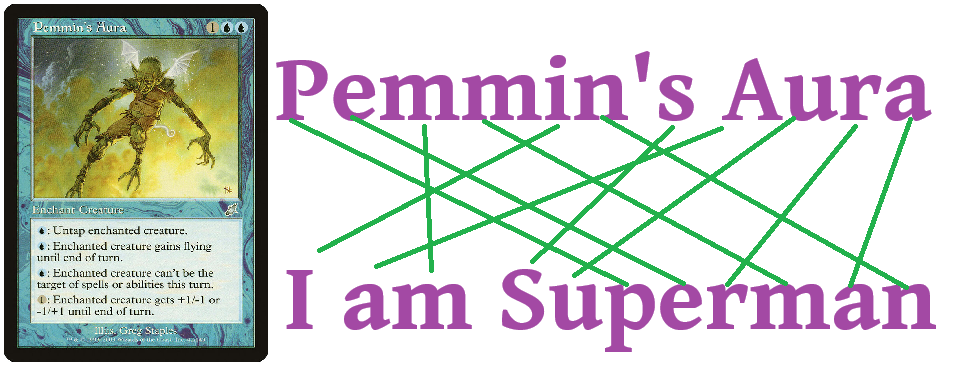
Some of the most fun anagrams are the ones that are nearly, if not entirely, self-referential. “Linvala” is an anagram for “vanilla”, and it turns off creatures’ abilities making them more ‘vanilla”. My favorite is Pemmin’s Aura, an infinite combo piece with many different mana dorks, enchants a creature with the abilities of Morphling. Morphling was a powerhouse of a card, nearly impossible to kill and could do double duty as a flying attacker and then untapping itself to be a towering defender. The card was so powerful that it had the nickname “Superman”. Pemmin’s Aura is an anagram for “I am Superman”.
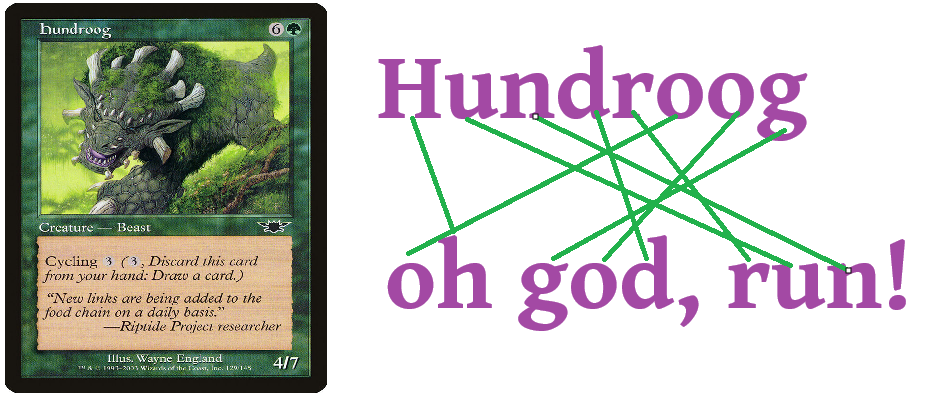
“Guided Strike” depicts a weird looking creature that eventually got its own card with “Ridged Kusite“. Anodet Lurker is an anagram of Darker Onulet, While that last one was probably intentional, others, like “Hundroog” being an anagram for “oh god, run!” may not be. It still does not make it any less of a true anagram than the others. Mangara is an anagram of the word “anagram“, which is weird and doesn’t appear immediately relevant, but perhaps there’s something there. And Asmoranomardicadaistinaculdacar is a well known anagram for (fill in when someone else figures that out).
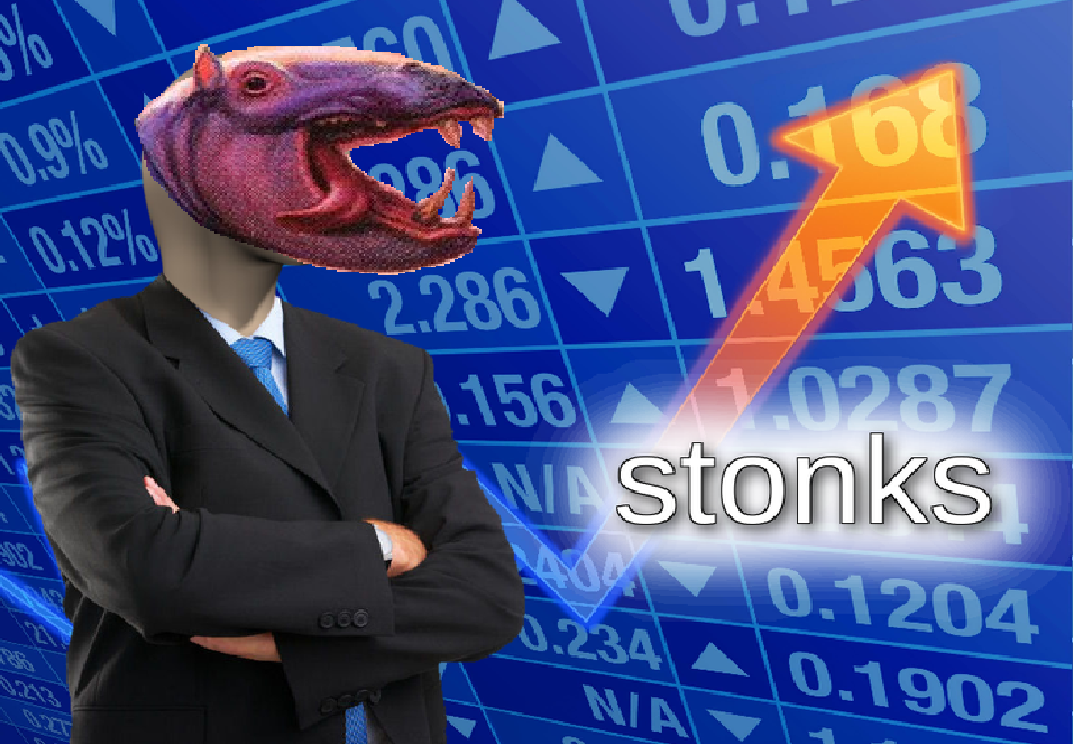
And, of course, Phelddagrif is an anagram for “Garfield PhD”. Given how many of his friends and family got cards before him, I’m surprised it took until Alliances for him to get a card.
What are we to do with these anagrams, these cards that transform before our eyes, from Wolf to Richard Garfield’s first wife, from an ancient disk created by a powerful mage to a plate named after a buffoon? It’s not like Guided Strike is much better with Ridged Kusite, and Pemmin’s Aura is a horrible aura to put on Morphling (any aura is pretty bad to put on Morphling). Are these hidden messages? Are they intentional? And can we measure it?
First, yes. These are hidden messages. Sure, these anagrams don’t reveal the best strategy to using these cards, you have to use your brain for that. They do demonstrate the psychic fields that the game’s designers are swimming through, what they and everyone else is thinking about.
What are they thinking about? The past! Always the past, that old chestnut! More and more often cards are printed as references to the game pieces and history of the game itself. Sometimes these are obvious, such as the smattering of cards in Edge of Eternities, while others are more subtle: references in art or flavor text to Magic‘s storied past. Perhaps, through anagram, Wizards is delivering a message to us, showing how much they are thinking about Phelddagrif and trying to convey that through their naming conventions.
Don’t worry about measuring, I already did that.
Measuring Phelddagrif
I needed a method and a machine that could measure the amount of “Phelddagrif” in a set quickly. I know it may not seem like it, but I am a human being and I only have a certain amount of time before my bedtime or I’m cranky the next day. While I could count out every card in Magic‘s history, measuring how much “Phelddagrif” is in each card, this seemed like the perfect task to outsource to a machine. I then outsourced building that machine (or “program” as it’s sometimes called) to someone else. Thanks!
The goal was to measure how many sets have cards that are anagrams of “Phelddagrif”, as well as cards that are near or incomplete anagrams of “Phelddagrif”. Looking at every set the program searched each card and assigned them a score based on how many letters the name of the card had in common with “Phelddagrif”. This score, which everyone on the team enthusiastically agreed to call a “%-agrif” score, works on a scale of 11, one for each letter in “Phelddagrif”.
For example, a card that has four letters in common with Phelddagrif would score 4/11, or have a 36%-agrif score. One of the benefits of calculating how much Phelddagrif is contained in a card is that it was an easy calculation that was not based in logic, fact, or reason, which makes it difficult to challenge. It also would give Questing Phelddagrif and Richard Garfield, Ph.D.100%-agrif scores because they are, undoubtably, Phelddagrifs.
From this data, we gathered how many and which cards scored the highest and lowest %-agrif score, as well as an average %-agrif score from each set, so that the data could reveal correlations of when Magic was trending towards a higher %-agrif and when it was moving away from it.
So, what did the data show?
So much. So, so much.
The Data
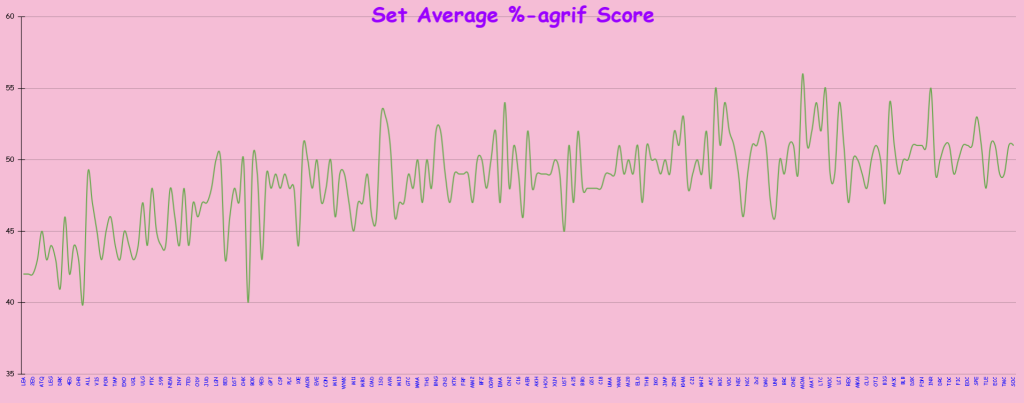
When Alpha released in 1993, the set had an average score of 42%-agrif. Not bad for Phelddagrif not even being conceived of yet, although below average.2 Alliances, in 1996, the set that introduced Phelddagrif, has an average score of 49%-agrif. While it’s a bit outside the median range, we can see that the average %-agrif score per set is rising even when factoring in outliers like Alliances and March of the Machine (with a whopping set score of 56%-agrif), or Unhinged (which has a 40 %-agrif score, tying Homelands for the lowest %-agrif score). After 10th Edition, which scores 44 %-agrif, the average %-agrif set score does not dip below 45.
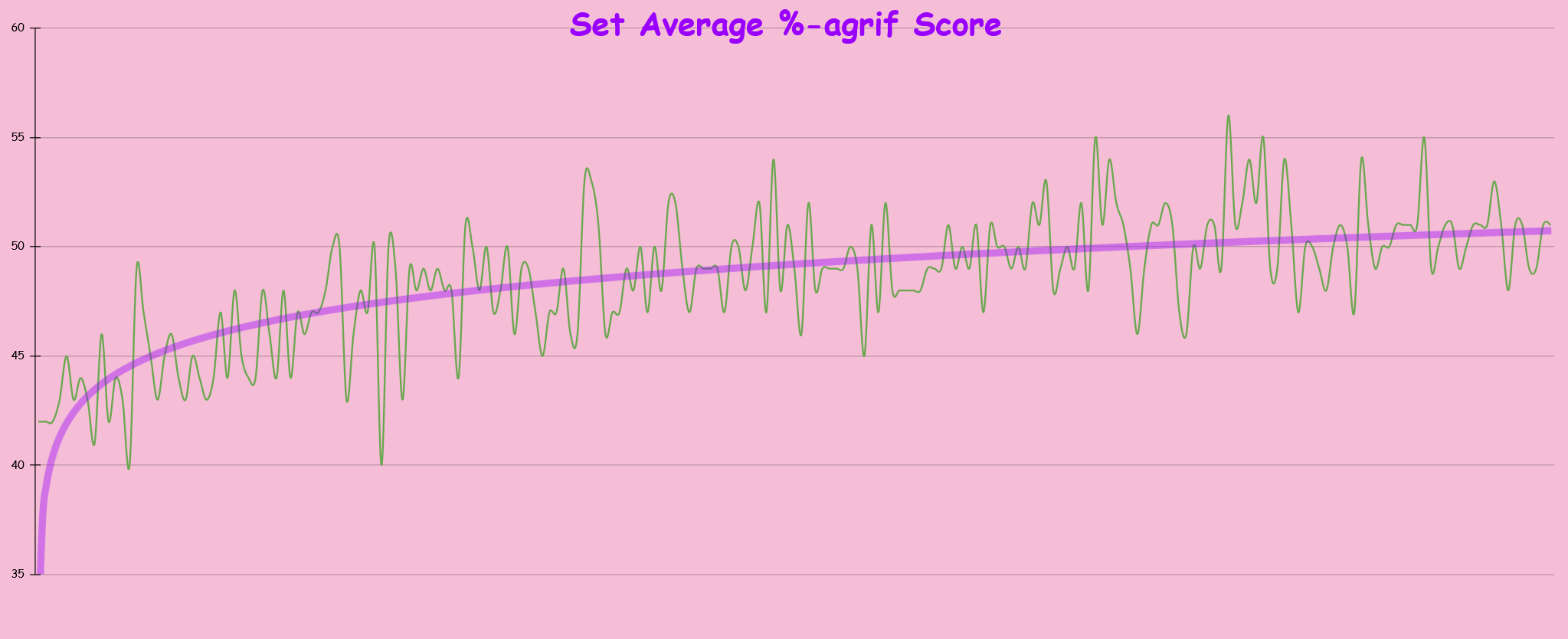
While there was a more rapid climb between Unhinged and Battle for Zendikar, the average %-agrif score for each set is continuing to rise, with the most recent set release, Secrets of Strixhaven’s having an average score of 51%-agrif.
Could it be that cards are getting longer than they were when Magic first started? That we’re seeing more letters on cards and it’s easier to include three out of five possible vowels, some consonants like “d”, “h”, “l” and “g”? Or perhaps it’s a hidden message that the designers at Wizards are designing sets with a bent towards Phelddagrif? This could be a secret so closely guarded, that the designers themselves may not be consciously aware of it.
It is most definitely the last one, because the line is going up (not down).
The Perfect 5
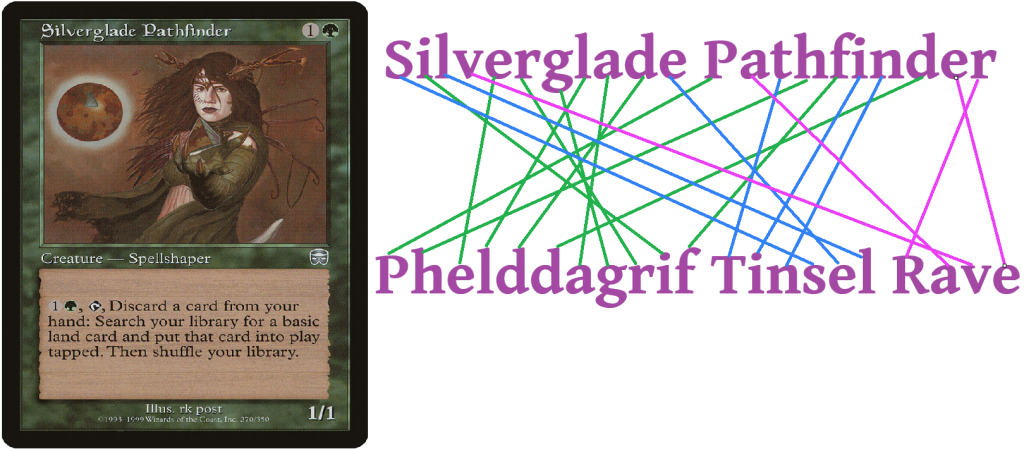
The highest scoring cards in Alpha were Merfolk of the Pearl Trident and Two-Headed Giant of Foriys, each with 82%-agrif scores. These would not be beat until three years later when Phelddagrif, with a 100%-agrif score, was printed in Alliances in 1996 (duh, (which has a 18%-agrif score by the way)). Predator Flagship, printed in 2000’s Nemesis, would be the first card with a 91%-agrif score, but it wouldn’t be the next highest scoring card after Phelddagrif. That was in the previous set: 1999’s Silverglade Pathfinder from Mercadian Masques which has a perfect score: 100%-agrif.
“Silverglade Pathfinder” obviously has more letters than “Phelddagrif”, which means there’s an extra message about Phelddagrif and Phelddagrif lore that we can take from this card. This is similar to how Questing Phelddagrif card name illuminates that Phelddagrifs go questing sometimes. After taking out the 11 Phelddagrif letters we are left over with these letters:
SVLEATHINER
Which we can get a lot of things from (svelte arni? Alerts vine?) but I’m pretty sure the correct answer is:
“Phelddagrif Tinsel Rave”
Outside of the clear cards (Phelddagrif, Questing Phelddagrif, and Richard Garfield Ph.D.), there are a total of 5* cards with perfect %-agrif scores:
Silverglade Pathfinder (1999)
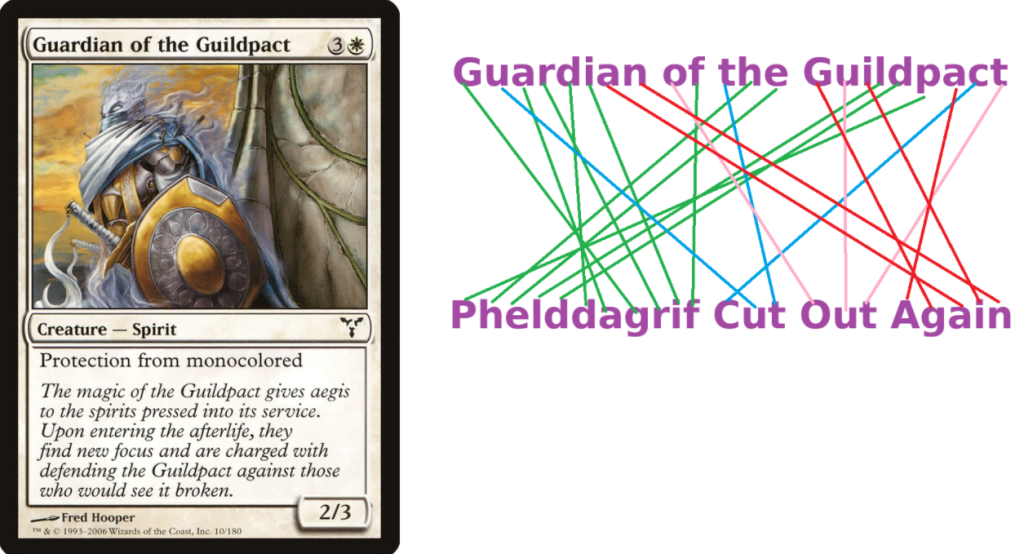
Guardian of the Guildpact (2006)
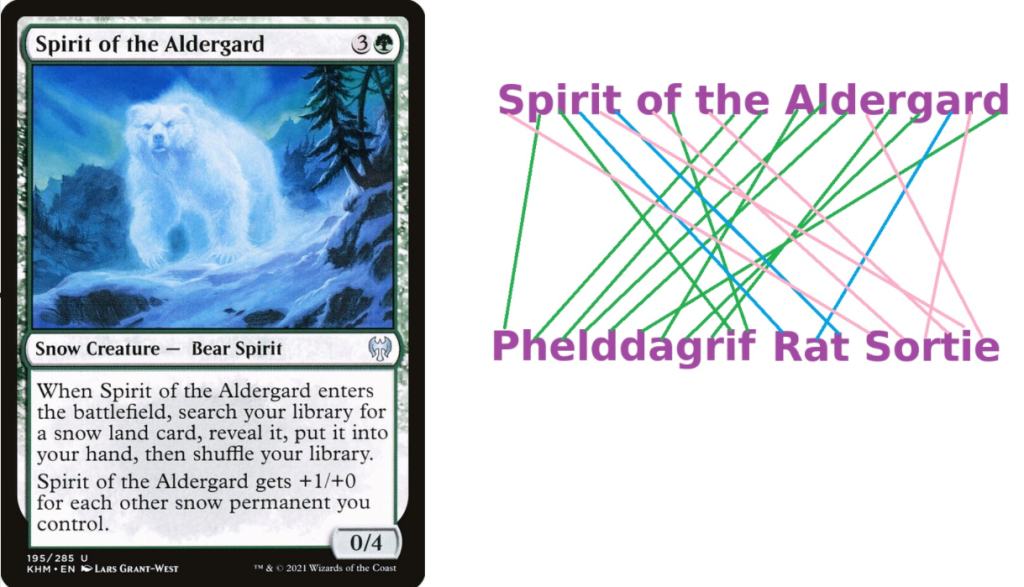
Spirit of the Aldergard (2021)
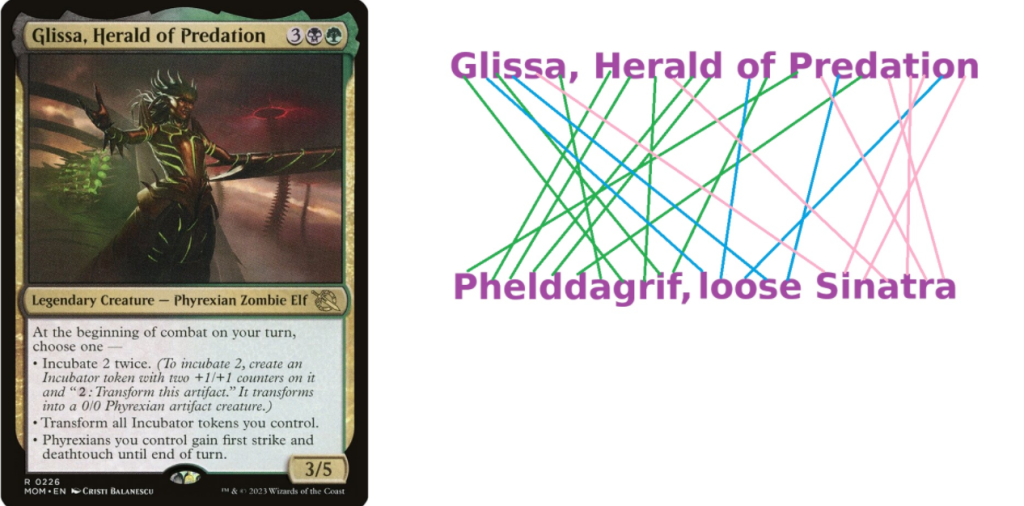
Glissa, Herald of Predation (2023)
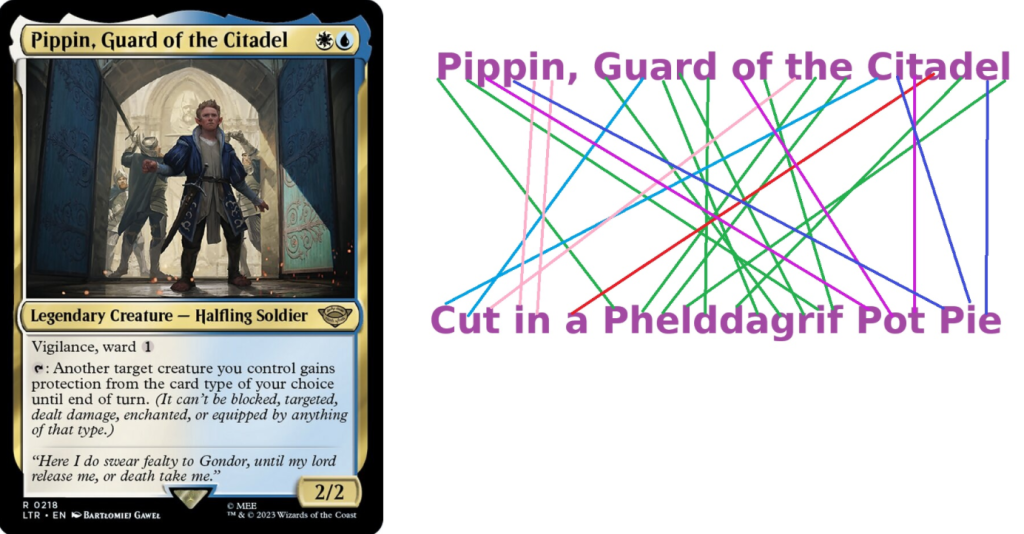
Pippin, Guard of the Citadel (2023, wow, what a good year for Phelddagrif anagrams)
Extra letters for these cards are3:
Guardian of the Guildpact: AACGINOTTUU
Spirit of the Aldergard: SRITOTAER
Glissa, Herald of Predation: LISSAAORETON
Pippin, Guard of the Citadel: PIPINUOTCTAE
After at least 30 minutes spent decoding until I decided to eat chips and watch Legacy videos I came up with these anagrams:
Guardian of the Guildpact: Phelddagrif Cutout Again (perhaps a reference to how Phelddagrif was meant to be in Dissension, and several sets before.
Spirit of the Aldergard: Phelddagrif Rat Sortie. This alludes to a dropped story line where Phelddagrif appears on Kaldheim with an army of rats. An intern misheard “Phyrexian” instead of “Phelddagrif”, so we got Vorinclex, Monstrous Raider instead.
Glissa, Herald of Predation: Phelddagrif, loose Sinatra. This one makes sense.
Pippin, Guard of the Citadel: Cut in a Phelddagrif Pot Pie. If you need to eat a Phelddagrif Pot Pie, you have to cut into it.
Silverglade Pathfinder, a card powercrept by the Secrets of Strixhaven’s prepare mechanic may be doomed to the dustbin of bulk, but it’ll hold a special place in my heart for being the first perfect %-agrif non-Phelddagrif.
The Horrible Hordes
Despite Phelddagrif being such a fun card that no one hates, there are many many cards with the lowest %-agrif score possible: 0. The first of these was Unsummon in alpha. Bad enough that it had a typo but they reprinted this card into the dirt. While sorting through the data if I saw a card with a 0%-agrif score, it would usually end up being Unsummon. But there are a few others:
Cocoon (1994)
Monsoon (1995)
Kookus (1996)
Stun (1997)
Ow (1998)
Okk (1998 Wow, fuck Phelddagrif this year I guess)
Wu Scout (1999)
S.N.O.T (2004)
_____ (2004)
Sun’s Bounty (2006)
Boom//Bust (2007)
Oust (2010)
Combust (2010)
X (2017)
Mob (2019)
Joust (2019)
Junktown (2024)
Boom Box (2024)
Buzz Bots (2026)
20 cards and counting!
Boom//Bust is special because neither card name in the split has a letter in common with Phelddagrif. It’s almost like a 2-for-1 anti-Phelddagrif card. (I mean “anti” in the sense of the opposite value, like Bizarro from DC Comics or Antipasta from lived experience).
That Asterisk from Earlier
You, dear attentive reader who nothing gets past, may have noticed an asterisk in the section previous to the previous one. You see, it turns out that there may be more than those five “perfect” %-agrif cards. When pulling from the Scryfall API and sorting, the program my friend made counted both sides as double faced cards as one name. So, for example:
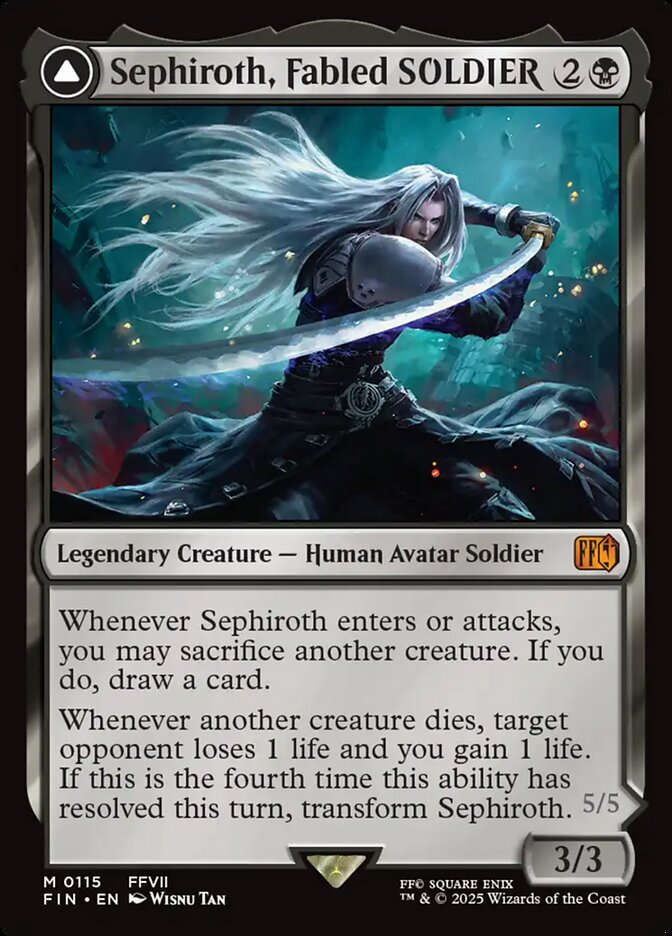
Would be pulled as:
Sephiroth, Fabled SOLDIER//Sephiroth, One-Winged Angel
Which has a 100%-agrif score. (extra letters are: EILOORSSSWabdeeeeeghhhiilnnnooprtt by the way. The anagram I could find here is “Phelddagrif hides rebellion. How? It hoops tangerines!” I am not putting that into MSPaint). But it only has this score because of the letters on Sephiroth’s precious back half (the ‘a’ and ‘g’ specifically). In theory, these cards (double face cards, adventures, battles, omens, and now cards with prepared spells) all contribute to, perhaps, a higher %-agrif than they should and each name should be separated out. Many words have been spent in the Phelddagrif subreddit debating whether these cards count towards a perfect %-agrif score. If someone wants to do all that, go ahead. I think if Boom//Bust gets to be a double whammy then Phelddagrif fans are allowed to count these cards:
Daybreak Ranger // Nightfall Predator (2011)
Villagers of Estwald // Howlpack of Estwald (2011, Innistrad was good for %-agrif)
Hadana’s Climb // Winged Temple of Orazca (2018)
Reidane, God of the Worthy // Valkmira, Protector’s Shield (2021)
Alrund, God of the Cosmos // Hakka, Whispering Raven (2021, same set as Spirit of the Aldergard. Kaldheim was even better for %-agrif than Innistrad)
Selfless Glyphweaver // Deadly Vanity (2021)
Jugan Defends the Temple // Remnant of the Rising Star (2022)
Invasion of Kaladesh // Aetherwing, Golden-Scale Flagship (2023)
Idol of the Deep King // Sovereign’s Macuahuitl (2023)
Sephiroth, Fabled SOLDIER // Sephiroth, One-Winged Angel (2025)
Lluwen, Exchange Student // Pest Friend (2026)
More than double than if we were not counting both “cards” included.
The Future of %-agrif
Sometimes the world can be dreary. A total bore, a dull amorphous mass that ingests the bright light of imagination to excrete the violent products of capital. Or sometimes it just fucking sucks! How are we supposed to find joy when we are forced to leave those things in the past and strapped down into the forward facing “grindset”?
I mean, what the hell am I supposed to do when I sit down to a commander pod with Phelddagrif and my opponents are on Witherbloom, the Unbalanced and Prismari, the Insipid?4
Let’s finish by wrapping ourselves in the warm faux-wool blanket of extrapolating from our current data. Magic started with a below average score (the first set be below average?) of 45%-agrif, but grew 6 points with Secrets of Strixhaven and more recent sets averaging 51%-agrif. That’s 33 years for ~6%-agrif worth of growth of 0.05%-agrif/year.
But we can get a little more accurate. Not too much because I’m not looking to spend more time on this blog post.
If we’re to assume that this is a steady trend that is linear, then the average of set %-agrif scores is “y=0.0321*x+45.1”, with “x” being number of Magic Sets released (including commander and reprint releases). When y = 100%-agrif, x should equal ~1710, meaning by the 1710 set/product release we can expect to have an average of 100%-agrif. With 265 data points over 33 years of Magic releases, averaging ~8 releases/year (although there’s reason to believe that the current rate of product releases will increase over time as they have in the past, I’m too lazy to figure out what that line looks like), we can expect that by Magic’s 213th year, around 2206, we’ll see the set that has a set average of 100%-agrif.
Only 180 more years to go!
Leave a Reply
- Most of these taken from this reddit thread. ↩︎
- 50% is average when it comes to complex statistical models like this. It’s the number halfway between 1 and 100. We start at 1 because a world with a 0%-agrif score cannot be conceived. ↩︎
- Good chance I messed this up, which is why I had to show my math below using MSPaint. ↩︎
- I actually don’t have a problem with these commanders, or pretty much any commander. I just needed to do a bit, and I guess include a footnote? ↩︎
Leave a Reply