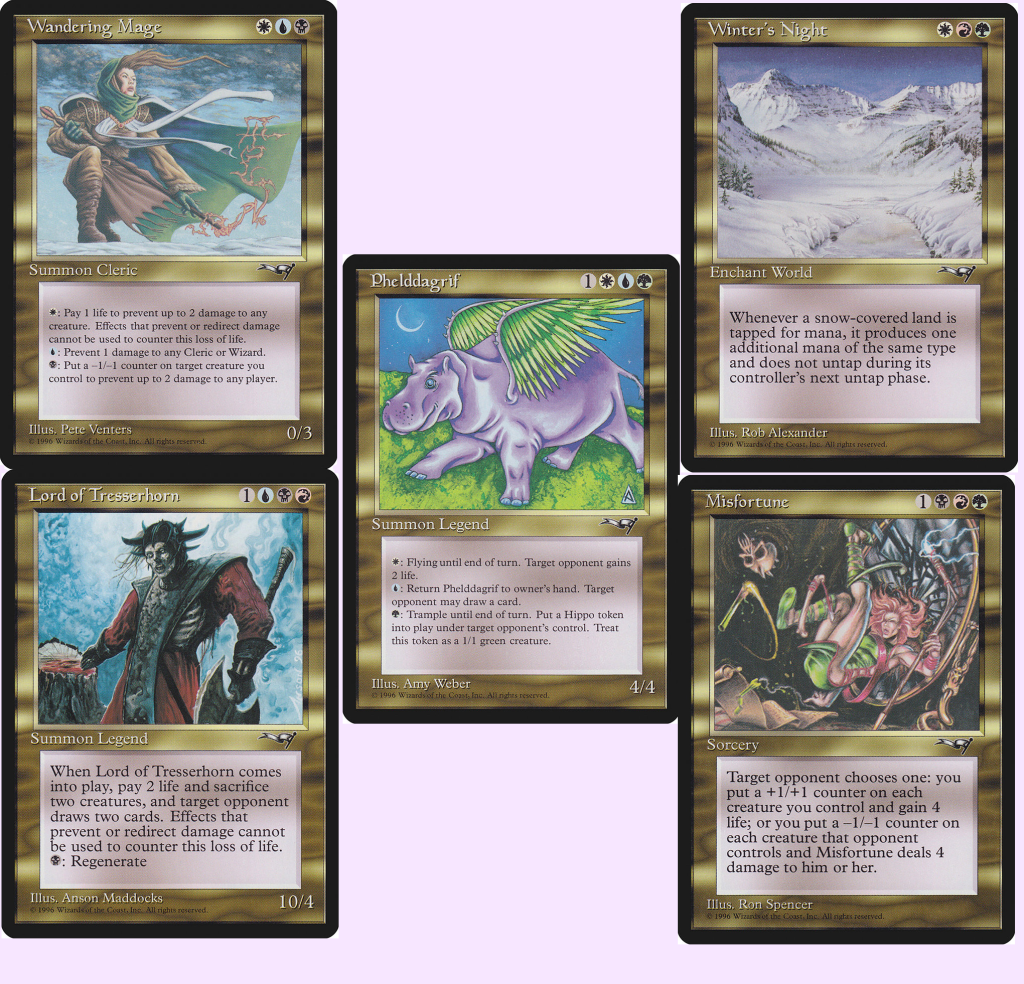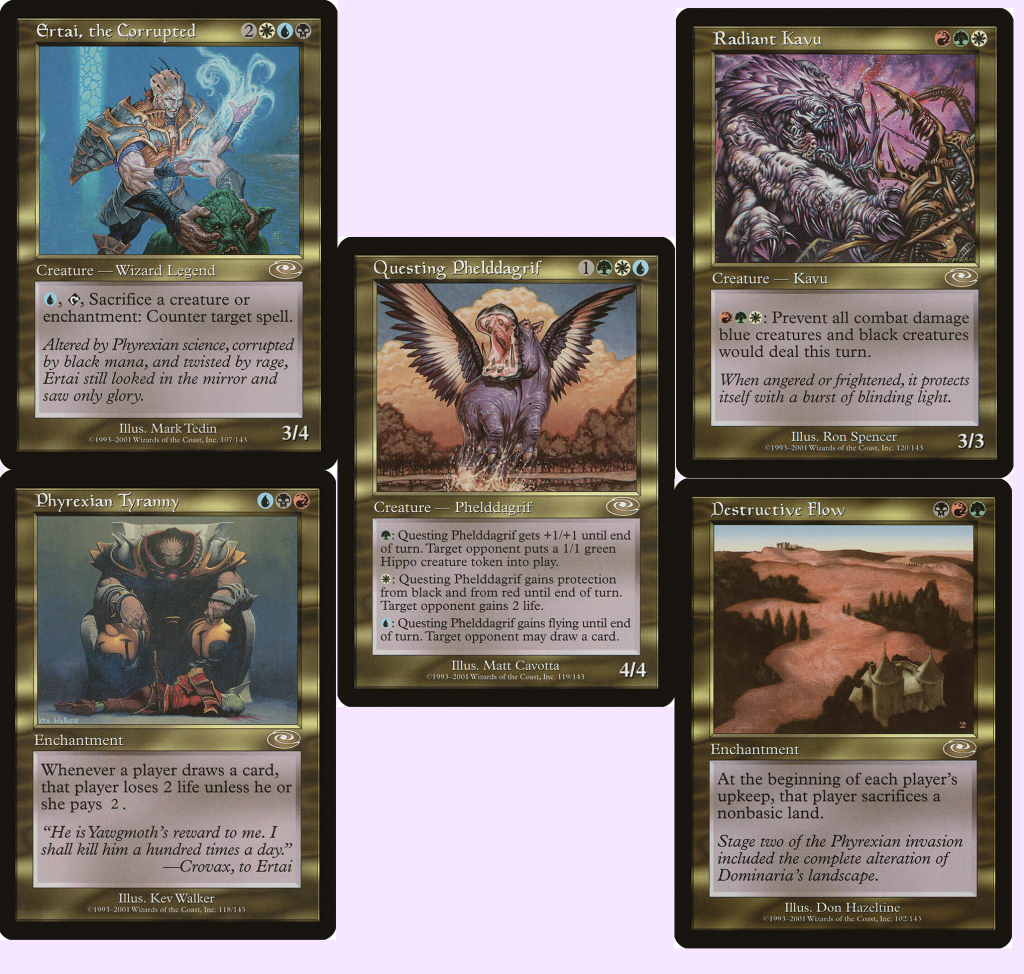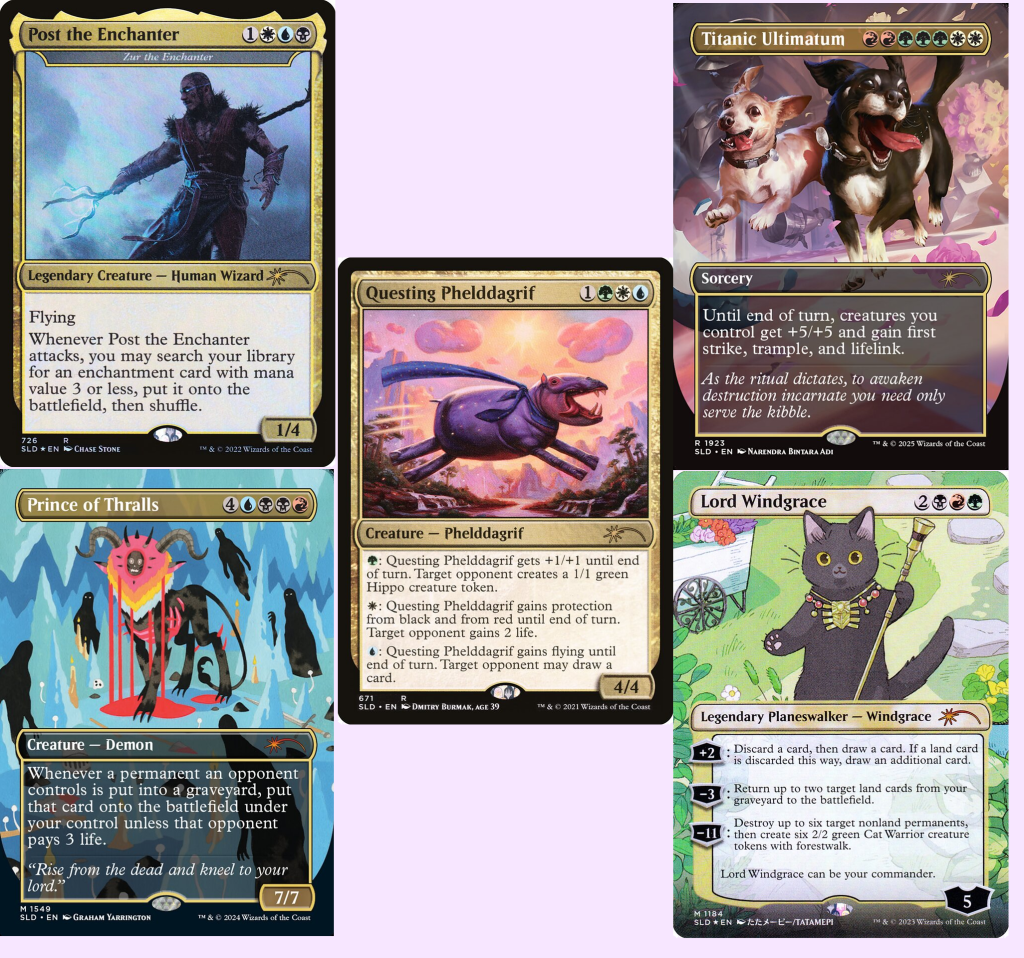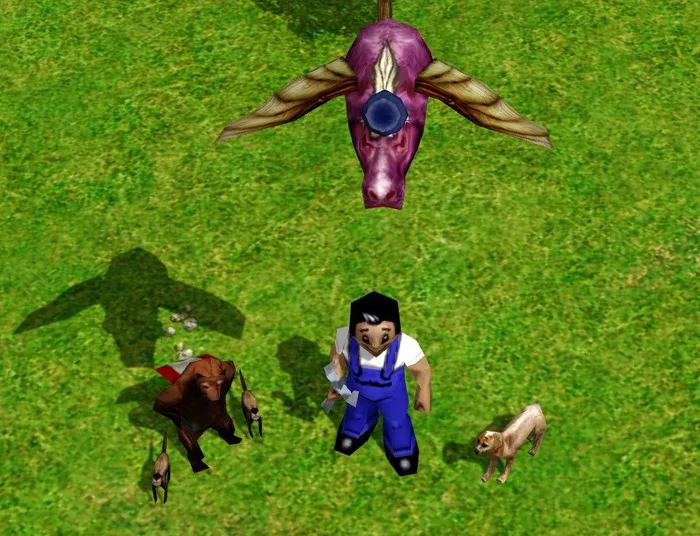
Category: Phelddagrif Musings

  • %-Agrif

    %-Agrif

    The anagram1 has a long and enmeshed history with Magic.  Wyluli Wolf is an anagram of Lily Wu, creator of the game Richard Garfield’s first wife. Erhnam Djinn is an anagram of Richard Garfield’s sister’s husband. Ydwen Efreet and Mijae Djinn are anagrams of Wendy and Jamie (friends of, you guessed it, Richard Garfield). “Leshrac” came from “Charles” Page, a playtester at Wizards. “Nevinyrral” from Nevinnyral’s Disk is Sci-fi author Larry Niven backwards, which is sort of an anagram.

    Magic has some anagrams that are a little less esoteric. Elkin Bottle is Klein Bottle, and Bösium Strip is Möbius strip, both of which are named after people who are not related to or friends with Richard Garfield. And there are some cards that don’t depend on having knowledge of the designers of the game, of tertiary games, or any real people at all. “Citanul” of Citanul Druid and Citanul Flute is an anagram of “lunatic”. Liliana Vess is an anagram for “A Villainess”.

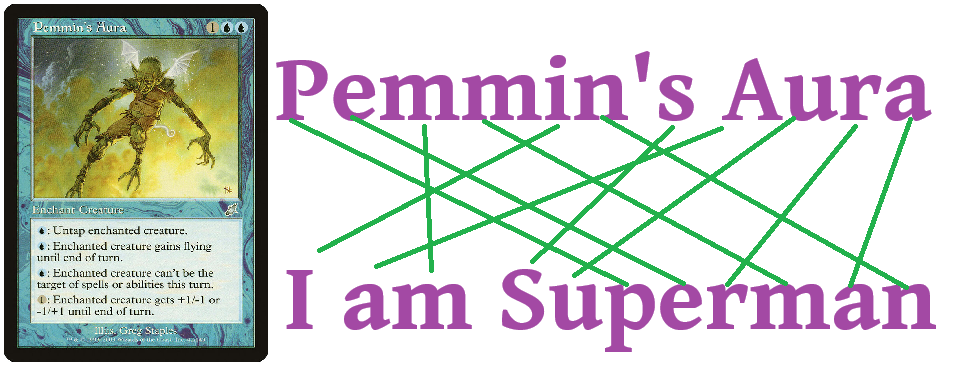
    Some of the most fun anagrams are the ones that are nearly, if not entirely, self-referential. “Linvala” is an anagram for “vanilla”, and it turns off creatures’ abilities making them more ‘vanilla”. My favorite is Pemmin’s Aura, an infinite combo piece with many different mana dorks, enchants a creature with the abilities of Morphling. Morphling was a powerhouse of a card, nearly impossible to kill and could do double duty as a flying attacker and then untapping itself to be a towering defender. The card was so powerful that it had the nickname “Superman”. Pemmin’s Aura is an anagram for “I am Superman”. 

    I figure out a better way to demonstrate anagrams later

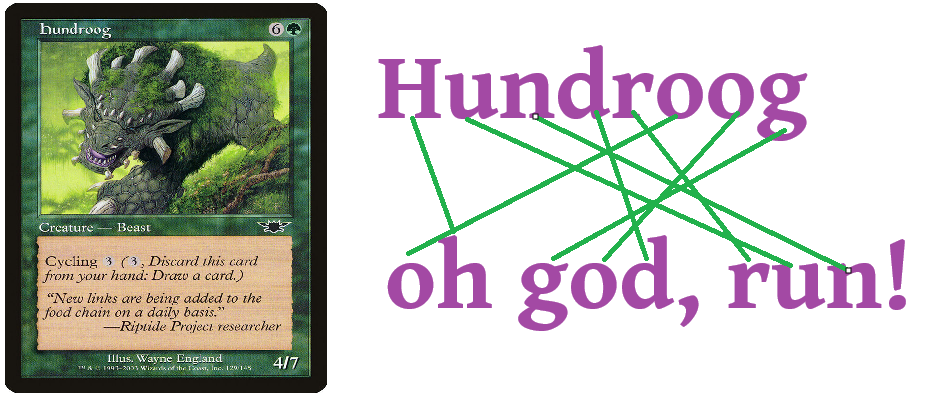
    Guided Strike” depicts a weird looking creature that eventually got its own card with “Ridged Kusite“. Anodet Lurker is an anagram of Darker Onulet, While that last one was probably intentional, others, like “Hundroog” being an anagram for “oh god, run!” may not be. It still does not make it any less of a true anagram than the others. Mangara is an anagram of the word “anagram“, which is weird and doesn’t appear immediately relevant, but perhaps there’s something there. And Asmoranomardicadaistinaculdacar is a well known anagram for (fill in when someone else figures that out).

    No, not here, after this

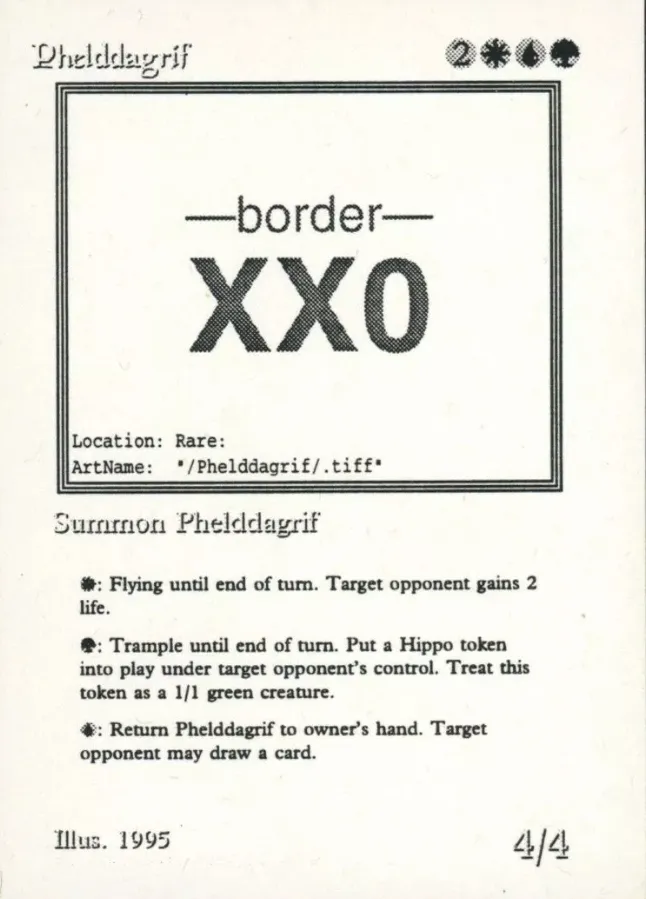
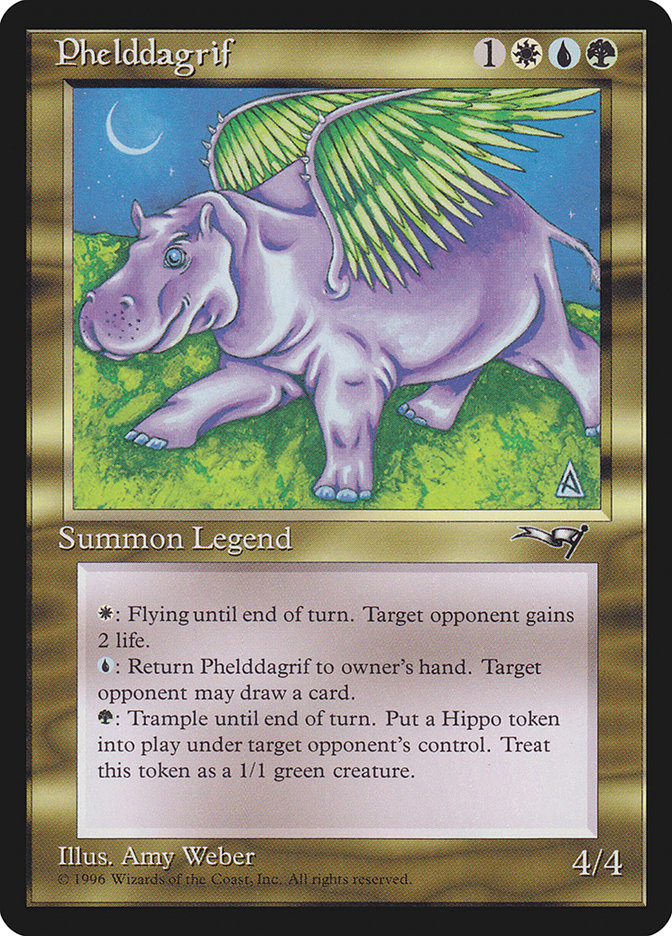
    And, of course, Phelddagrif is an anagram for “Garfield PhD”. Given how many of his friends and family got cards before him, I’m surprised it took until Alliances for him to get a card.

    What are we to do with these anagrams, these cards that transform before our eyes, from Wolf to Richard Garfield’s first wife, from an ancient disk created by a powerful mage to a plate named after a buffoon? It’s not like Guided Strike is much better with Ridged Kusite, and Pemmin’s Aura is a horrible aura to put on Morphling (any aura is pretty bad to put on Morphling). Are these hidden messages? Are they intentional? And can we measure it?

    First, yes. These are hidden messages. Sure, these anagrams don’t reveal the best strategy to using these cards, you have to use your brain for that. They do demonstrate the psychic fields that the game’s designers are swimming through, what they and everyone else is thinking about.

    What are they thinking about? The past! Always the past, that old chestnut! More and more often cards are printed as references to the game pieces and history of the game itself. Sometimes these are obvious, such as the smattering of cards in Edge of Eternities, while others are more subtle: references in art or flavor text to Magic‘s storied past. Perhaps, through anagram, Wizards is delivering a message to us, showing how much they are thinking about Phelddagrif and trying to convey that through their naming conventions.

    Don’t worry about measuring, I already did that.

    Measuring Phelddagrif

    I needed a method and a machine that could measure the amount of “Phelddagrif” in a set quickly. I know it may not seem like it, but I am a human being and I only have a certain amount of time before my bedtime or I’m cranky the next day. While I could count out every card in Magic‘s history, measuring how much “Phelddagrif” is in each card, this seemed like the perfect task to outsource to a machine. I then outsourced building that machine (or “program” as it’s sometimes called) to someone else. Thanks!
    The goal was to measure how many sets have cards that are anagrams of “Phelddagrif”, as well as cards that are near or incomplete anagrams of “Phelddagrif”. Looking at every set the program searched each card and assigned them a score based on how many letters the name of the card had in common with “Phelddagrif”. This score, which everyone on the team enthusiastically agreed to call a “%-agrif” score, works on a scale of 11, one for each letter in “Phelddagrif”.

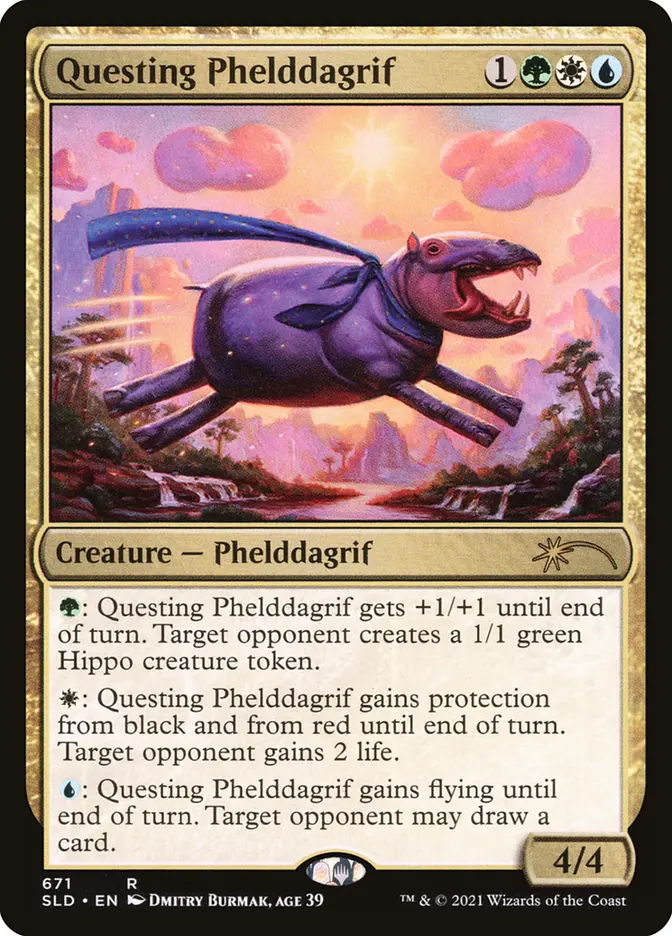
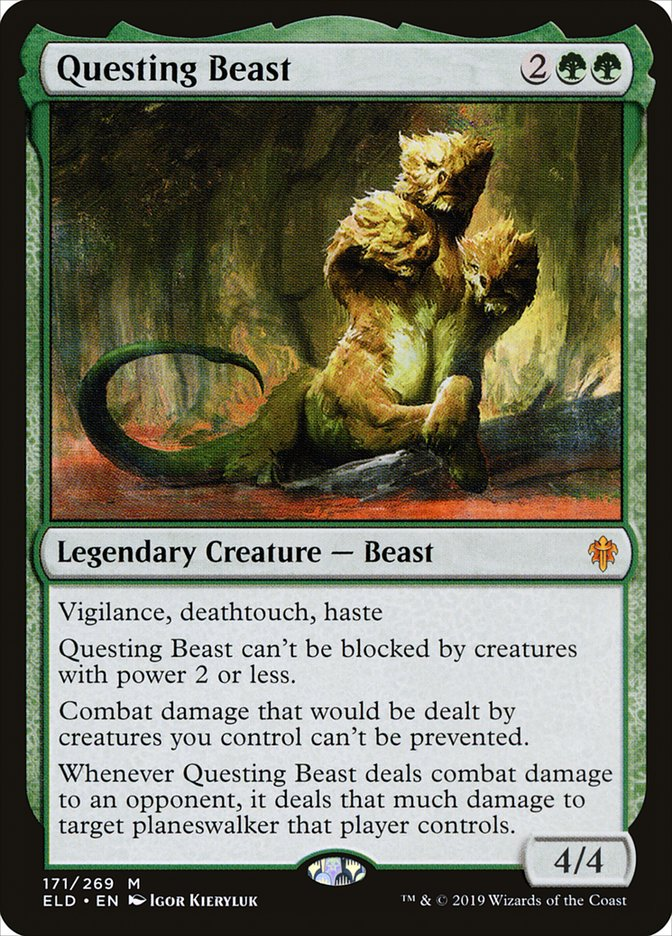
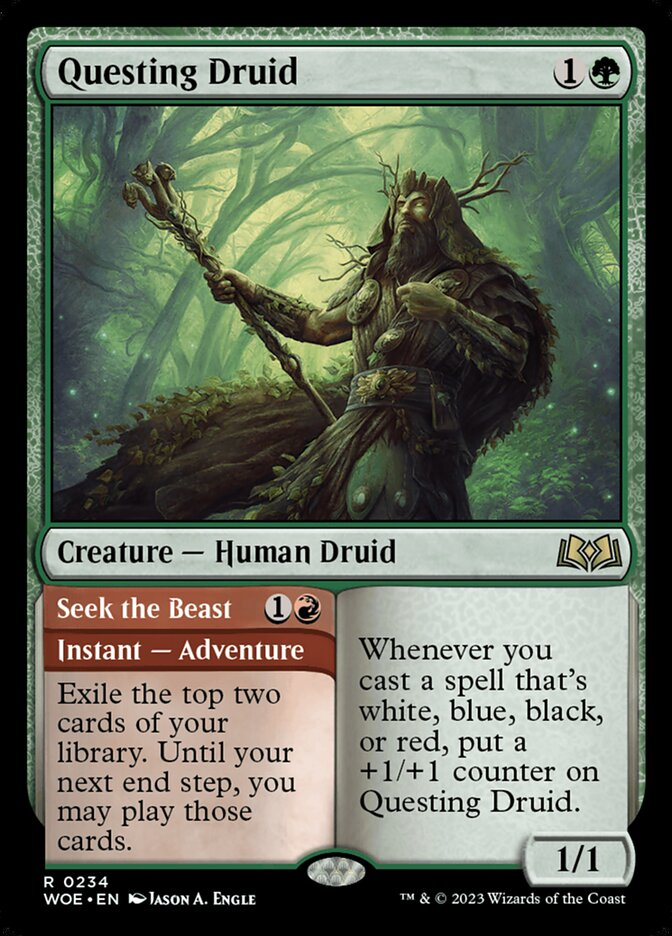
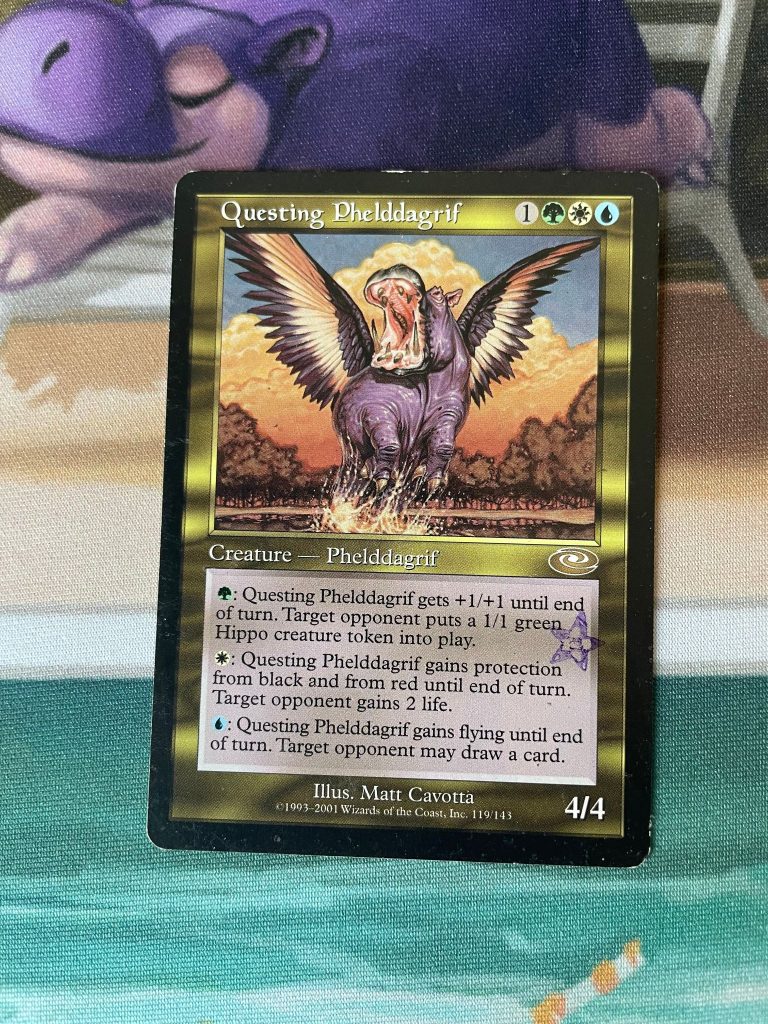
    For example, a card that has four letters in common with Phelddagrif would score 4/11, or have a 36%-agrif score. One of the benefits of calculating how much Phelddagrif is contained in a card is that it was an easy calculation that was not based in logic, fact, or reason, which makes it difficult to challenge. It also would give Questing Phelddagrif and Richard Garfield, Ph.D.100%-agrif scores because they are, undoubtably, Phelddagrifs.

    From this data, we gathered how many and which cards scored the highest and lowest %-agrif score, as well as an average %-agrif score from each set, so that the data could reveal correlations of when Magic was trending towards a higher %-agrif and when it was moving away from it.

    So, what did the data show?

    So much. So, so much.

    The Data

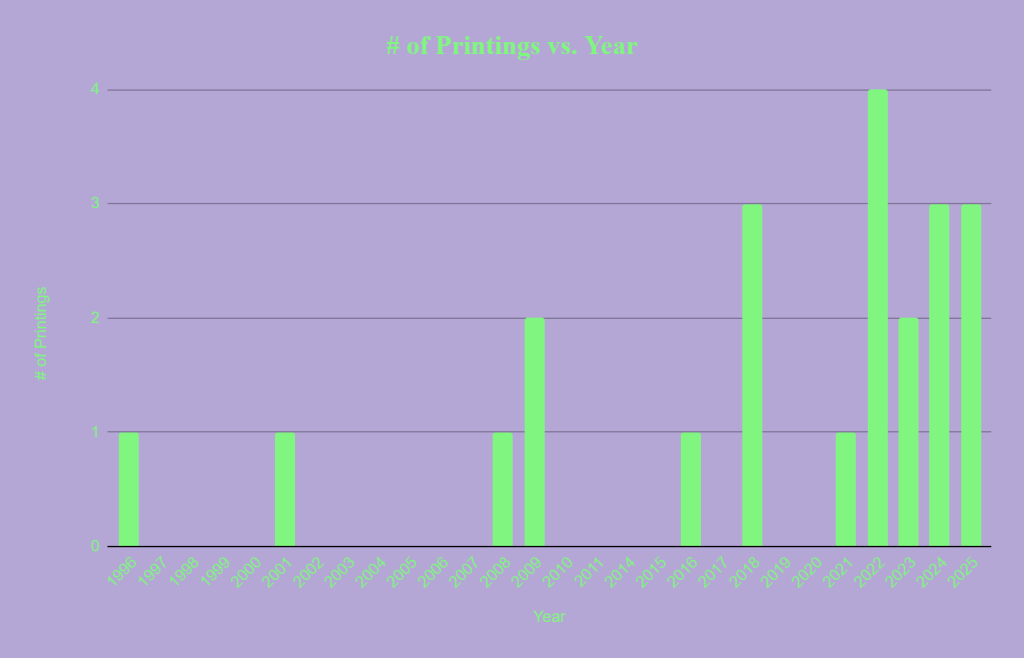
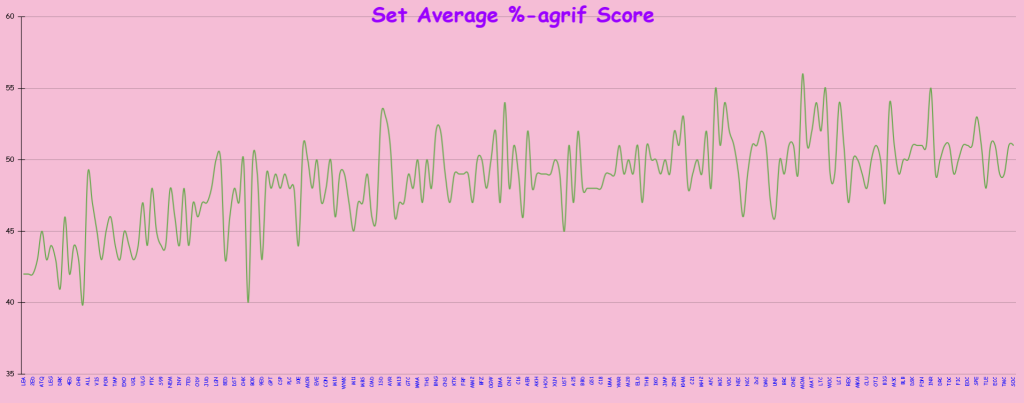
    This image is a link to a more detailed chart, one that you can actually see.

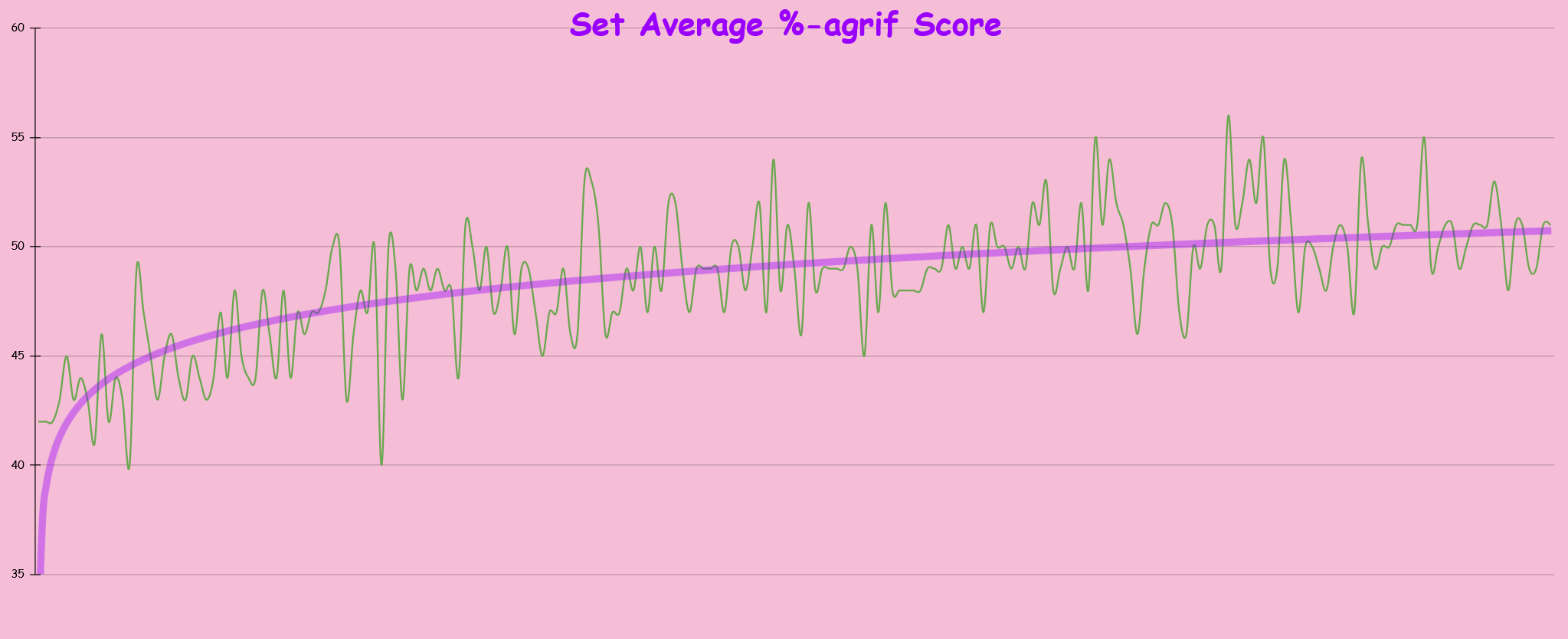
    When Alpha released in 1993, the set had an average score of 42%-agrif. Not bad for Phelddagrif not even being conceived of yet, although below average.2 Alliances, in 1996, the set that introduced Phelddagrif, has an average score of 49%-agrif. While it’s a bit outside the median range, we can see that the average %-agrif score per set is rising even when factoring in outliers like Alliances and March of the Machine (with a whopping set score of 56%-agrif), or Unhinged (which has a 40 %-agrif score, tying Homelands for the lowest %-agrif score). After 10th Edition, which scores 44 %-agrif, the average %-agrif set score does not dip below 45.

    While there was a more rapid climb between Unhinged and Battle for Zendikar, the average %-agrif score for each set is continuing to rise, with the most recent set release, Secrets of Strixhaven’s having an average score of 51%-agrif.

    Could it be that cards are getting longer than they were when Magic first started? That we’re seeing more letters on cards and it’s easier to include three out of five possible vowels, some consonants like “d”, “h”, “l” and “g”? Or perhaps it’s a hidden message that the designers at Wizards are designing sets with a bent towards Phelddagrif? This could be a secret so closely guarded, that the designers themselves may not be consciously aware of it.

    It is most definitely the last one, because the line is going up (not down).

    The Perfect 5

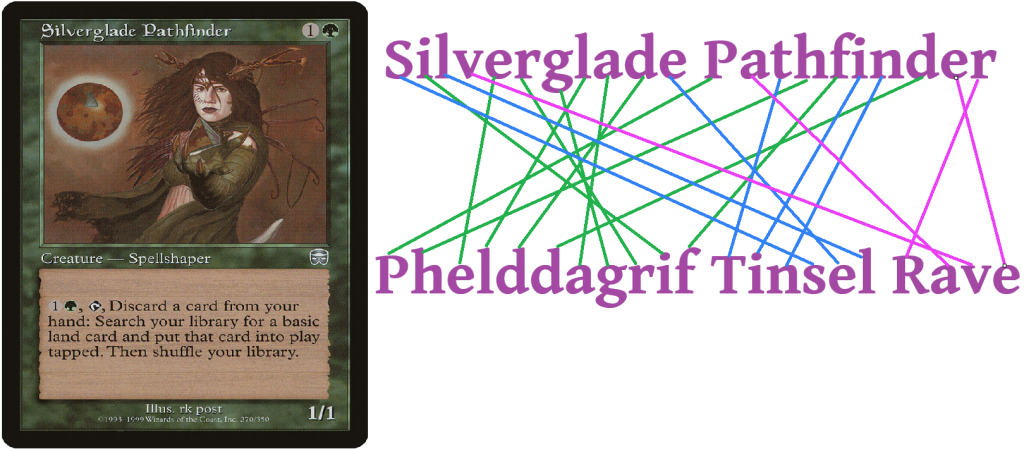
    The highest scoring cards in Alpha were Merfolk of the Pearl Trident and Two-Headed Giant of Foriys, each with 82%-agrif scores. These would not be beat until three years later when Phelddagrif, with a 100%-agrif score, was printed in Alliances in 1996 (duh, (which has a 18%-agrif score by the way)). Predator Flagship, printed in 2000’s Nemesis, would be the first card with a 91%-agrif score, but it wouldn’t be the next highest scoring card after Phelddagrif. That was in the previous set: 1999’s Silverglade Pathfinder from Mercadian Masques which has a perfect score: 100%-agrif.

    “Silverglade Pathfinder” obviously has more letters than “Phelddagrif”, which means there’s an extra message about Phelddagrif and Phelddagrif lore that we can take from this card. This is similar to how Questing Phelddagrif card name illuminates that Phelddagrifs go questing sometimes. After taking out the 11 Phelddagrif letters we are left over with these letters:

    SVLEATHINER

    Which we can get a lot of things from (svelte arni? Alerts vine?)  but I’m pretty sure the correct answer is:

    “Phelddagrif Tinsel Rave”

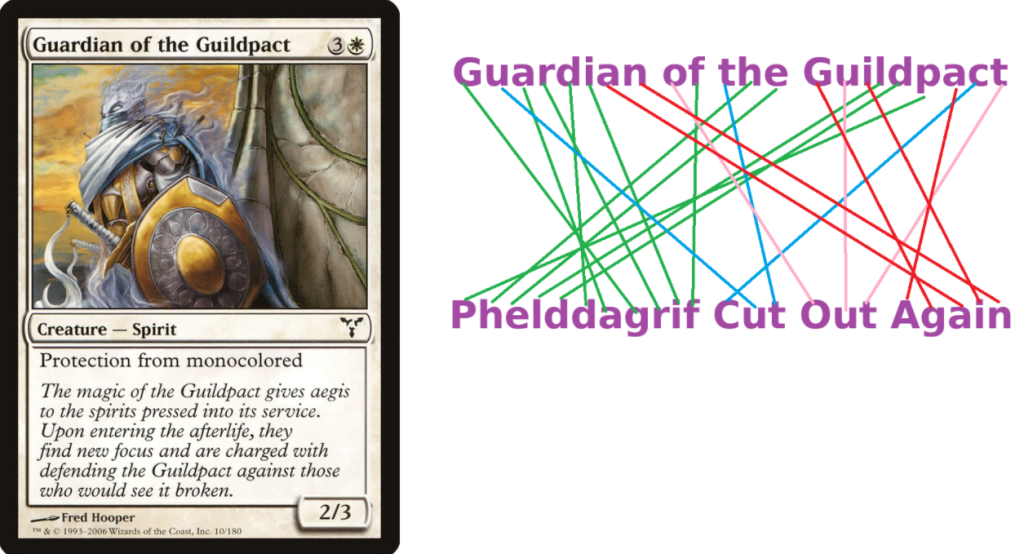
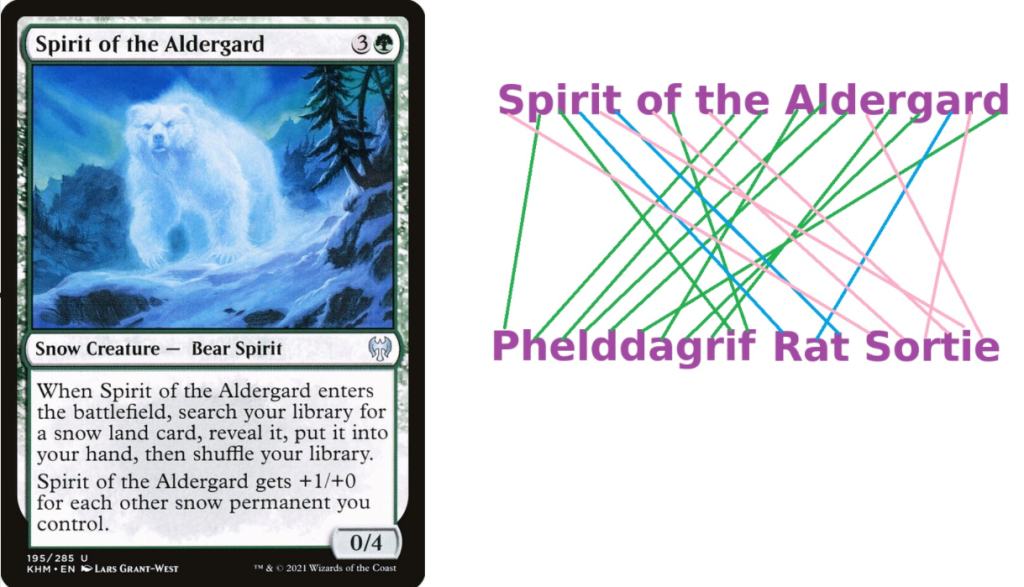
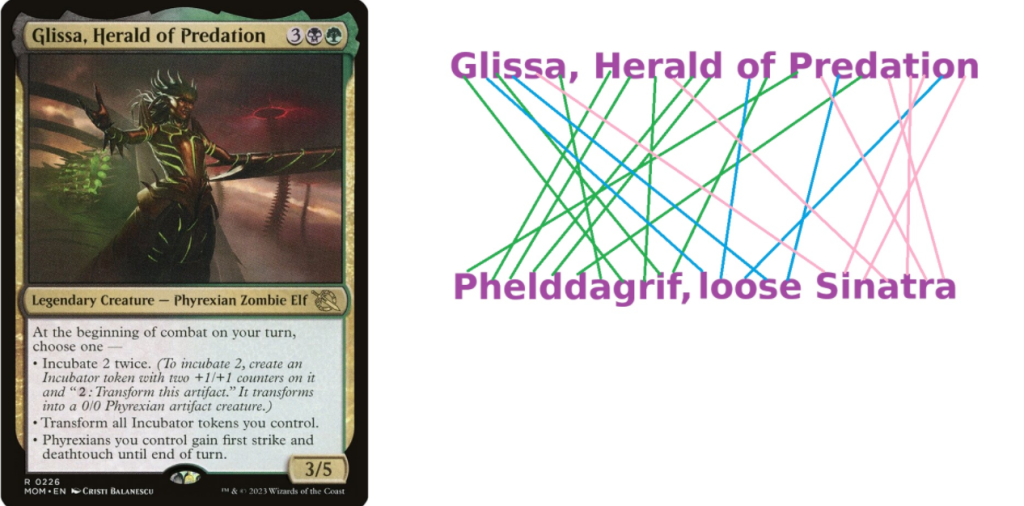
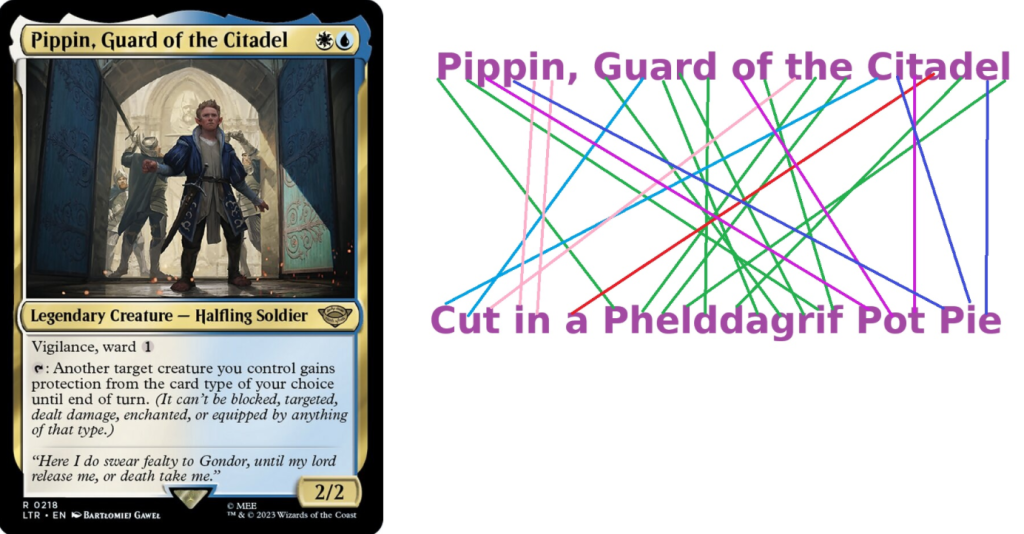
    Outside of the clear cards (Phelddagrif, Questing Phelddagrif, and Richard Garfield Ph.D.), there are a total of 5* cards with perfect %-agrif scores:

    Silverglade Pathfinder (1999)

    Guardian of the Guildpact (2006)

    Spirit of the Aldergard (2021)

    Glissa, Herald of Predation (2023)

    Pippin, Guard of the Citadel (2023, wow, what a good year for Phelddagrif anagrams)

    Extra letters for these cards are3:

    Guardian of the Guildpact: AACGINOTTUU

    Spirit of the Aldergard: SRITOTAER

    Glissa, Herald of Predation: LISSAAORETON

    Pippin, Guard of the Citadel: PIPINUOTCTAE

    After at least 30 minutes spent decoding until I decided to eat chips and watch Legacy videos I came up with these anagrams:

    Guardian of the Guildpact: Phelddagrif Cutout Again (perhaps a reference to how Phelddagrif was meant to be in Dissension, and several sets before.

    Spirit of the Aldergard: Phelddagrif Rat Sortie. This alludes to a dropped story line where Phelddagrif appears on Kaldheim with an army of rats. An intern misheard “Phyrexian” instead of “Phelddagrif”, so we got Vorinclex, Monstrous Raider instead.

    Glissa, Herald of Predation: Phelddagrif, loose Sinatra. This one makes sense.

    Pippin, Guard of the Citadel: Cut in a Phelddagrif Pot Pie. If you need to eat a Phelddagrif Pot Pie, you have to cut into it.

    Silverglade Pathfinder, a card powercrept by the Secrets of Strixhaven’s prepare mechanic may be doomed to the dustbin of bulk, but it’ll hold a special place in my heart for being the first perfect %-agrif non-Phelddagrif.

    The Horrible Hordes

    Despite Phelddagrif being such a fun card that no one hates, there are many many cards with the lowest %-agrif score possible: 0. The first of these was Unsummon in alpha. Bad enough that it had a typo but they reprinted this card into the dirt. While sorting through the data if I saw a card with a 0%-agrif score, it would usually end up being Unsummon. But there are a few others:

    Cocoon (1994)

    Monsoon (1995)

    Kookus (1996)

    Stun (1997)

    Ow (1998)

    Okk (1998 Wow, fuck Phelddagrif this year I guess)

    Wu Scout (1999)

    S.N.O.T (2004)

    _____ (2004)

    Sun’s Bounty (2006)

    Boom//Bust (2007)

    Oust (2010)

    Combust (2010)

    X (2017)

    Mob (2019)

    Joust (2019)

    Junktown (2024)

    Boom Box (2024)

    Buzz Bots (2026)

    20 cards and counting! 

    Boom//Bust is special because neither card name in the split has a letter in common with Phelddagrif. It’s almost like a 2-for-1 anti-Phelddagrif card. (I mean “anti” in the sense of the opposite value, like Bizarro from DC Comics or Antipasta from lived experience).

    That Asterisk from Earlier

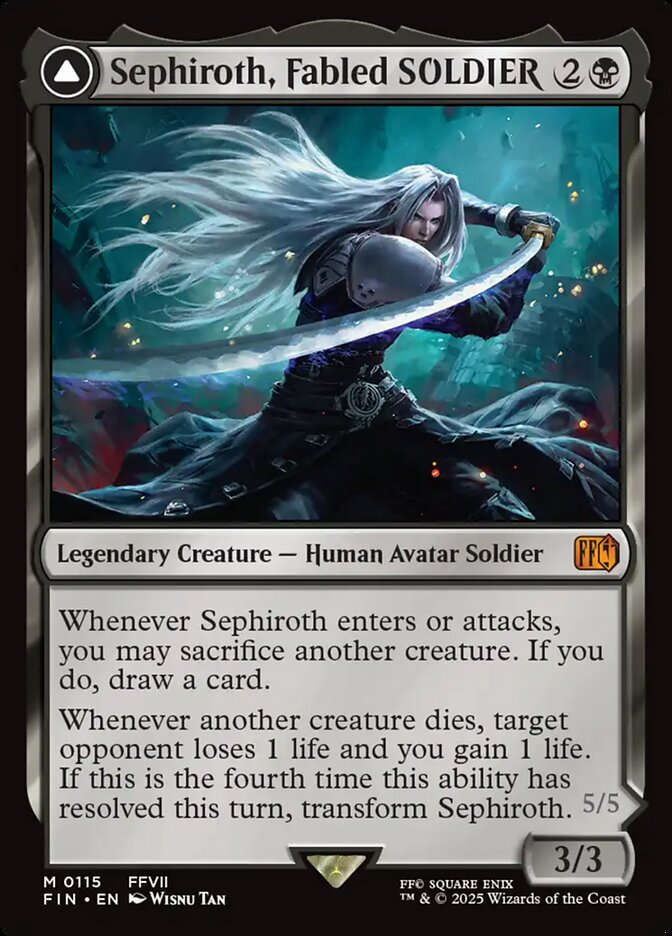
    You, dear attentive reader who nothing gets past, may have noticed an asterisk in the section previous to the previous one. You see, it turns out that there may be more than those five “perfect” %-agrif cards. When pulling from the Scryfall API and sorting, the program my friend made counted both sides as double faced cards as one name. So, for example:

    Would be pulled as:
    Sephiroth, Fabled SOLDIER//Sephiroth, One-Winged Angel 

    Which has a 100%-agrif score. (extra letters are: EILOORSSSWabdeeeeeghhhiilnnnooprtt by the way. The anagram I could find here is “Phelddagrif hides rebellion. How? It hoops tangerines!” I am not putting that into MSPaint). But it only has this score because of the letters on Sephiroth’s precious back half (the ‘a’ and ‘g’ specifically). In theory, these cards (double face cards, adventures, battles, omens, and now cards with prepared spells) all contribute to, perhaps, a higher %-agrif than they should and each name should be separated out. Many words have been spent in the Phelddagrif subreddit debating whether these cards count towards a perfect %-agrif score. If someone wants to do all that, go ahead. I think if Boom//Bust gets to be a double whammy then Phelddagrif fans are allowed to count these cards:

    Daybreak Ranger // Nightfall Predator (2011)

    Villagers of Estwald // Howlpack of Estwald (2011, Innistrad was good for %-agrif)

    Hadana’s Climb // Winged Temple of Orazca (2018)

    Reidane, God of the Worthy // Valkmira, Protector’s Shield (2021)

    Alrund, God of the Cosmos // Hakka, Whispering Raven (2021, same set as Spirit of the Aldergard. Kaldheim was even better for %-agrif than Innistrad)

    Selfless Glyphweaver // Deadly Vanity (2021)

    Jugan Defends the Temple // Remnant of the Rising Star (2022)

    Invasion of Kaladesh // Aetherwing, Golden-Scale Flagship (2023)

    Idol of the Deep King // Sovereign’s Macuahuitl (2023)

    Sephiroth, Fabled SOLDIER // Sephiroth, One-Winged Angel (2025)

    Lluwen, Exchange Student // Pest Friend (2026)

    More than double than if we were not counting both “cards” included. 

    The Future of  %-agrif

    Sometimes the world can be dreary. A total bore, a dull amorphous mass that ingests the bright light of imagination to excrete the violent products of capital. Or sometimes it just fucking sucks! How are we supposed to find joy when we are forced to leave those things in the past and strapped down into the forward facing “grindset”?

    I mean, what the hell am I supposed to do when I sit down to a commander pod with Phelddagrif and my opponents are on Witherbloom, the Unbalanced and Prismari, the Insipid?4

    Let’s finish by wrapping ourselves in the warm faux-wool blanket of extrapolating from our current data. Magic started with a below average score (the first set be below average?) of 45%-agrif, but grew 6 points with Secrets of Strixhaven and more recent sets averaging 51%-agrif. That’s 33 years for ~6%-agrif worth of growth of 0.05%-agrif/year.

    But we can get a little more accurate. Not too much because I’m not looking to spend more time on this blog post.

    If we’re to assume that this is a steady trend that is linear, then the average of set %-agrif scores is “y=0.0321*x+45.1”, with “x” being number of Magic Sets released (including commander and reprint releases). When y = 100%-agrif, x should equal ~1710, meaning by the 1710 set/product release we can expect to have an average of 100%-agrif. With 265 data points over 33 years of Magic releases, averaging ~8 releases/year (although there’s reason to believe that the current rate of product releases will increase over time as they have in the past, I’m too lazy to figure out what that line looks like), we can expect that by Magic’s 213th year, around 2206, we’ll see the set that has a set average of 100%-agrif.

    Only 180 more years to go!

    Leave a Reply

    Your email address will not be published. Required fields are marked *

    Leave a Reply

    Your email address will not be published. Required fields are marked *

    1. Most of these taken from this reddit thread. ↩︎
    2. 50% is average when it comes to complex statistical models like this. It’s the number halfway between 1 and 100. We start at 1 because a world with a 0%-agrif score cannot be conceived. ↩︎
    3. Good chance I messed this up, which is why I had to show my math below using MSPaint. ↩︎
    4. I actually don’t have a problem with these commanders, or pretty much any commander. I just needed to do a bit, and I guess include a footnote? ↩︎
  • Cede Time

    Cede Time

    “What a strange demented feeling it gives me when I realize I have spent whole days before this inkstone, with nothing better to do, jotting down at random whatever nonsensical thoughts have entered my head.”

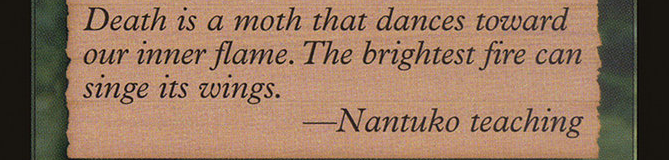
    -Tsurezuregusa of Kenkō (Trans. Donald Hall)

    “I know of one Greek labyrinth which is a single straight line. Along that line so many philosophers have lost themselves that a mere detective might well do so, too.”

    -Death and the Compass by Jorge Luis Borges

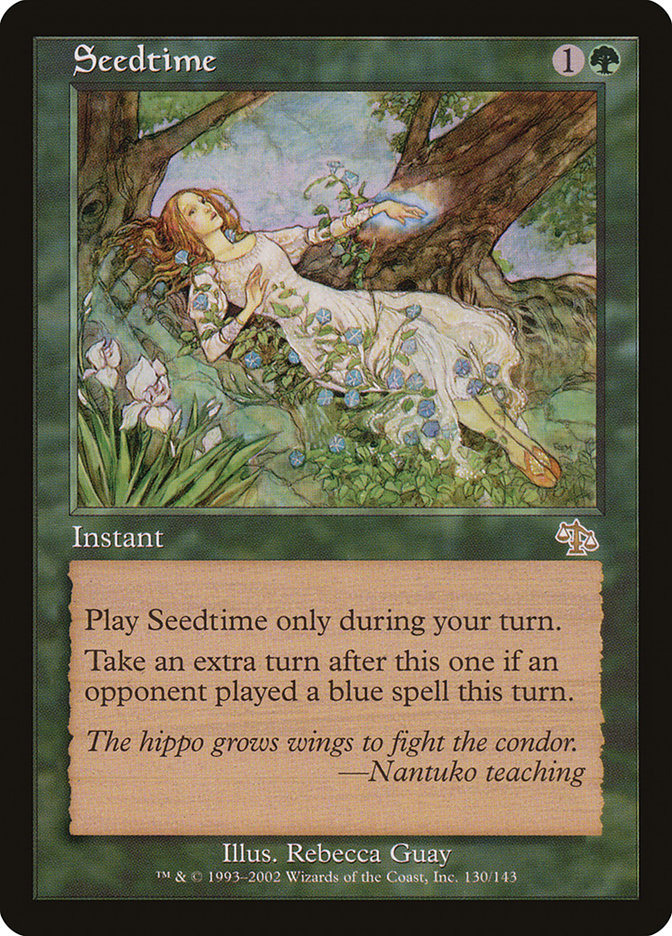
    Seedtime is 2 mana instant for one generic and one green mana that gives players an extra turn. It only does this if an opponent has cast a blue spell that turn.

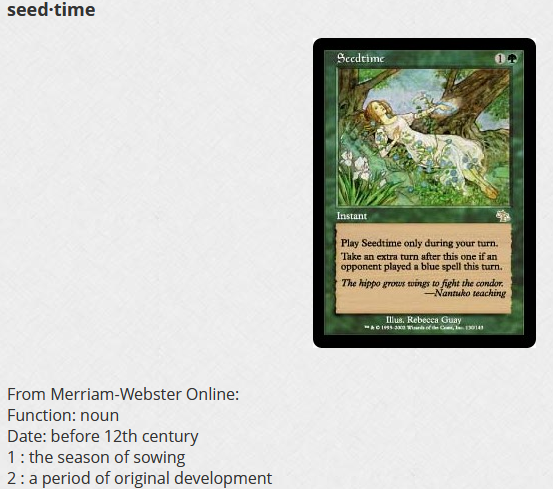
    The term “Seedtime” refers to “a season of sowing” or “a period of original development. 

    Screenshot of “The Lexicon Archive” from the Magic Homepage published January 15, 2002.

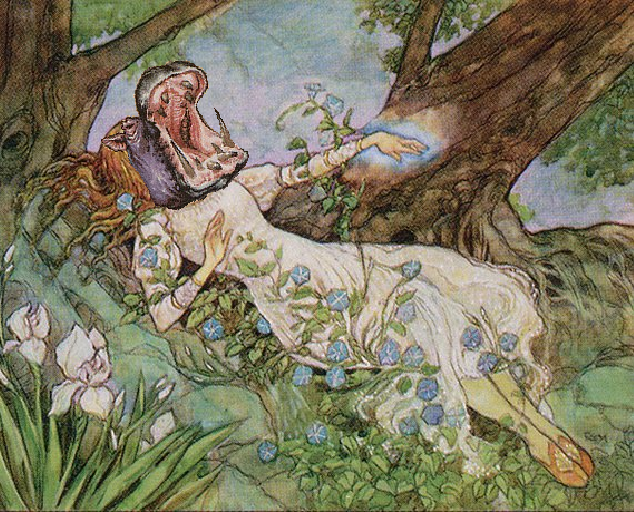
    The art is classic Rebecca Guay woman doing something in nature. This time, she’s laying on some tree trunks with blue flowers coiling around her. Her left hand is held up with her palm facing forward commanding a halt, while her left hand is surrounded by a pale blue glow. Her position, and the surrounding vegetation, is reminiscent of the painting of John Everett Millais painting of Ophelia. I wonder what that’s about?

    Seedtime is unique in being an instant, but it can only be played during your turn. This is a bit odd since the effect is not immediate, you’ll get the extra turn anyways, but it allows the player to cast the spell in response to a blue instant, say an impulse or opt, at the end of turn, allowing you to go through your extra turn with your opponent down on resources. The name doesn’t quite match the card’s name and sewing seeds as a metaphor. It feels a bit dissonant for planting the seeds for further success to be done at instant speed, or as a reactive action. But the card conjures a feeling of waiting, of discerning timing of when to “deploy” Seedtime. This feels more like an ambush, a trap, playing more like a blue spell that it seeks to hose. The green mage is waiting for the blue mage to respond, who is waiting for the green player to do something worth countering or responding to. Now imagine how much wasted time there is when the blue mage suspects the green mage of holding a Seedtime.

    At the bottom of the card we reach perhaps the most befuddling flavor text ever created in Magic: the Gathering, a linguistic labyrinth, a semiotic snarl, a perfect mystery. Something that twists the mind into knots and exerts the vocal chords into forcing out a deflating “huh?”

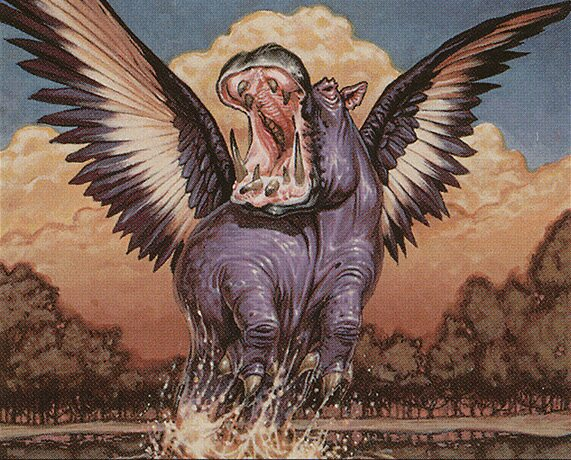
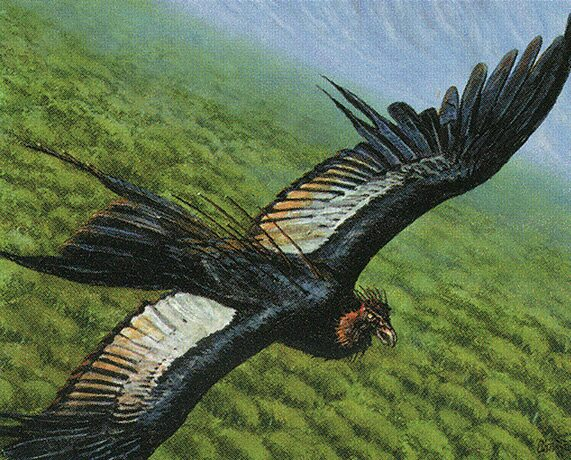
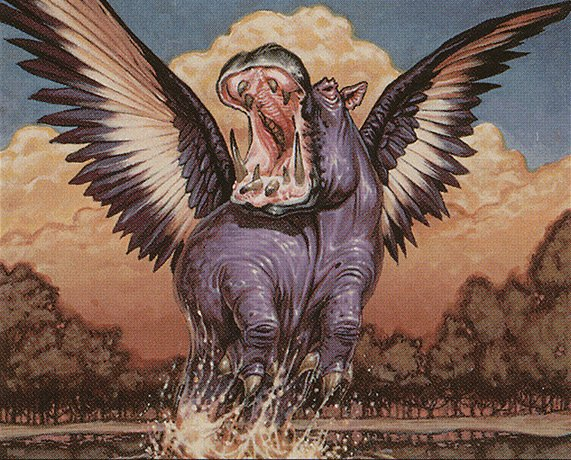
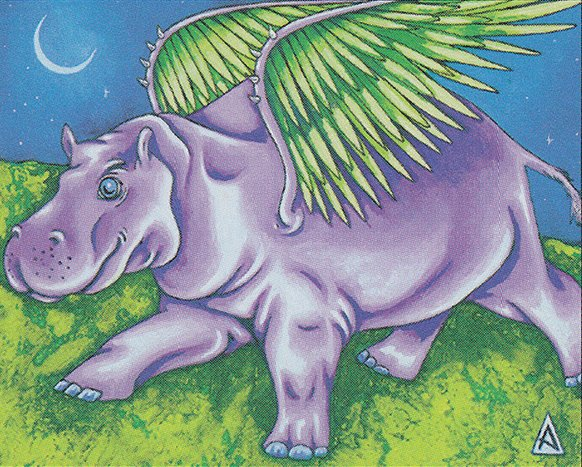
    “The hippo grows wings to fight the condor.”

    I’m familiar with aphorisms, I’m not supid.1 I’ve heard“The road up and the road down is one and the same.” and “whereof one cannot speak, thereof one must be silent.” And I still have no clue what Seedtime’s flavor text is supposed to convey. It’s so baffling that I feel like I’ve been struck by the torpedo-fish. There has to be some meaning behind it. We’re nearly 400 words in, it can’t mean nothing!

    I would be fine, perfectly fine, if it wasn’t for the flavor text’s subject. After all, what looks like a hippo with wings?

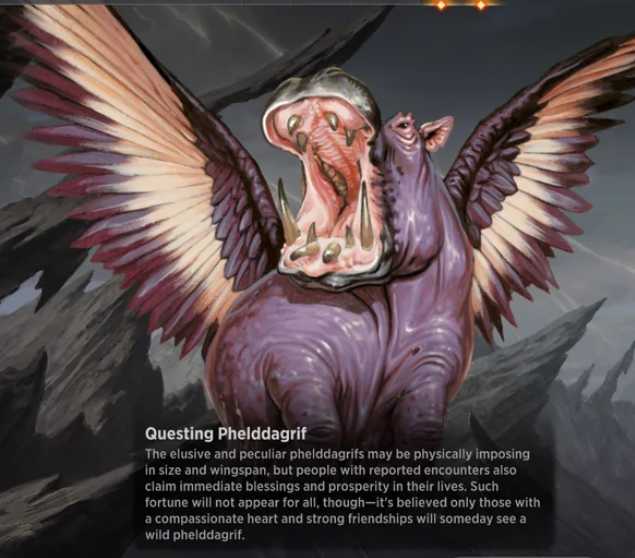
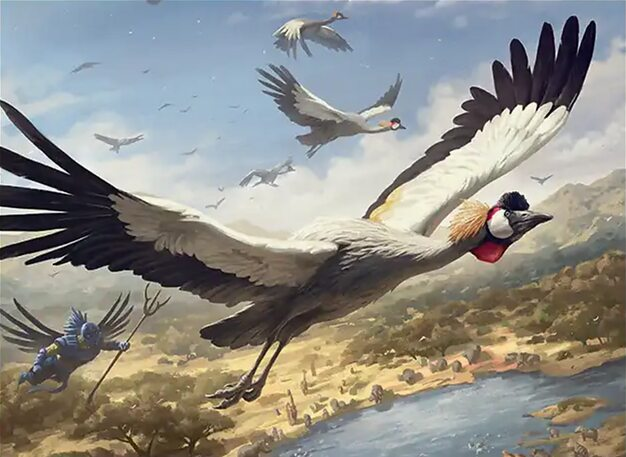
    Questing Phelddagrif by Matt Cavotta

    This one bit of flavor text might be the only in world lore of Phelddagrif, the only time it is obliquely mentioned on a card and taken as a known quantity in the fantasy world of Dominia.2 But can we be sure that this is about Phelddagrif? How could we know, when the flavor text is so opaque and it’s hard to tell what it’s about at all!

    Normally, this type of flavor text isn’t very difficult to understand. The attribution of flavor text to a cultural teaching, a saying, some bit of plane-specific philosophy has been a long standing feature of the game. The one that springs to my mind is the 5th edition Llanowar Elves from 1997. 

    This specific example gives the reader an idea of the judicial system of Llanowar, but this bit of penal code helps flesh out the player’s idea of Llanowar. The flavor text evokes the Code of Hammurabi with unflinching violence and a focus on proportion. It also illustrates how Llanowar values the non-anthropomorphic natural world to the point that trespassing isn’t a violation of the person, but a violation of the will of the natural world. Pretty good for just twelve words.

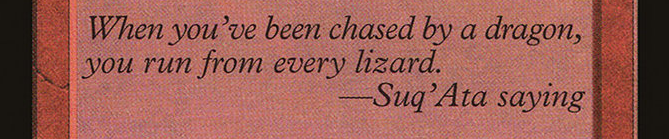
    Aphorism as flavor text is older than Llanowar elves, and there’s even more specific examples closer to the structure of Seedtime’s Aphorism. Mirage’s Pyric Salamander in 1996 offers insight to trauma responses and how that fear can hold a grasp on us. It also points out how scary and big dragons are.

    And in Lion’s Eye Diamond:

    Lion’s Eye Diamond recognizes that the saying might be difficult to parse without context, offering an translation of the aphorism to the reader.3

    But that was just looking at “sayings”. There’s more than one way to say “saying”. Take “proverb” for example:

    Draconian Sylex, printed in 1994, and rightfully part of the reserved list, offers a look into the Icatian way of life. This one, not appealing to fantastic and expensive things like dragons and Lion’s Eye Diamonds, needs less explanation. The Icatians believe that there is no gain without sacrifice, a moral spin on the second law of thermodynamics, and a klein-bottle twist on the body-building mantra “no pain, no gain.” 

    There’s a lot of flavor text like this in the game. Plenty of proverbs, sayings, adages, poems, expressions, dwarvish forge-chants, troll chants (which are traditional?), riddles, and aphorisms, but what about teachings? A teaching is different from the rest of that cherry-picked list in that previous sentence. “Teachings” may point to a larger body of knowledge, not just one-off specific lessons like one of Aesop’s fables. Are there enough lessons to try and “recreate” this body of knowledge, knowing that the lesson from Seedtime falls in there somewhere?

    We can always try, we’ve wasted so much time already. There are 22 cards which are attributed as a teaching from culture or ideology in Magic. 9 of those come from the Nantuko. They have the largest share of flavor text focused on teachings by a wide margin, with “Teachings of Eight-and-a-Half-Tails” having the second most at three.

    Wow, those Nantuko are some studious bug nerds. Who are they?

    Who are the Nantuko?

    Nantuko Cultivator by Darrell Riche

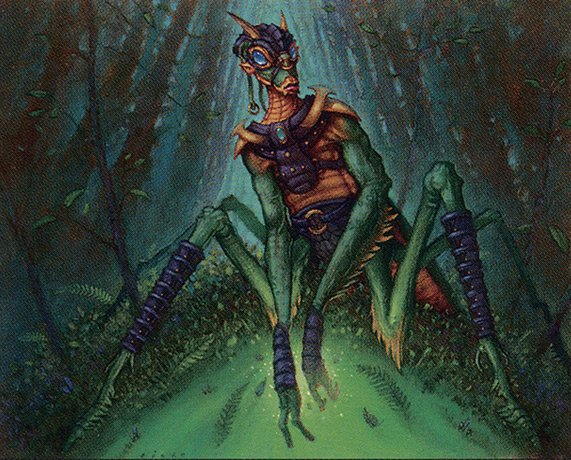
    Not to be confused with the more recently re-introduced mantis looking Eumidians from Edge of Eternities: The nantuko are, according to the Odyssey Style Guide: “a race of wise, mantis-like creatures…Spiritually close to nature.”  The earliest nantuko may be from The Brothers’ War as part of the Thelonite Order, but that’s not confirmed anywhere other than art for that one card. Besides, if it was ever true, it may have already been retconned. 

    The Nantuko of the Krosan Forest are thought of as contemplative by the other species of Otaria, or at least imagined as thinkers compared to goblins, who do not have a lot of teachings. The Nantuko respect for nature is juxtaposed by their disdain towards artifice, as well as magic using black mana. They also have an interesting relationship with death, sometimes turning into shades, indicating some transgression (maybe) has taken place by that individual. Although that’s not always the case, sometimes the Nantuko end up being weird stoically-smiling ghosts

    Phantom Nantuko proposes a problem with Nantuko clothing. It’s hard to tell how many clothes are appropriate for Nantuko, as the ghost is naked, but the Broodhatch Nantuko is  geared up in leather, an odd choice for a “nature lover”. I wonder if the Nantuko raise cattle? There seems to be a large continuum on how much clothing a Nantuko wears…

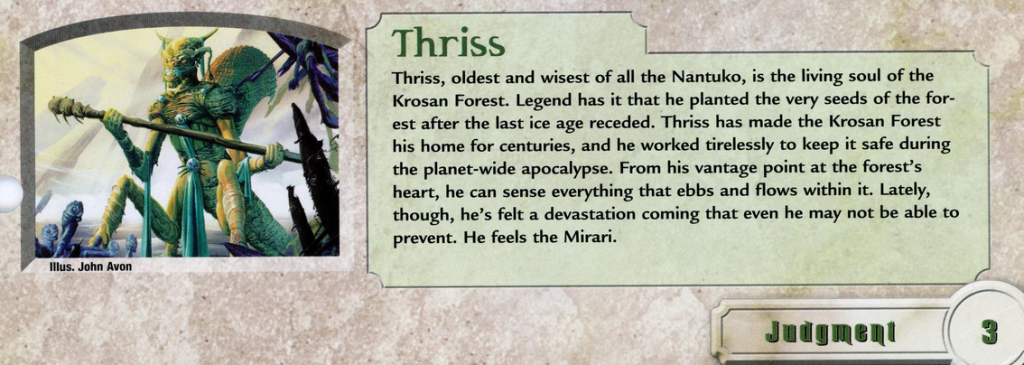
    There is a single legendary Nantuko: Thriss. He is the oldest of the Nantuko and, according to the Judgment Player’s Guide, has been around since shortly after the Ice Age, where he planted the seeds that became the Krosan Forest. 

    All that stuff about the “planet-wide apocalypse” and the devastation the Mirari is going to cause is fine, but what’s really interesting is the bit about the last ice age. There was another creature that made their debut shortly after Ice Age:

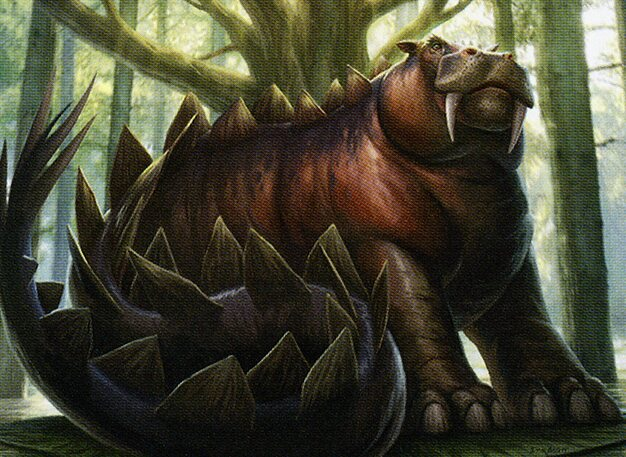
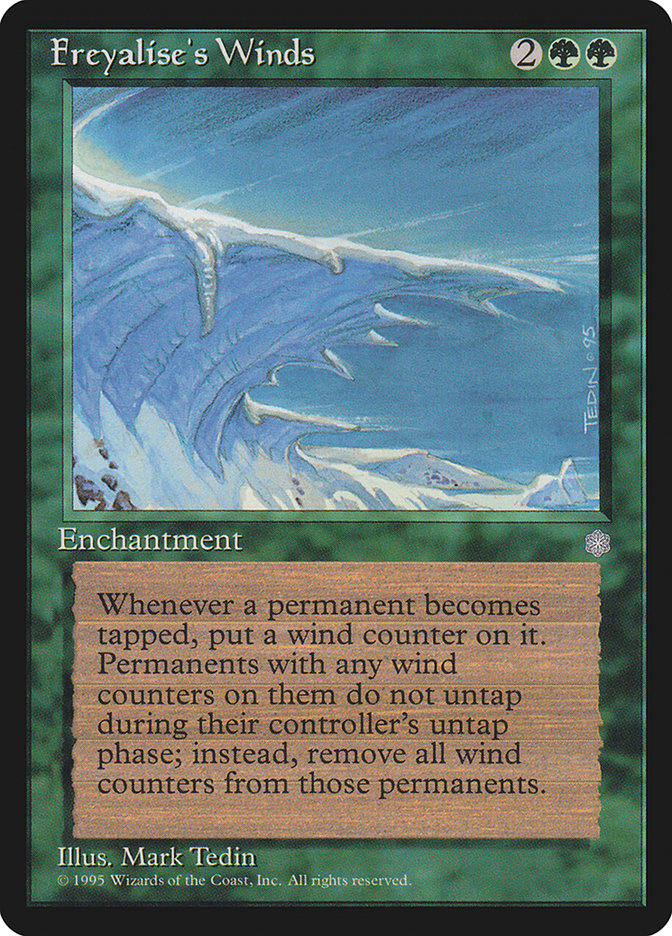
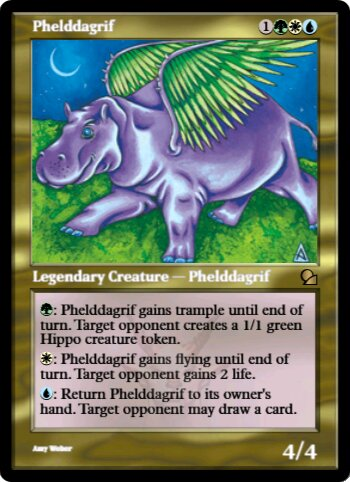
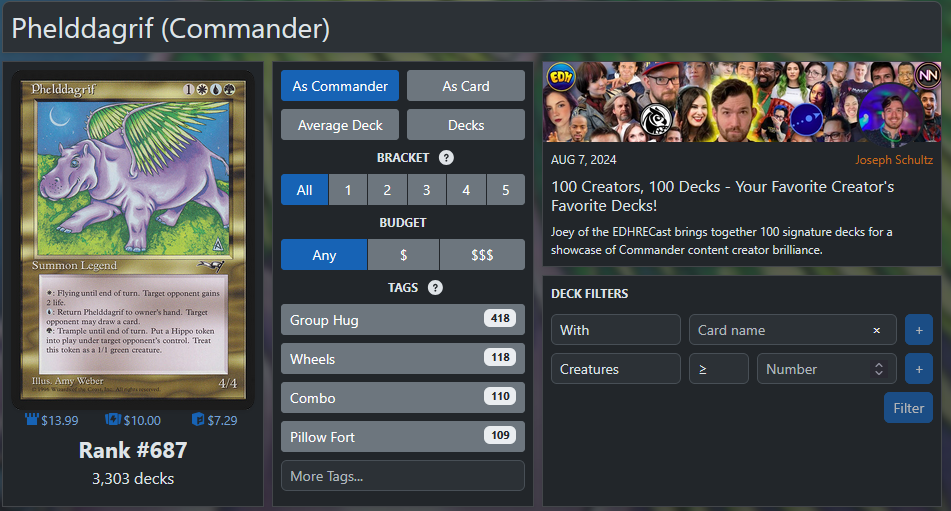
    Phelddagrif by Amy Weber

    I don’t know what else Thriss did other than teach Kamahl to be a druid instead of a barbarian. Thriss was probably mutated by the Mirari and then died when the Krosan Forest was destroyed. 

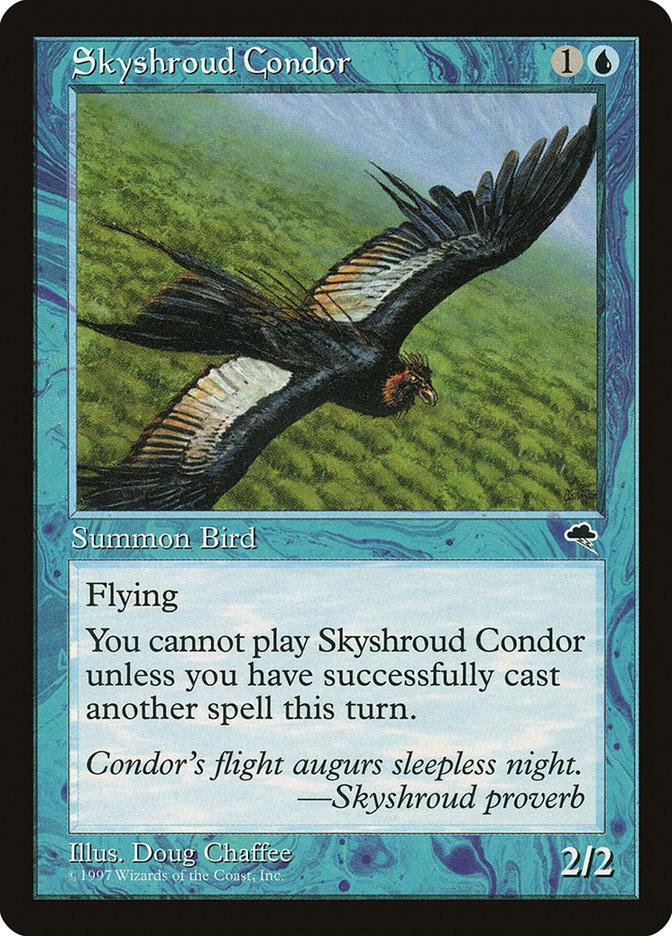
    Perhaps Thriss and Phelddagrif had met at some point? Could the Nantuko teaching from Seedtime be a historical fact, and Phelddagrif fought a condor and Thriss saw it and thought “I should tell people about this in the future.” Although this is a bit specious: who is the condor? Why isn’t it an eagle, a griffon, another Phelddagrif? There are hardly any condors in Magic, the only condor around by the time Seedtime was printed was Skyshroud condor.

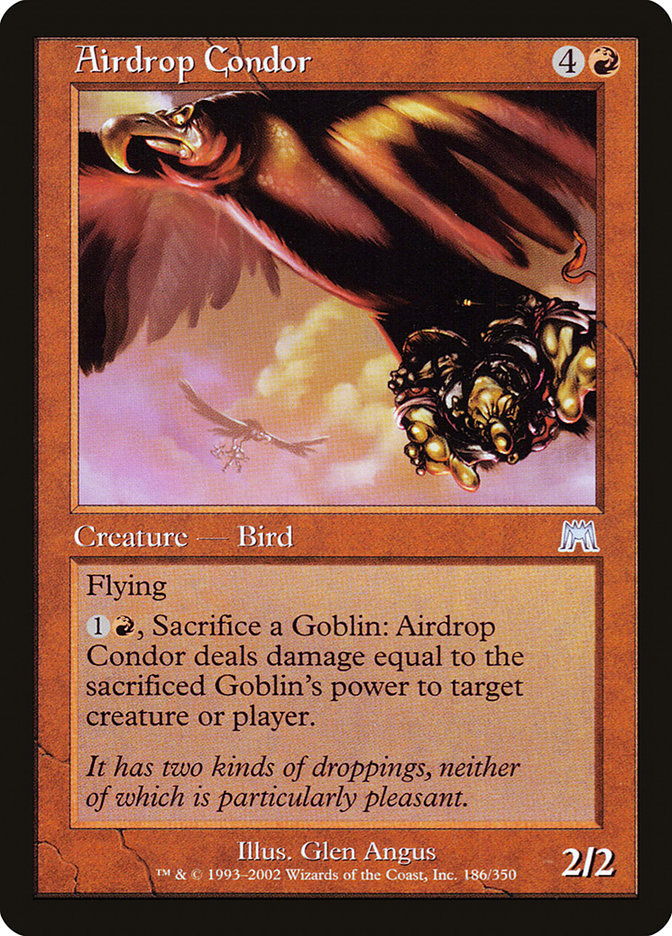
    Which is on a different plane entirely! Airdrop Condor would be printed a couple months after:

    Did the hippo grow wings to…save goblins?

    After Legions, Wizards stopped making Nantuko cards for 20 years, until Springheart Nantuko was printed in Modern Horizons 3, implying that they also may have originated from Kamigawa, slipping into Dominaria from the portal the Myojin of Night’s Reach opened to Madara.4

    I’m not sure if understanding Nantuko culture helped with any interpretation of Seedtime other than taking it literally as Thriss seeing a flying hippo and a condor fight and telling other Nantuko about it. Although it may give some understanding for looking at the other teachings, and, through reading those together we might assemble a gestalt of Nantuko philosophy to guide an interpretation of Seedtime’s flavor text. 

    The Nantuko Teachings

    A Note on Order

    Approaching a collection of “teachings” brings a difficulty: what order to you read them in? Whether it’s the fragments of Heraclitus or the Tao Te Ching, the editor has to consider how to present these teachings and how to “stitch” these together.

    Luckily, I get to side-step this conversation thanks to the ontological neutrality of collector numbers. So, no agenda here. Besides, we’re hoping to get a general idea of Nantuko ideology to help interpret a specific teaching, so the order may not matter much anyways.

    Odyssey

    Nantuko Disciple5

    Nantuko Elder6

    Nantuko Mentor7

    Refresh8

    Simplify9

    Torment

    Dwell on the Past10

    Judgment

    Nantuko Tracer11

    Seedtime

    Still nothing to say about this one. Starting to think the most likely theory is that this was a story Thriss told young nantuko to scare them.

    Onslaught

    Nantuko Husk12


    Can any conclusions be drawn from this? What might we say, after this deep dive into all the remaining Nantuko Teachings, Nantuko Philosophy is?

    We know that the Nantuko believe in a soul, although it’s indeterminate whether it is immortal or not. They also believe that the spirit is separate from life and death. The tension between life and death as opposites is near the center of Nantuko philosophy. But at the core, Nantuko teachings seem very interested in identity and the self, as well as notions of personal responsibility: One should not necessarily seek solace in prayers because they could go unanswered, it’s better to do what needs to be done yourself. There’s a focus that the self should be industrious, and self-reliant, not relying on “wishes” or “prayers”, that there’s a risk in being “rooted” in something larger than oneself. And that the power of the self can be so strong it can literally ward off death.

    Oh my god.

    The Nantuko were libertarians, weren’t they?

    The Interview

    No…no…This is hard hitting investigative journalism attempting to solve the mystery of seedtime, not fanfiction. I will not brook unsubstantiated claims! I needed confirmation, something official. Obviously, it’s best to hear from the horse’s mouth. Who better than consulting the person who wrote the flavor text about what they were thinking when they wrote it? 

    Obviously, dear reader, there was some difficulty in tracking this person down. The flavor text was written over 20 years ago. I have a hard time remembering what I wrote yesterday, so it might be unlikely that anyone could remember what they intended by writing it.13 Even more difficult, flavor text was written in house at Wizards during that time, and no one may know who was responsible for writing which flavor text. Some said that it was impossible, I’d never find Seedtime’s flavor text author and, even if I did, they would never talk to me. Others said it was too difficult, which, since I shrink at any resistance within the first zeptosecond, meant it was also impossible. 

    And those people were right. Good on them! I couldn’t find anyone who would talk to me about Seedtime’s flavor text.

    The trail stopped cold here. I can look at these texts all I want, mix and match them, collage them and put them in a summoning circle surrounded by Contracts from Below until the Holy Cows come home, but I’ll never really understand what the flavor text of Seedtime is about, what it’s trying to get at. It’s semantic nonsense, a bedfellow of the Walrus and the Carpenter. If only one could reveal the numinous meaning at the core of things by cutting them open and looking inside, literally getting to the core of the issue.

    If only it was that easy!

    Might as well give it a shot.

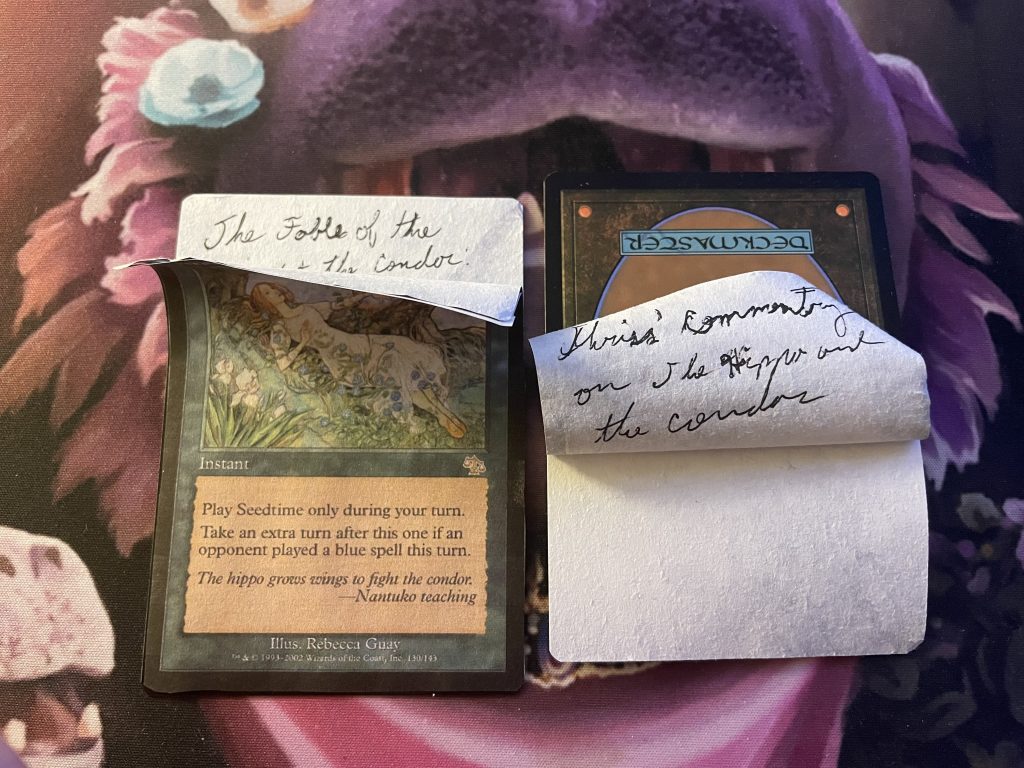
    Totally real cards that were torn open

    hmm…Well…Here’s what the cards say inside them:

    The Fable of the Hippo and the Condor: A Nantuko Teaching

    After the Ice Age, the ground thawed and the world teetered as its denizens relearned what warmth was. The world swung between harvest and desperate famines, and contagion spread across the world.

    In this new world the condor believed it was their duty to bring order. The condor, holding court from its perch, claimed to see all from above, and would clean up the disease and carcass littered world. There were those who rebuked the condor’s magnanimity, claiming the condor was a tyrant imposing their will. But the condor had a rebuttal for each appeal.

    “You swim in greed and are blind for it,” said the condor. “Such fecundity will be rot without end. Their blood will drench the ground and crush your crops, leaving nothing for the dirt to grow. The bones of the dead will fill the sky and blot the sun.” Which many found hard to argue against.

    One day, while the condor flew seeking carrion, it received a request from a merchant.

    “The road ahead has been blocked by a stone between this city and the next,” said the merchant. “With your swift wings, you would be able to carry the stone off the road, clearing the road and helping us continue to rebuild.”

    “I am impartial,” the condor told the merchant. “And not used to taking requests. I take and clean as the world needs to return to a world that knows how to live with warmth, and to survive it without succumbing to fiery conflagration. I’m not a gravel huckster. Why not deal with this yourself?”

    The merchant explained that they had tried, but none were able to move the stone. It was being guarded by the hippo, who was too strong for the merchant, the farmers, and the knights combined. “I cannot sell my wares, and the farmers are unable to bring their crops to the city. Without the road, the city cannot dispatch knights to deal with the bandits in the country. Without the road, the world cannot move on.”

    The condor, seeking to return to a world that once was, warmth and all that yadda yadda, took up the request while making it clear to the merchant that it was not exchanging services but working towards a common goal. 

    The condor flew down the road and saw the hippo, standing resolutely over the stone. Seeing the determined expression in the hippos eyes, a furrowed brow and determined grin, the condor tried to reason with the hippo first. Perhaps conflict could be avoided.

     “You must move on. The merchants, farmers, and kingdom need this road.” Said the condor.

    The Hippo, a proud and noble beast who was not unfair, questioned why they must hinder themselves for those weaker than it, why must it relinquish what it had earned fairly, gesturing to the giant rock, by the sweat of its brow and the strength of its thighs, shoulders, loins and mind? Why must it cede what is theirs?

    “The world cannot heal if you stay here,” explained the condor. “Eventually, all cedes to time, and, while unfair and unknowable, it is how the world is. We have no teachings on how to avoid death by igniting our soul or something like that.”

    “It wasn’t meant to be this way.” Said the hippo.

    “This is the only way for it to be.” Said the condor. Reason and understanding were not working, and the condor, reluctant, resorted to force, swooping down and soaring into the sky with the hippo’s stone.

    The hippo continued to argue, and, when that didn’t work, begged the condor for more time.

    The condor would only say “It will only bring you pain.” as it continued to fly away.

    As the hippo felt their stone-like-burden (which is literally a stone) lifted from them, they also felt themselves grow lighter, but not any less determined. And so, seeking to take back what was lost, the hippo grew wings to fight the condor.

    Thriss’ Final Commentary on The Fable of the Condor and The Hippo:

    Bored, bored, bored! How bored I am of all these commentaries, of writing, of wetting my nib and scrawling on these dried leaves. I have left so many commentaries, on the condor being death, the hippo grief, on the violence of the state through taxation, heaps upon heaps of attacks on The Cabal, the nature of death, the motion of the heavens, how to crystallize a peach and milk a baloth…and there is no end! Words still come and I continue to write.

    The monastery continues to publish these, handing out the leaflets of Thriss’ latest commentary, later, after a long process of review and a longer process of cultural adoption for it to become a new “teaching”…I can’t blame the monastery. I planted the seeds and named this forest “Krosa”, after all. This is what it is to be the Primus.

    So I continue to write, and the forest continues to grow, roots penetrating further into the Earth while words continue their march across the page. How does one know when this stops, if not all at once and abruptly? It would be like dimming a candle; there is light until there is none. In the face of such instantaneity, what else can we do other than continue? Death, as natural as life, can only be defeated through the absurd belief that our projects keep going after we are gone, that others take up the nibs and continue our linguistic lineage. There is no guarantee, though, perhaps my descendants will scratch out my words and replace them with their own. History is rewritten, words acting like portals opening to other worlds and invading our home. Who is to say how it has ever been, or ever will be. 

    How absurd. How absurd. 

    How absurd. And yet, I continue. This is believing the hippo grows wings to fight the condor, to do otherwise is to lay down in defeat. 


    My first encounter with Phelddagrif was not with the original Alliances printing, but with Questing Phelddagrifs. I started collecting them, and, eventually someone keyed me in that my growing collection had a predecessor in Phelddagrif. It blew my mind that two different cards could appear to show the same thing while also being wildly different. One is clearly purple, the other thick grey skin; purple wings with spikes, the wings of a condor; one roaring in triumphant glory, the other with a peaceful enigmatic gaze. These Magic cards could show change across time, a story of a character at two different points in a story? The gears in my head started to turn, there might be more to this game than meets the eye…

    But is there? So many decks, so much product around this flying purple creature-that-looks-like-a-hippo. It’s so much time spent writing and reading and rewriting about this thing. And I’m nowhere closer to understanding Seedtime’s flavor text, or if its connected to Phelddagrif at all!

    Surely, this time must have meant something.


    Seedtime is a bizarre color hoser from older Magic. The card asks the player to consider time, or timing, at least. The card is an instant, and can be played at any time, but only during your turn. It’s responsive, you only get something if your opponent cast a blue spell. Otherwise, nothing happens. The card makes the player consider time and timing. You have to predict not only what your opponents have in their hand, whether they want to play a spell on your turn or not, but what is in your opponent’s deck, or what opponents you’ll face at an event when playing the spell. You could run into red decks all day, and then you devoted slots to a card that does literally nothing. It might never happen, you might never get to take that extra turn. And then you spent your time doing nothing for no good reason.

    Leave a Reply

    Your email address will not be published. Required fields are marked *

    1. I am not too proud to avoid an obvious and cheap joke. ↩︎
    2. This is not a typo. I meant to type it that way, to establish some Vorthos cred. ↩︎
    3. Although I think we could have gotten there, understanding that lions are generally dangerous and to have one looking at you might mean you’re in a tough situation. The reader understands that, because this is a saying, unless Zhalfirin has a major voyeuristic lion problem, this is meant to be taken metaphorically. Still, this clarification is nice, and it would have been nicer to have one on Seedtime. ↩︎
    4. Which doesn’t exactly contradict the Thelonite Order thing, but the Thelonite Order turning into Nantuko was never confirmed anyways. ↩︎
    5. This teaching places an emphasis on silence. A simple reading of this teaching would lead us to believe that the silence is the response of negation for our prayer. But the teaching isn’t emphasizing silence, but negation. The “un”answer is the answer to the prayer, the negation of something contains a germ of the positive description. It’s reminiscent of the apophatic way, or an argument via negativa,of the medieval theologian Pseudo-Dionysus. The response, which is given (even if unanswered), is so holy, so transcendent that it gets interpreted as silence.  ↩︎
    6. “Shit in one hand and wish in another and see which fills up first.” is the first thing that comes to mind reading this, although the Nantuko are a little less vulgar. The farming analogy is interesting, and a bit difficult to parse if the Nantuko view agriculture favorably or not. Viewed negatively, perhaps it is a teaching about the insidiousness of wishing, the addictive quality of counterfactuals that leads to regret and resentment: a metaphysical If You Give a Mouse a Cookie. Viewed in a more positive light, perhaps it is a teaching about cultivating a positive view of the universe and attracting the good you want in the world.  
      A weird flavor text to include in the block that contained the original wishes. As written, both Cunning Wish and Burning Wish, could actually get copies of themselves. This, combined with Mirari, could lead to loops of wishing for a card and using the Mirari copy to get the original wish. ↩︎
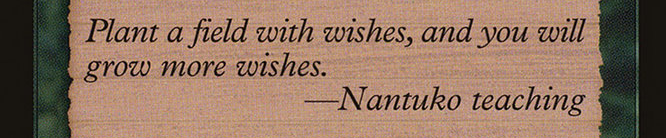
    7. So far, the Nantuko philosophy is leaning towards statements bordering on tautology. Of course a field of wishes would grow wishes. A field of carrots doesn’t grow cabbages. It’s unfair to think of these bits of flavor text emulating koans that way though.
      I suppose a reading of this could be about avoiding “rootedeness”, an attempt to persuade one to not be attached to the physical world, to those things that are changing, to not “root” yourself down, or to grow, to add to oneself, without being fixated on one thing. A plea to draw water from many wells.
      Once again, another weird flavor text considering that the white faction in Odyssey block were Nomads. The Order were also deeply spiritual, so perhaps there is some cultural cross-pollination of ideas occurring here, although the flavor text of Beloved Chaplain points to Nomad and Nantuko standing opposite of each other in some sense. ↩︎
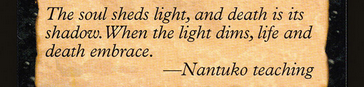
    8. Getting a bit into metaphysics here, that our death is inscribed in our beginnings, a recognition of mortality as being the other half of mortality. The “inner fire” suggests that death can be warded off through intensity of ego, and that death is a force that effaces the personal. A couple things that are odd here (anticipating future teachings) is that death is characterized as neutral if not harmless. Before Kamigawa’s Kabuto Moth, moths were not a very threatening force in Magic. A dancing moth doesn’t exactly seem like a powerful adversary that one must defeat. More like a chore to take care of in order to live a healthy life. Repair the screen door to keep the moths out, warn them off with fire, put the poison in your clothes so moths don’t eat them, continue to live in order to avoid death.
      The image of fire is odd here because Nantuko aren’t often seen or associated with fire. That would be the barbarians and dwarves. But I guess fire is universal enough that I shouldn’t be splitting hairs here. ↩︎
    9. Perhaps a look into  Nantuko Aesthetic theory, that there are periods of “beauty” (when the blossom’s petals open) as well as periods without (during seasons with frost). This could indicate a natural aesthetic cycle, that there are seasons with and without beauty and they are dependent on the conditions of the environment, perhaps not just the natural world but the structures and “seasons” of one’s life as well.
      It’s hard to tell if there is some psychology here too, because one could read the blossom closing as a reaction to “frost”, one’s psyche closing one off as a defense mechanism. The frost could also be the I, that one should not  have a frosty demeanor (or “a mind of winter” as some horrible poet would put it) otherwise they will close the blossoms around them. ↩︎
    10. Another tautology, along the lines of “It’s always in the last place you look.” Perhaps a warning against fruitless searching, and an affirmation of Nantuko Philosophy of identity and semiotics. This brushes against Russel’s Barber paradox, trying to cleanly cut the gordian knot of that thorny philosophical dilemma.
      Perhaps this points towards a bit of Nantuko Theology/Atheism, suggesting that there isn’t an omnipotent metaphysical force so great that it can break the rules of logic while remaining consistent. “None”, meaning “no thing”, can do this. If the Nantuko were asked “Could God make a boulder so heavy he could not lift it?” The Nantuko would say “No”, and perhaps also say that there isn’t a God (at least in that sense). ↩︎
    11. Charitably, there’s an interpretation towards Aristotelian metaphysics here, that our past creates our meaning in the world. This could be taken as a teleological argument, the acorn has the potential of an oak tree, but it isn’t as fixed as that. A map can show one where they will go, but a map isn’t a set of rules forcing one onto that path. There may be inertia of my personal history causing me to write about Phelddagrif, but perhaps tomorrow I’ll start carving the path towards an obsession with Brushwaggs instead. ↩︎
    12. This feels like it’s retreading the teaching from Refresh, although it’s painting it in a less adversarial light and showing life and death as a sort of two-halves-of-the-same-coin, and that the moment of death is not a victory over life, but an embrace between the two creating a sense of balance.
      Perhaps, myself already primed here, this is similar to notions of death in the Tao Te Ching, that one does not simply “die” or “pass on”, but matter returning or changing shape, and the only thing that is lost is that form of matter, but the identity of the person (the soul) continues on in some fashion. ↩︎
    13. Although the flavor text is so iconic that is hard to imagine, but keeping an open mind is a virtue I’m trying to cultivate this year and not any longer. ↩︎

  • Emergency Blog Post Double Feature: Phelddagrif Will and Won’t Appear in Secrets of Strixhaven!

    Emergency Blog Post Double Feature: Phelddagrif Will and Won’t Appear in Secrets of Strixhaven!

    “This web of time – the strands of which approach one another, bifurcate, intersect or ignore each other through the centuries – embraces every possibility. We do not exist in most of them. In some you exist and not I, while in others I do, and you do not.”

    ― Jorge Luis Borges, The Garden of Forking Paths

    Phelddagrif Will Appear in Secrets of Strixhaven!

    On April 24, 2026, the third Magic set of the year, Secrets of Strixhaven, will be released. The set is a return to the plane of Arcavios, a mashup of two planes colliding with each other creating tangles of opposing mana called snarls. The plane is ruled by 5 elder dragons who draw power from enemy mana color pairs. The elder dragons have been on the plane since their inception, along with the archaics, sage-wizards who time-travel to the beginning of the plane after finding wisdom. The first six thousand years of the plane’s history is known as the “blood age”, an epoch marred by violence and war. The natural conclusion of this plane is to make it American college themed through cards like Mascot Exhibition, Pop Quiz, and Study Break.

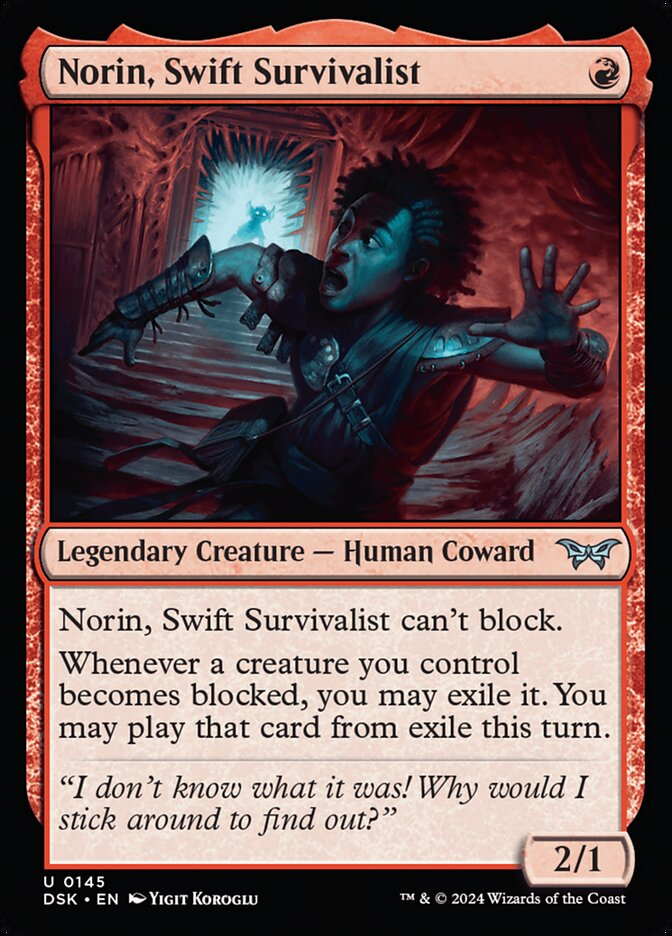
    So far, 929 cards have been printed in 2026. And, much like 2025, none of these have Phelddagrif in them.1 Much like Lorwyn Eclipsed, Secrets of Strixhaven is not set on Dominaria or Bablovia, the only planes where we’ve seen Phelddagrif. And, despite the Omenpaths promising cross-planar travel, Wizards has shown little appetite to show off non-legendary creatures off their home plane. And, while Phelddagrif is legendary, most legendaries that we have seen have been more recent, with Norin, a character originally from flavor text in Alpha printed two years ago in Duskmourn, being the exception.

    You know you’re clutching at straws when this guy shows up

    Despite the academic setting and theme, the enemy color types and lack of three color ‘shards’, the time travel shenanigans, and this, that, and the other things stacked against Phelddagrif appearing in Secrets of Strixhaven, Phelddagrif will appear in the this set.

    “Quesitoning P., hasn’t this joke gone on long enough? It was fine last year, but I’m afraid that you’re sinking into a mania, an obsession that was once cute but now is destructive. I’m seeing some thematic resonances between the current story of Jace and his obsessive pursuits and your own.” You may be saying, reader who is so generous and empathetic and caught up on Magic story. Well, that may be true, although I haven’t melted into a puddle of Meditation Realm goo.2 Besides, this time we have a most choice way of Phelddagrif making their way back on the scene.

    The How

    We have already seen that Wizards is reprising the bonus sheet for Secrets of Strixhaven. The Mystical Archives represents spells a student could find in the Biblioplex.3 It’s an amazing piece of worldbuilding meeting ludonarrative. The actual cards act as instructions on casting these spells; you’ll need these components and it will have this effect. Sometimes it’ll come with some historical commentary on the spell, and it also includes an illustration to help depict what the spell should look like. If your lightning bolt comes out green, you may have cast the spell wrong.

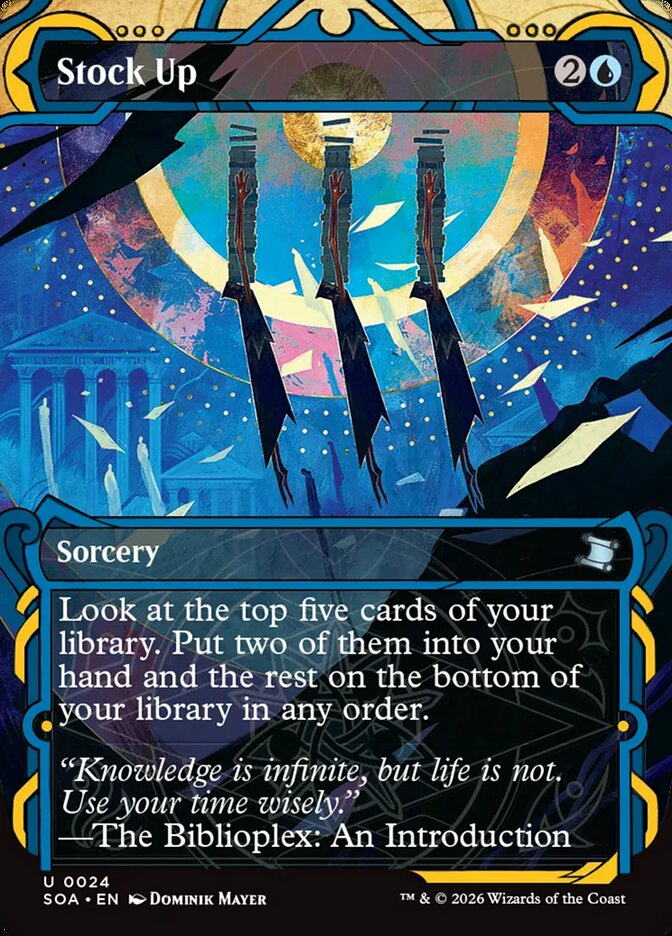
    “Stock up” is a funny name for a spell, but spells having names is pretty funny to begin with

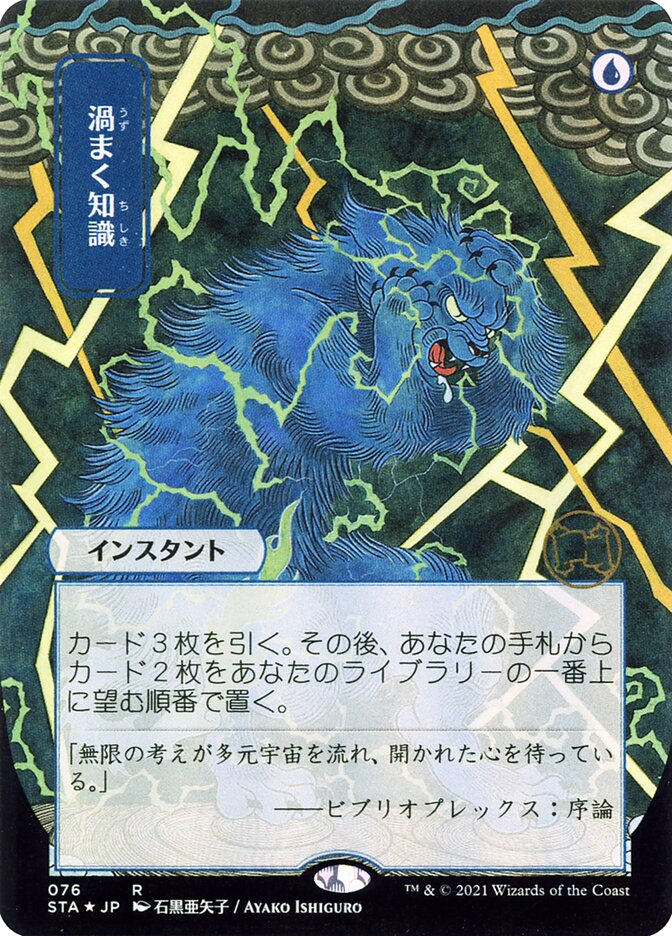
    The first Mystical Archives included different art and versions in Japanese language boosters, giving credence to how these cards are pages from a spell book. One lightning bolt is depicted in a different way because there were different artist portraying them. They aren’t photographs meant to capture the exact reality, but representations to give the spellcaster an idea of what it should look like. (I suspect that there is an argument with “spell names” and the rules text of these cards, being slight variations in what is written and lost in translation, where one might be able to read these as giving descriptions at having to cast the spell but not giving it a “true name”, just the name the person who is writing the spell book came up with. But I would have to either learn Japanese or sit down with a translator and talk about that to make this argument, which is kind of lost in a silly little blog post about something we all know isn’t really going to happen.)

    The game has a fantasy setting because Cats can’t brainstorm in our reality

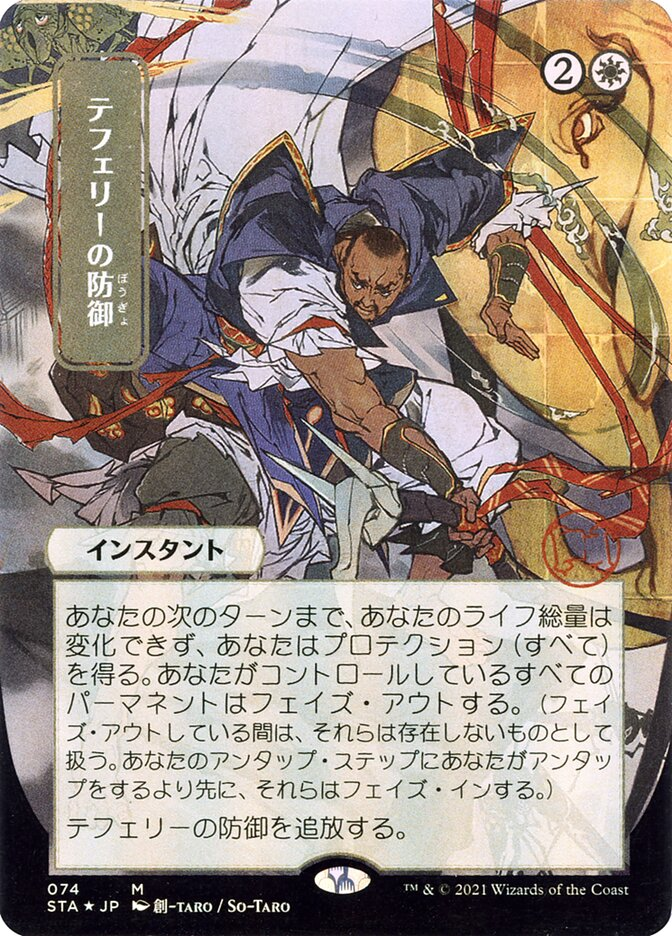
    While the Mystical Archives represents spells that can be cast, they aren’t limited to the generic ones like Lightning Bolt, Duress, and Brainstorm. (the last two of which are hard to imagine as spells, unless your BOSS! is casting them! oh ho ho ho!) A few of them are tied to specific characters, such as Urza’s Rage, Inquisition of Kozilek and Teferi’s Protection, or specific moments or locations in Magic story like Crux of Fate, Approach of the Second Sun and Blue Sun’s Zenith. It seems that, beyond being an instant or sorcery, there are little limitations on what can show up in the Mystical Archives. The cards don’t beat around the bush on this, Teferi appears on Teferi’s Protection, Tezzeret on Tezzeret’s Gambit, and Nicol Bolas on a couple of them.

    Pictured: Teferi on Teferi’s Protection (by So-Taro)

    Given Phelddagrif’s great historical significance not just to Magic history, but the Magic narrative, that Phelddagrif will appear on one of the spells in the Mystical Archive.

    The Wrinkle on the Hinge

    There is, as there always is, a wrinkle to this plan. The theming of the Mystical Archives is around casting spells and lends itself to spellcasters. While it’s kind of strange that this is Strixhaven’s “thing” and not, just, every plane in a game literally called “Magic”: the Gathering, them are the rules. And many of the characters show on the Mystical Archives are spellcasters, humanoids firing magical bolts or beams of light or energy or whatever you want to call it. Phelddagrif, not being humanoid, has rarely, if ever, been seen casting spells. The card itself does not seem to lend itself to a “spellslinger” strategy.(much to my chagrin, but I’m still trying) 

    And yet…4

    What better opportunity does Wizards have for Phelddagrif’s return? For their triumphant return? It would be so…unexpected.

    I doubt that we’ll see a card where Phelddagrif is spellcasting, but they can be depicted in the art as the object or accident of the spell (along the lines of Divine Gambit or Natural Order. We’ve also seen non-spell-casters casting a spell on Mystical Archive cards with All is Dust; depicting Emrakul, who is not often depicted casting spells, “casting” the board wipe. Heck, we even got the frame on a creature in Dina, Soul Steeper  with the Multiversal Legends bonus sheet from March of the Machines. These examples are few and far between, but they help set precedent to be delightfully surprised by Wizards.

    Phelddagrif’s Spell on the Flyleaf

    With reason to believe we can apply our mental faculties, our noesis, our logos, the transcendental unity of apperception to figure out exactly which card Phelddagrif will appear on. We can also just look at the spells on EDHrec that show up in Phelddagrif decks. That seems a lot easier and not like a misuse of words I learned in college and forgot what they mean.

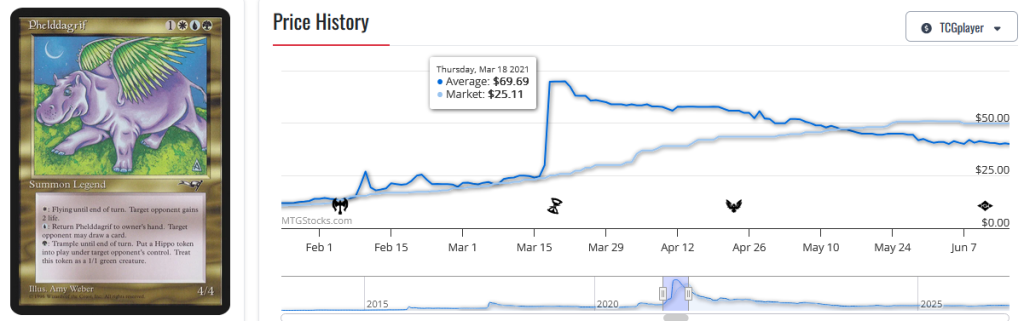
    Looking at this and all I can think is that I remember when Phelddagrif’s were below $10. Recession indicator?

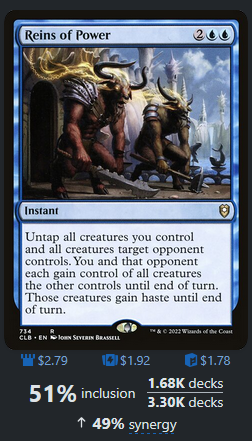
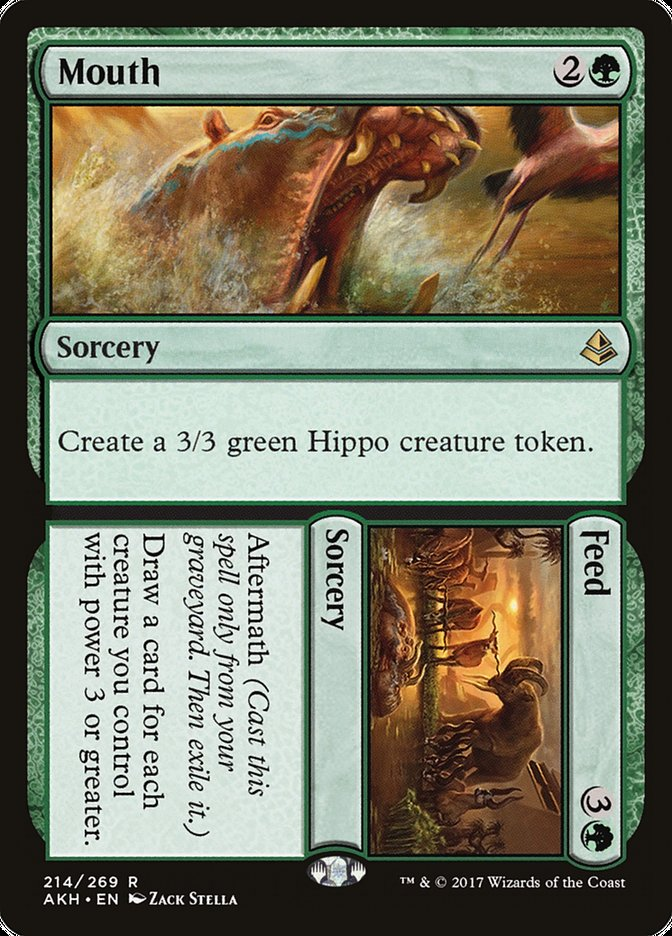
    We can knock off the most common cards that are played across decks: Cultivate, Path to Exile, Arcane Denial. These are not idiosyncratic enough to have Phelddagrif on it. The obvious answer would be, Mouth//Feed, although the aftermath border doesn’t seem like it would fit on the Mystical Archives frame. So, luckily we will avoid such an offensive representation of Phelddagrif. Besides, looking through the data (scrolling to “Top Cards”) the answer is clear: Reins of Power

    According to the EDHrec data, the commander with the second highest inclusion rate Firkraag, Cunning Instigator with 32% inclusion, and dropping off even further with Zedruu at 27% and Kros, Defense Contractor at 23%. Those are steep dropoffs from Phelddagriff’s 51% inclusion rate. It has fantastic synergy with the strategy of loading up one person with hippos and then taking everyone out with them. It can both be played casually in that way, or as a payoff for infinite hippo combos, casting the reins after giving someone however many hippos as you want.

    Sure, it might be a bit strange that Phelddagrif, the group hug commander, the peaceful-potamus, works so well with a card that is about overriding the will of others for violent ends. But it’s this dichotomy that adds rich texture to the complicated character that is Phelddagrif: a being of extremes and tension: both angel and beast, grace from divinity and savagery of nature. Is there a better card to depict Phelddagrif?

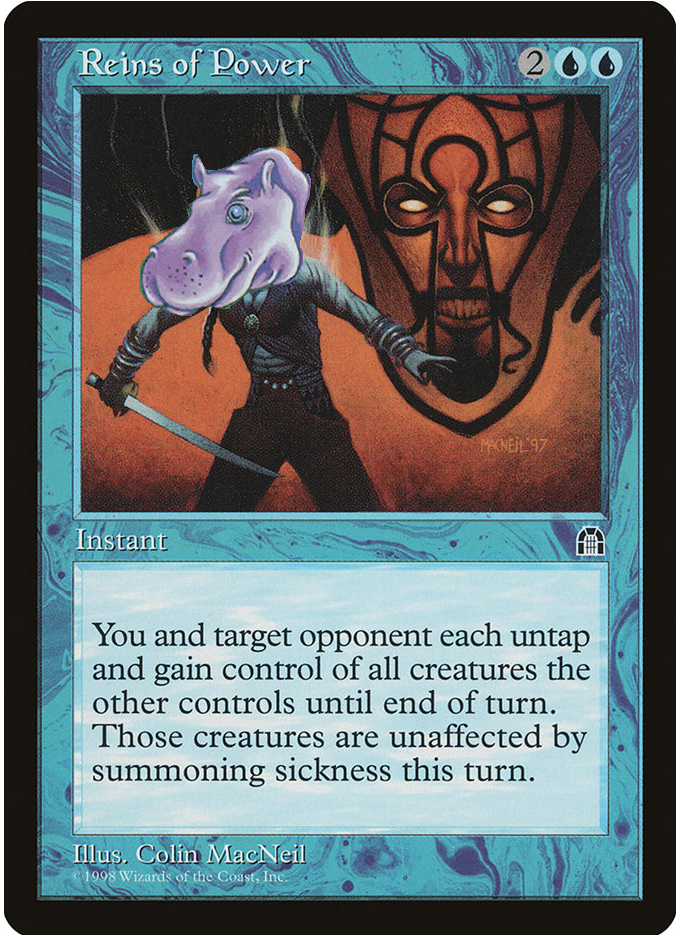
    It’d probably look like this but with the mystical Archives frame

    So that’s why it Phelddagrif will appear on the reprint of Seedtime in the Mystical Archives. Because…

    Well…I’m not really sure why it would show up on Seedtime, actually. But when I look at Seedtime I always think of Phelddagrif for some reason. It’s a green card, and it cares about blue spells, but it’s not fully Bant. Maybe it’s the flavor text? It mentions hippos with wings, but a Phelddagrif isn’t a hippo it’s a “Summon Phelddagrif”. So that doesn’t make much sense either.

    Well, you’ll just have to trust me not on my stunning logic but my sterling intuition then! Phelddagrif will appear on the Mystical Archives Bonus Sheet 2: T200 Bonus 4 U on the reprinted version of Seedtime!

    The Forking Path:  EMERGENCY BLOG POST: Phelddagrif DIDN’T appear in Secrets of Strixhaven! What Went Wrong!?

    April 24, 2026, the third Magic set of the year, Secrets of Strixhaven, is released. Phelddagrif did not appear. Why?

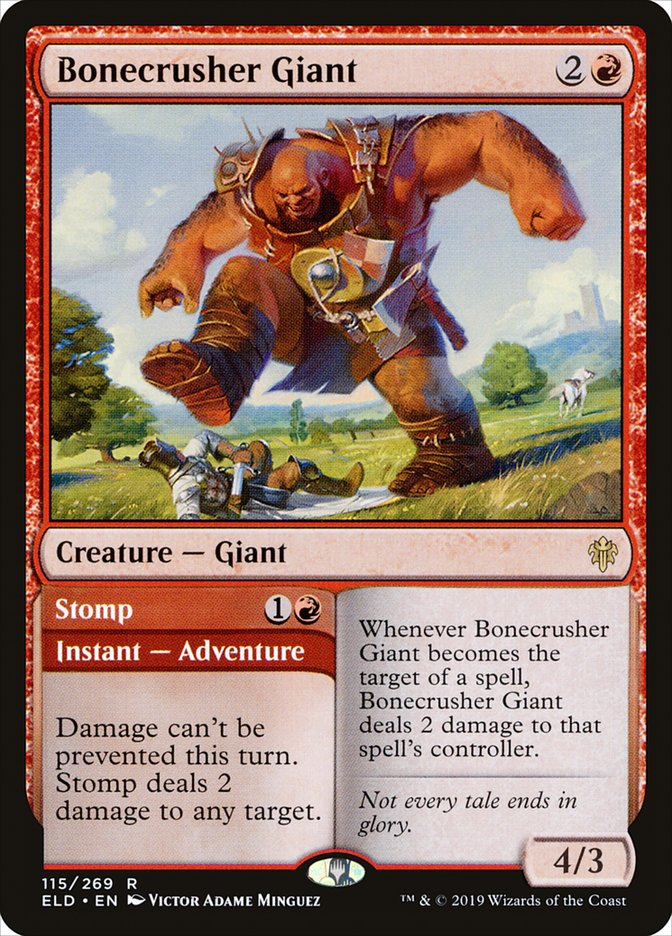
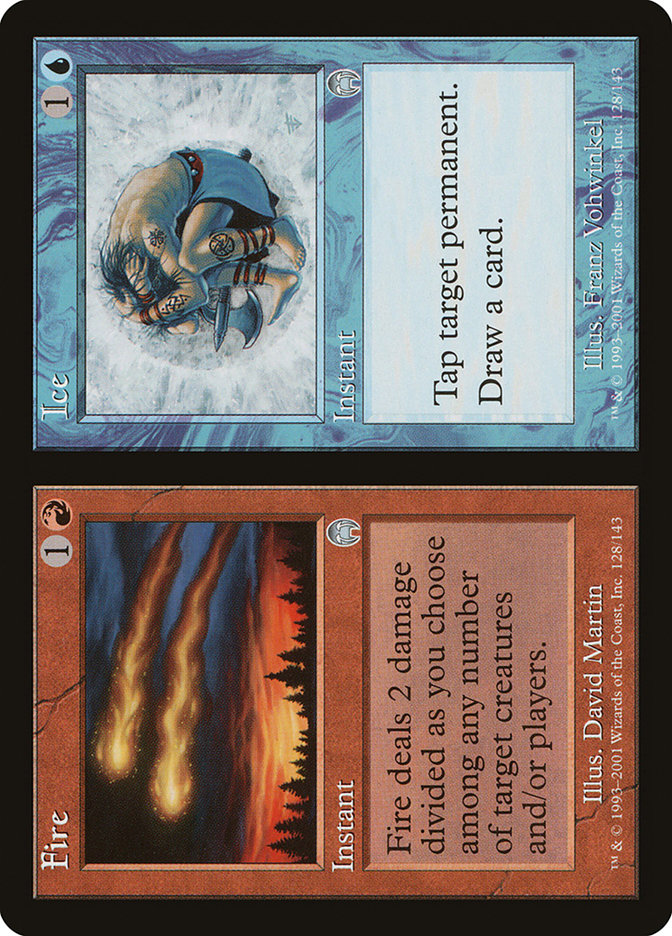
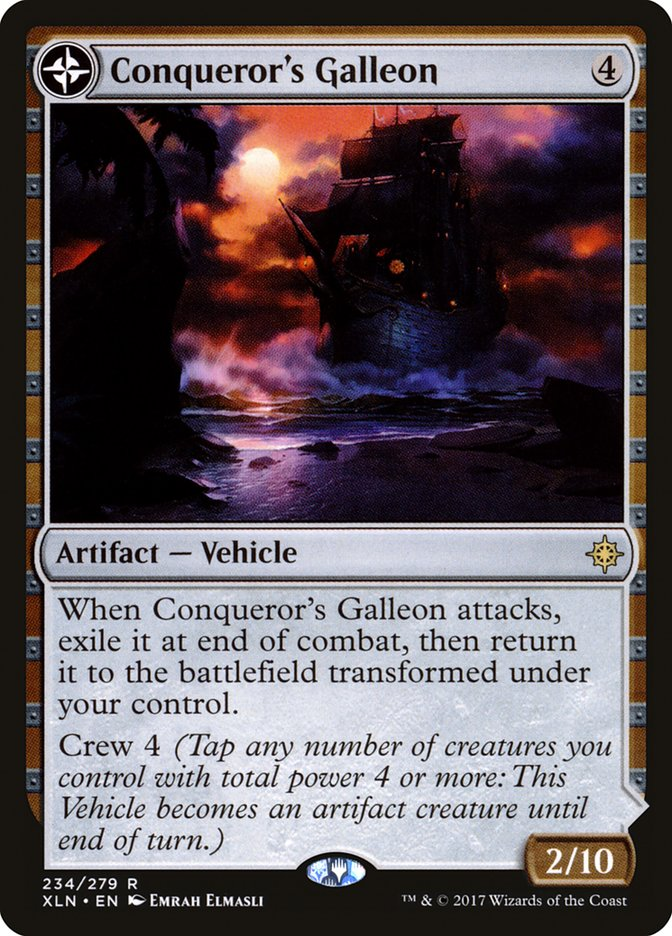
    Remember this card that was two cards?

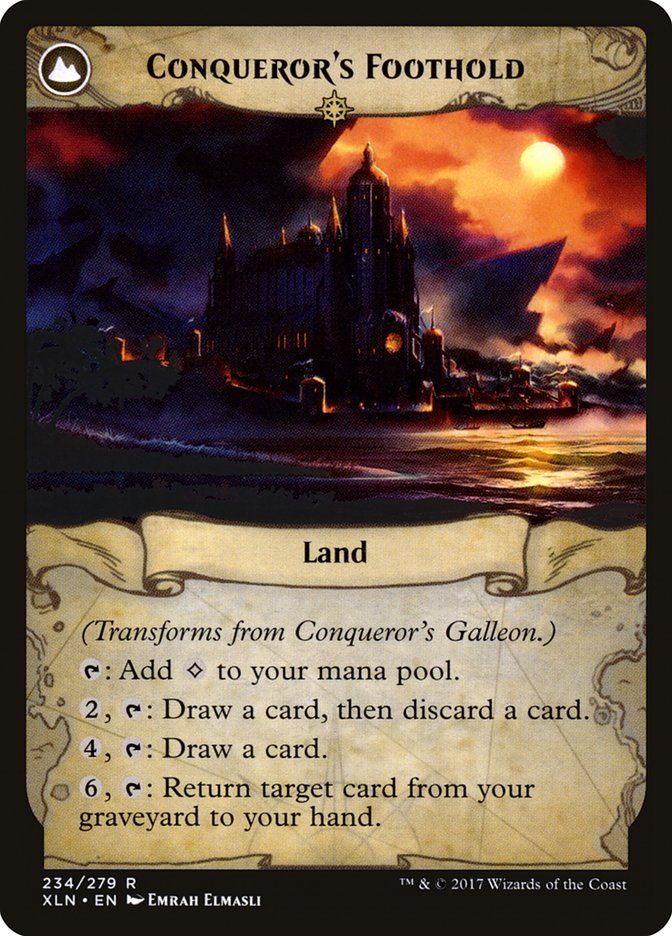
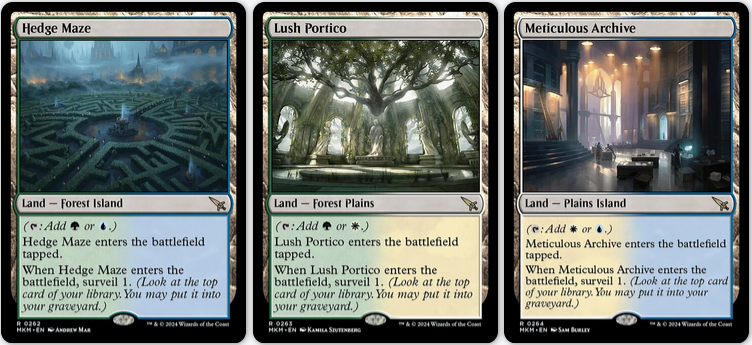
    And this card that was also two cards?

    One card being two cards isn’t anything new to the game, split cards being introduced in 2001.

    And I already complained in my previous article (above) about the most egregious slap in the face to Phelddagrif: 

    I suppose that at some point when they start designing two cards at once, they’re going to run out of designs and will have to start reusing some other cards. I didn’t realize that it would come at the same time that Wizards of the Coast decides that the Reserved List doesn’t mean anything.

    Which wasn’t (just) with the Judge Gift cards reprinting Reserved List cards in 2004.

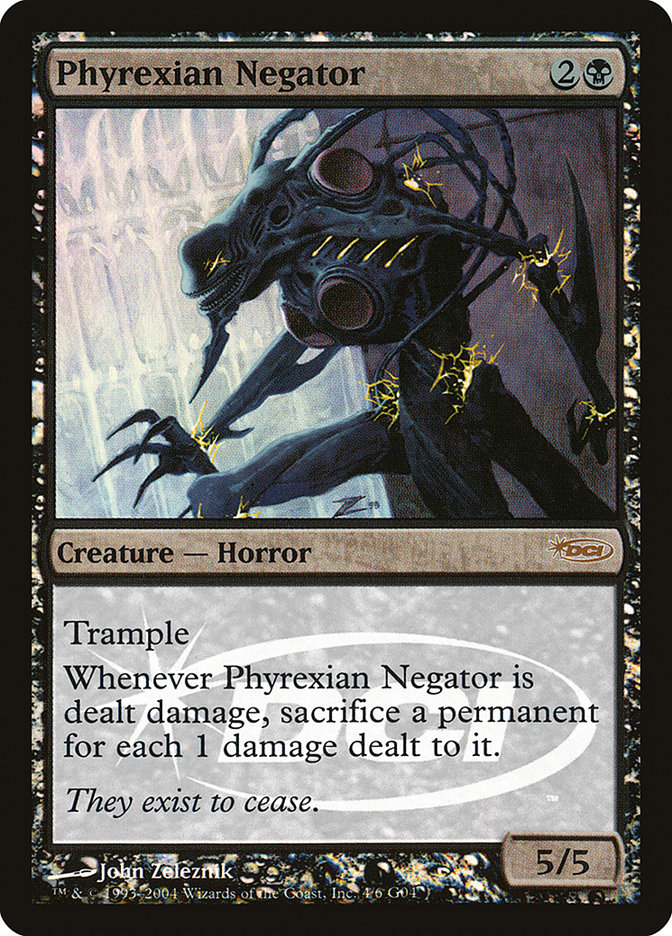
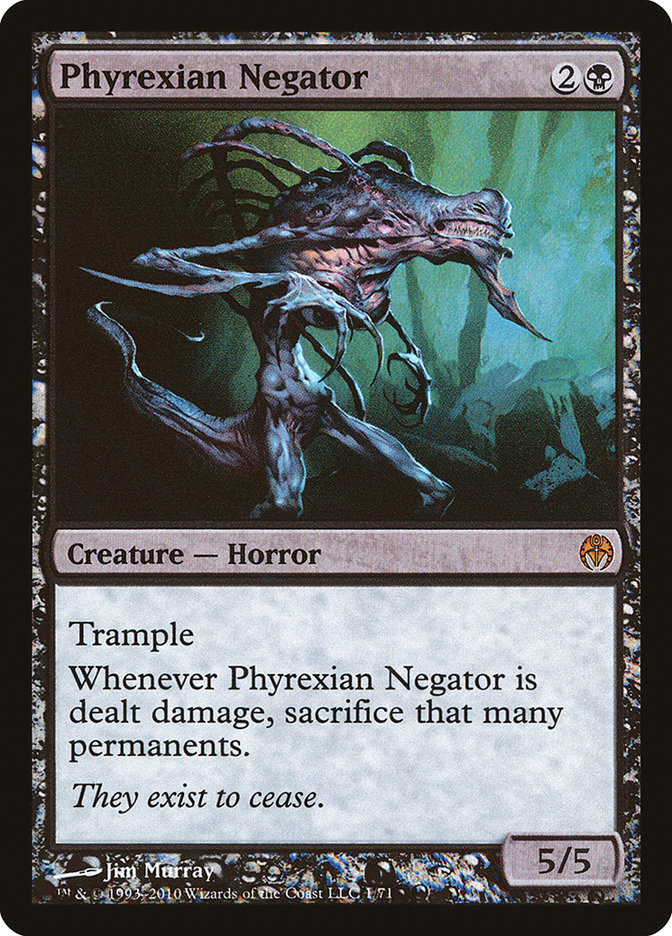
    Or with the Duel Decks reprinting Phyrexian Negator (again) in 2010.

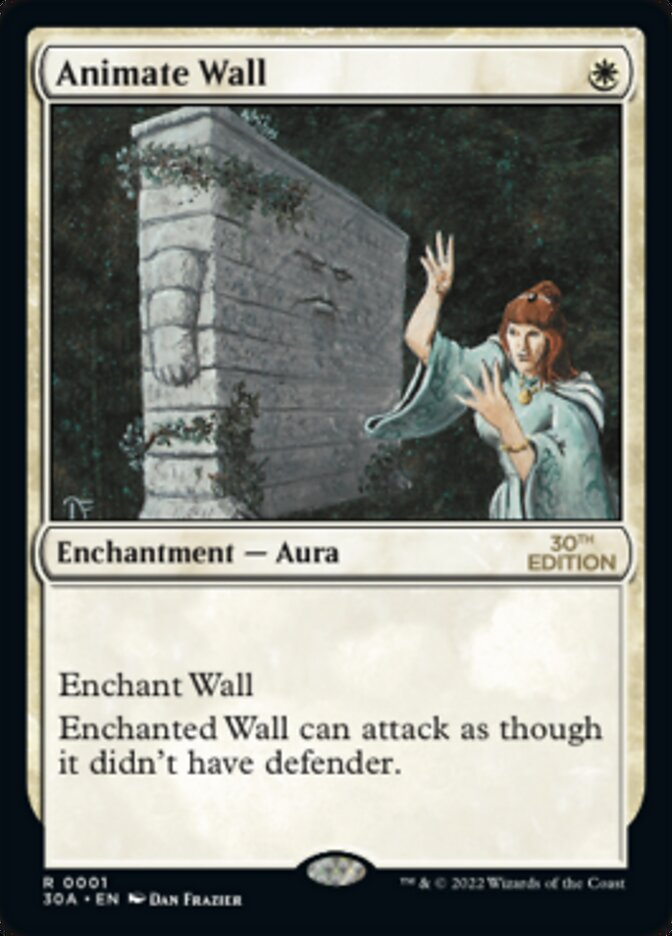
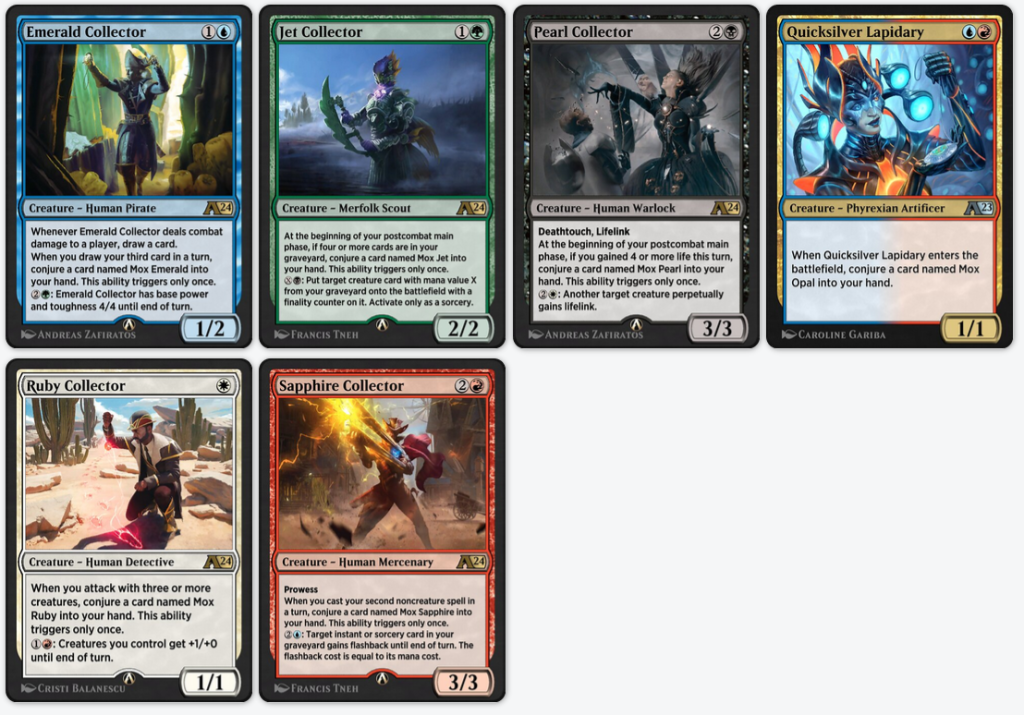
    Or with the release of Magic:30 in 2022. Or the countless cards on Arena that can “conjure” reserved list cards:

    All of these have contributed to eroding away that sacred promise that Wizards made to not print cards people want to play with and create a commodity that one can easily trade their crypto for that is easy to liquidate for a large amount of cash. Secrets of Strixhaven marks Wizards crossing the Rubicon, saying “Hells Bells!” to promissory estoppel and deciding to directly print legal reserved list cards with the Magic back. And it’s not things like Thunder Spirit or Wood Elemental.

    It’s:

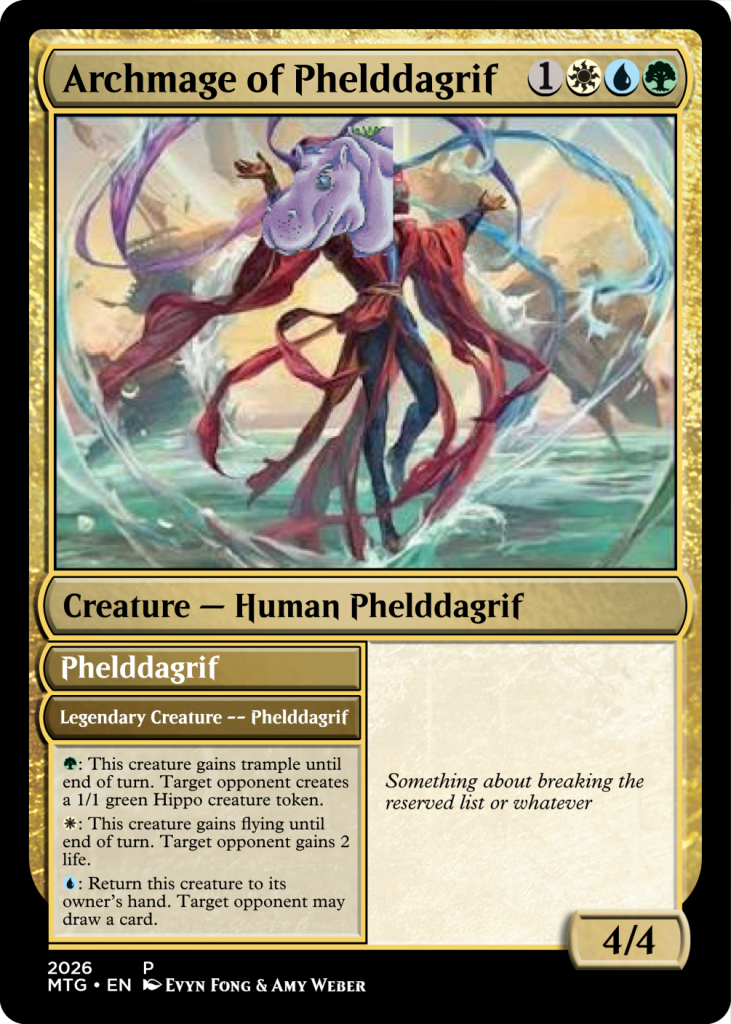
    The exact card you can get in Secrets of Strixhaven (some information redacted)

    Now, I have to stop being cute here because, while Wizards may not believe in the the legal promises they made for the reserved list anymore, they do believe in exercising extrajudicial punishment when it comes to minor leaks of upcoming products of their children’s card game. This is what it looks like when the people5 are silenced6. To be beyond 10,000% clear: I am scared for my life.

    But I am angry too. Why? For two reasons. The first being I have…quite a few Phelddagrifs, and I’m worried about my investment if they do decide to reprint Phelddagrif. But, more importantly, while Wizards exorcises the spirit of the reserved list harder than Father Damien Karras, they do all of this to reprint some crummy blue instant and not Phelddagrif!

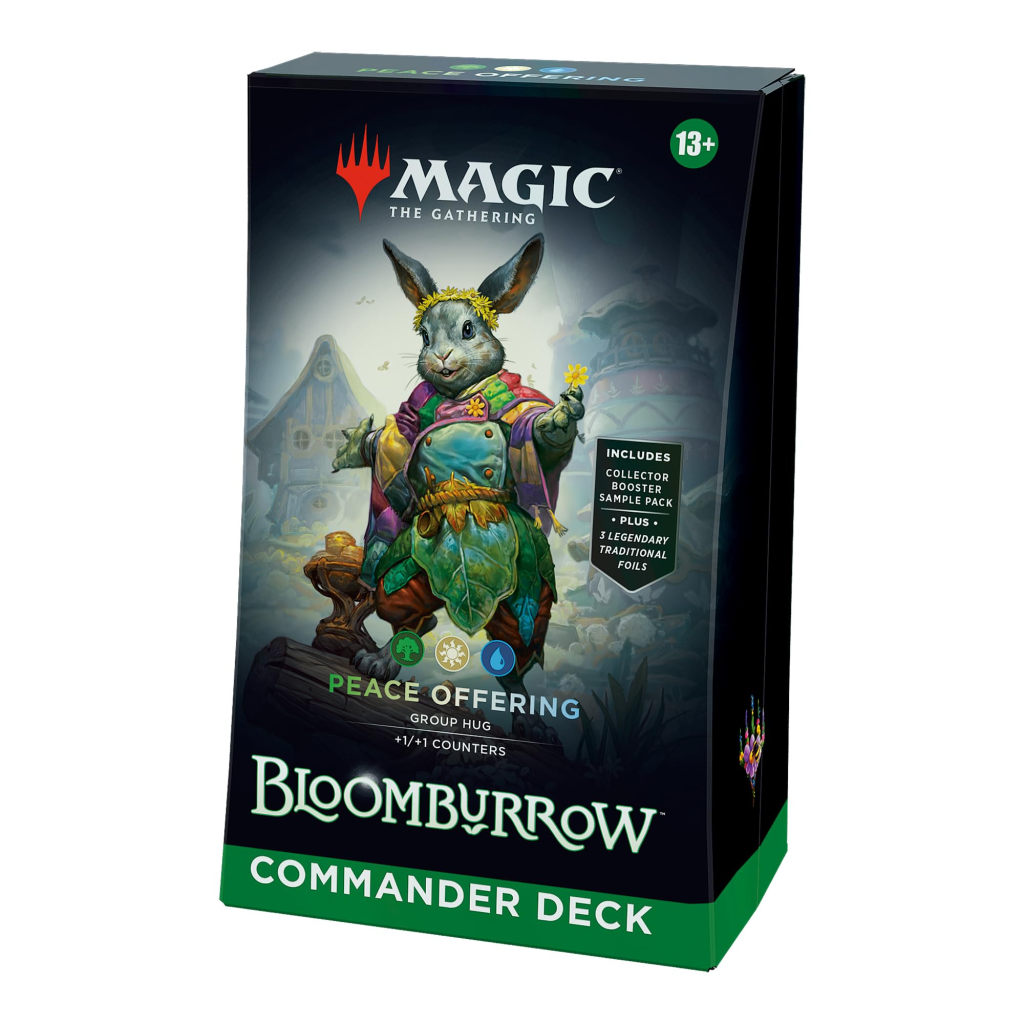
    We were so close! Why does Wizards miss, yet again! This is more disappointing than Phelddagrif not appearing in the Bant Commander precon titled “group hug” that was set on a magical animal plane.

    What could have been

    Well, I’m sure the main set is fun anyways. I don’t know, it’s not out yet and I don’t really do limited because each draft costs like, 2 Phelddagrifs.

    Conclusion

    Well, I hope you all enjoyed that sort of “What if?” Adventure into Phelddagrif appearing in Strixhaven. In the Magic story right now, it looks like we are moving towards a sort of Planar Chaos but bigger, with mono-white Liliana and a Silverquill Ral Zarek showing up. Secrets of Strixhaven will maybe feature some of this color mashup stuff, maybe not, but a few people are excited about this. This media-work was meant to be a sort of hypertext in conversation with the current Magic story, sort of like a jazz riff but the audience is trying to do it instead of the band. If you did enjoy this, good!

    Have a good night!7

    Leave a Reply

    Your email address will not be published. Required fields are marked *

    1. I know I said Phelddarif appeared in Lorwyn, but that was a bit facetious and I don’t think the Phelddagrif Community was satisfied with changelings representing Phelddagrif. Just check the Phelddagrif Subreddit to confirm this. ↩︎
    2. Yet ↩︎
    3. Maybe other places as well. I don’t know much about the lore of Arcavios and Strixhaven, it’s not really that interesting and it’s kind of strange. Well, I guess this footnote is as good of a place as any to get out my gripes about Strixhaven, which is that if feels like a Meyer’s Briggs test meets Academia. I’m not sure if I’m a fan of using education as an indicator of “personality type”, one very different from guilds. When identifying with a guild it’s an inward identification (Say, you’re into the natural world and mad scientist ethos so you’re Izzet or Simic. Or you think it’s cool to chain ghosts to debt so you identify with the Orzhov). Identifying with a school is outward facing (“I have an art degree so I’m Prismari, or I have an English degree so I’m Silverquill, or a Math degree therefore Quandrix). There’s a difference between thinking you’re “creative” so you identify with the Izzet, and having an art degree. it’s a marker determined by a whole host of factors, while perpetuating a myth that the field of one’s study is an indicator of what one is most drawn to (I suppose this is where we get into the ‘fantasy’ aspect of Strixhaven).
      Sure, this is all just marketing and kind of embarrassing. but this creeps me out a bit, it feels like identity becomes cemented in past decisions: did you get a degree in the humanities or did you get a degree in nursing? Prismari or Witherbloom?
      It reduces education to a faction, to personality type tropes and education changes from a discipline with the goal of the pursuit of knowledge to a new-age personality test for marketing. Part of me believes that getting an education is working towards answering the imperative at the entrance to the temple of Apollo at Delphi: “gnothi seauton”. Just because a piece of paper describes you a certain way, does not make that true. And it might be dangerous to believe that it does. ↩︎
    4. Isn’t there a reality where Phelddagrif was a spellslinger? Their name linked to the creator of a game literally called Magic it feels like the Purple Pachyderm should be casting spells! Why is that not how the game is now? Where is Phelddagrif casting iconic spells like Giant Growth, Healing Salve, and Ancestral Recall? Their connection outside of the game would seem like this should be a very different card, one that’s a bit more powerful, a bit more on par with the card honoring the game’s creator in Unhinged. What a mar on this timeline. Who will rectify this?  ↩︎
    5. A person with a Phelddagrif Blog ↩︎
    6. Can’t be bothered to find that leaked image ↩︎
    7. Hopefully you read this at night, otherwise I look like a total Doofus!
      I’m happy the footnotes are back. ↩︎

  • The Totally Complete and Exhaustive Guide to 1/1 Hippo Tokens

    The Totally Complete and Exhaustive Guide to 1/1 Hippo Tokens

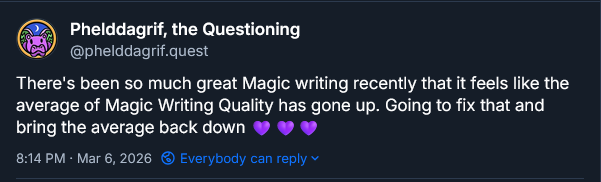
    On March 6, 2026, I skeeted out the following:

    I had thrown down the gauntlet, challenged the Magic community, and, engaged with social media to hold myself accountable to pushing out a real turd of a piece of writing. Yet, my think-pieces are seminal works in the Phelddagrif community, getting 100% of all possible upvotes when they’re posted in reddit.com/r/phelddagrif. I know the people will talk about what I write, because they love to think my thoughts with me. Paradoxically, I set myself up to fail by making this post, which made me a little bit angry.

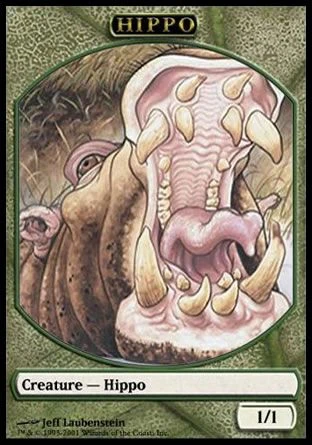
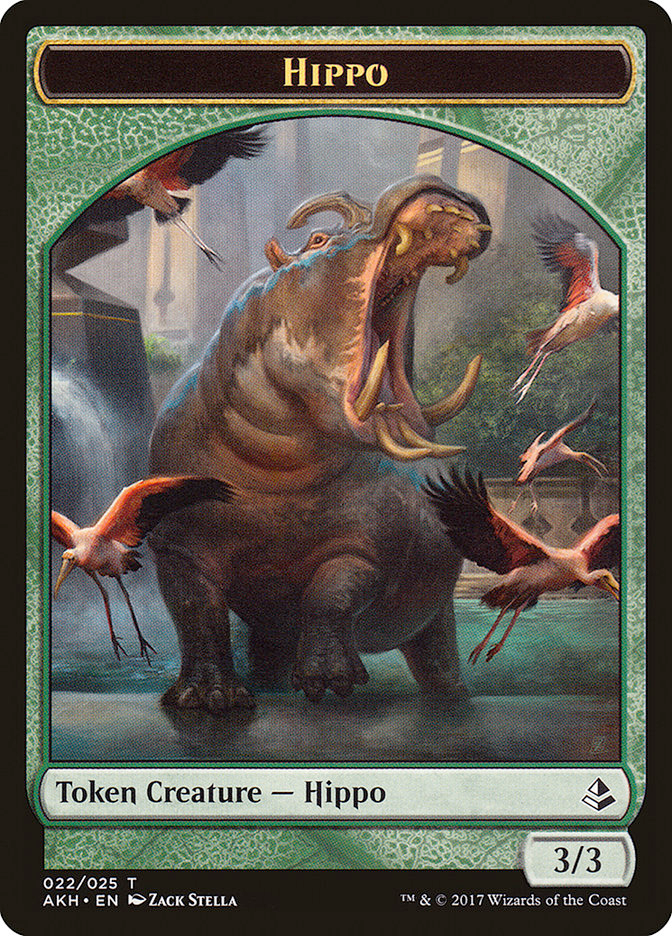
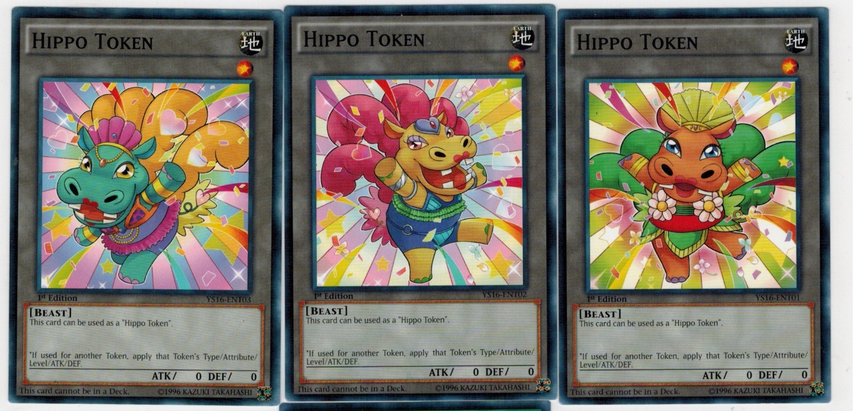
    Almost as angry as Wizards continued refusal to print an official 1/1 hippo token while this thing exists:

    The fucking bane of my existence

    Hypothetically, if you need a 1/1 hippo token while playing in the feature match area of something like, let’s say, the Magic: the Gathering Pro Tour, you won’t have anything to represent it with! They’ll probably kick you out!

    What is a humble Phelddagrif player to do? Go to etsy dot com and sort through a heap of AI Waifu tokens to find a suitable hippo token to play with? How horrible, how atrocious, how despondently despair inducing. Sifting through the unreal, those that were merely generated to find the illustrated; Who will sift through the tokens made with tools that induce psychosis to find the ones that were made with care and don’t poison the air. It would take a paragon of great moral character to act as a counterweight to the moral turpitude of tokens with AI art.

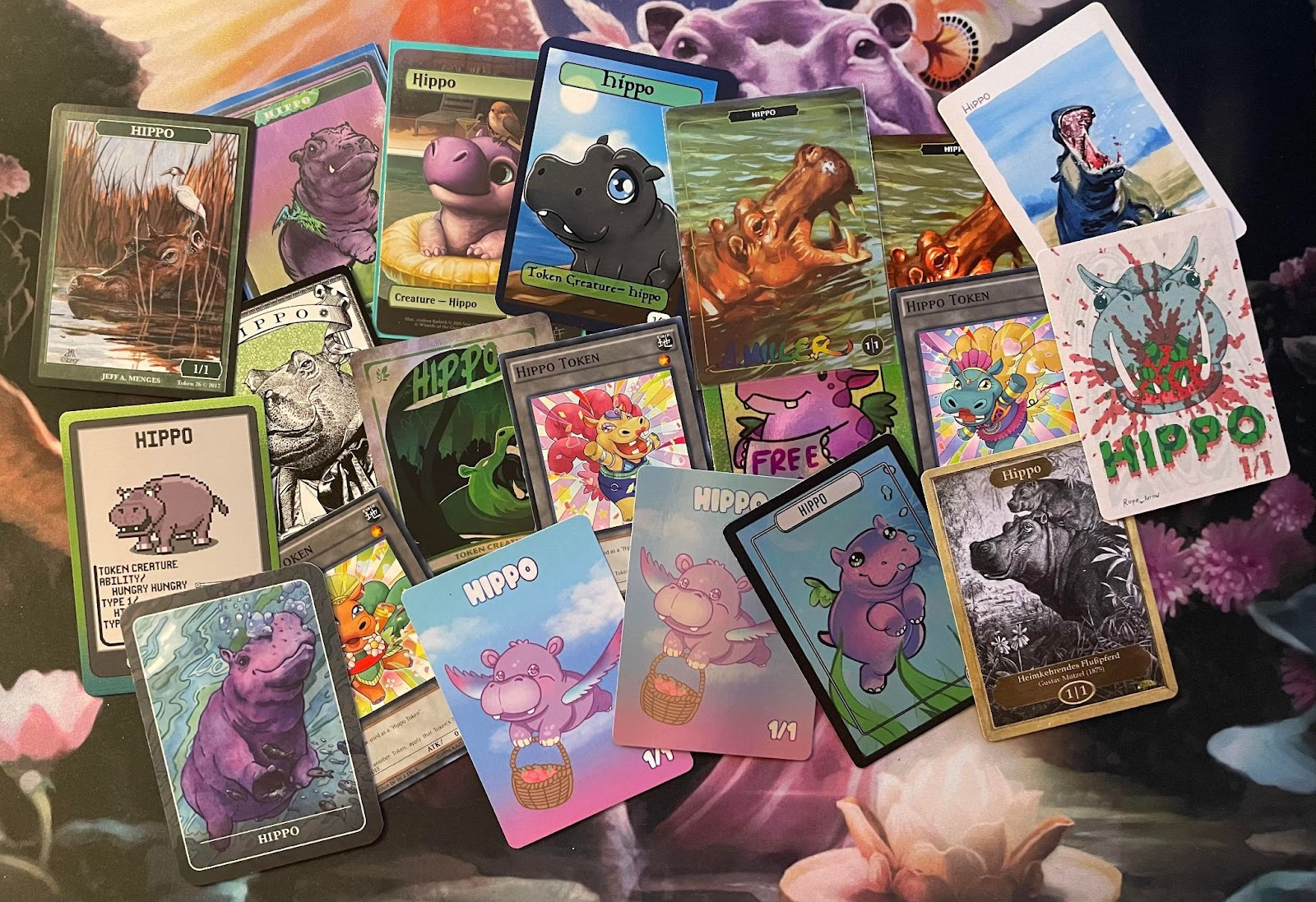
    Sometimes, in the depths of our deepest anger, we arrive at a brilliant idea on how to escape our flippant social media promises: What if I, Questioning Phelddagrif, reviewed all possible hippo tokens? I have already braved the pornographic sands of the ai-riddled internet for every human generated hippo token one can purchase. Why, it might be a public good, offering a service to the community, while appealing to the lowest common denominator as a rating listicle. And you, dear reader, can’t get angry and say this is unexpected because I’ve done this genre before, you thought I forgot? A Phelddagrif never forgets! 

    Besides, I already have these tokens on my desk next to my extra copies of Intruder Alarm, Seedborn Muse, and Angel’s Trumpets. How long could this take, realistically?

    Realistic

    A token already prompts the question about what ‘the real’ is. A token is meant to be a representation, but they are far from being some sort of ghostly presence that points away from itself. Tokens are game pieces with impact, with heft! Creature tokens can attack and block, deal damage and all sorts of other things! You can Wrath of God a creature token. Could God wrath away a ‘representation’? I’m not sure, and I doubt it.

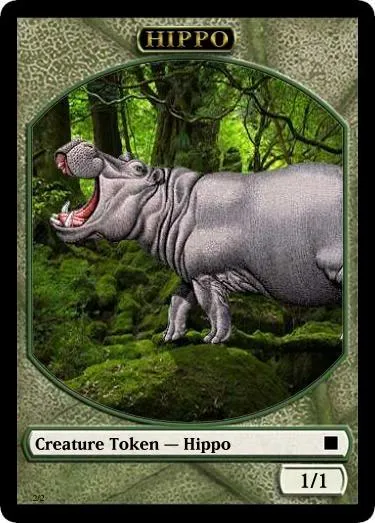
    Many artists take the path of portraying the 1/1 hippo as a realistic hippo. One you might see in the wild, locked in a zoo, or at your local or non-local swimming pool. These depict the gaping maws, the incisors and the rippling muscles of beasts driven by instinct. And the water, oh god, yes, the water these hippos are in! You cannot deny that it is sometimes a feature as well. 

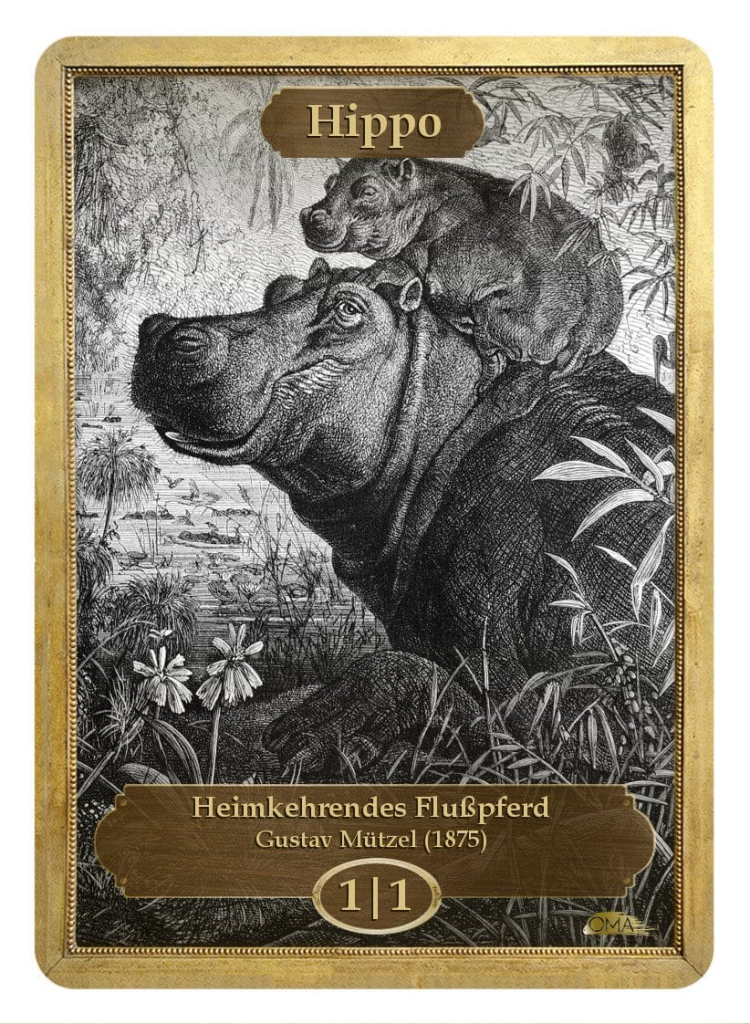
    Classic Art Token available through Original Magic Art

    These Gustav Mutzel tokens were the first set of hippo tokens I got when I started to play Phelddagrif. The classical art tokens series is a really genius idea. Use what is already there, literally reframing the work into a game piece. The piece itself is great, the wise and weary eyes of the mother hippo looking up at her calf standing on her neck with an impish grin. These aren’t looks of pain, but of a comedy duo performing some cosmic routine. And wow! That foot on the rock in the foreground is so large and ominous. I wonder what it will do.

    Unfortunately, The foot is done a disservice with the textbox giving the title of the work and artist, a necessary addition but one that hinders the work and crowds the foot. Cropping it to focus solely on mostly the head of the larger hippo also detracts a point from me.

    There is a pleasant confusion created by this token as well: which hippo is supposed to be the token? surely that fully grown hippo doesn’t quite seem like a 1/1 (which will be a common refrain throughout these reviews), but this piece has both a baby hippo and an adult. This recollects Ron Spencer’s Bear Cub, which focuses on the cute bear about to get attacked by the first token ever made, while mother bear lurks half in frame, ready to jump in and defend her cub. This interpretation doesn’t make so much sense, where bears have been established as 2/2 creatures, hippos are, usually, larger. So which is the one the Phelddagrif player is giving? How delightful, to give your opponents a riddle!

    But that’s just the art! What about how this functions as a token? Well, you can put it on your board to represent a 1/1 hippo token. It’s flammable, but most cardboard is as well. I dropped the token from a height of 10 feet and it didn’t shatter, so they’re also safe to do that with. I shook the token too, because I saw the Professor do that for his reviews, and the token was shook. Overall, you can use this token to represent something on your board, especially a 1/1 hippo token.

    I rate this token 5 hippos out of 5!

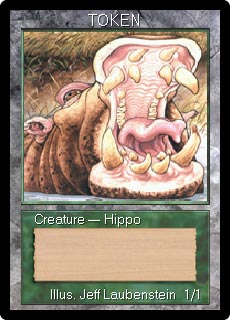
    Hippo Token by Jeff A. Menges (Available through OMA)

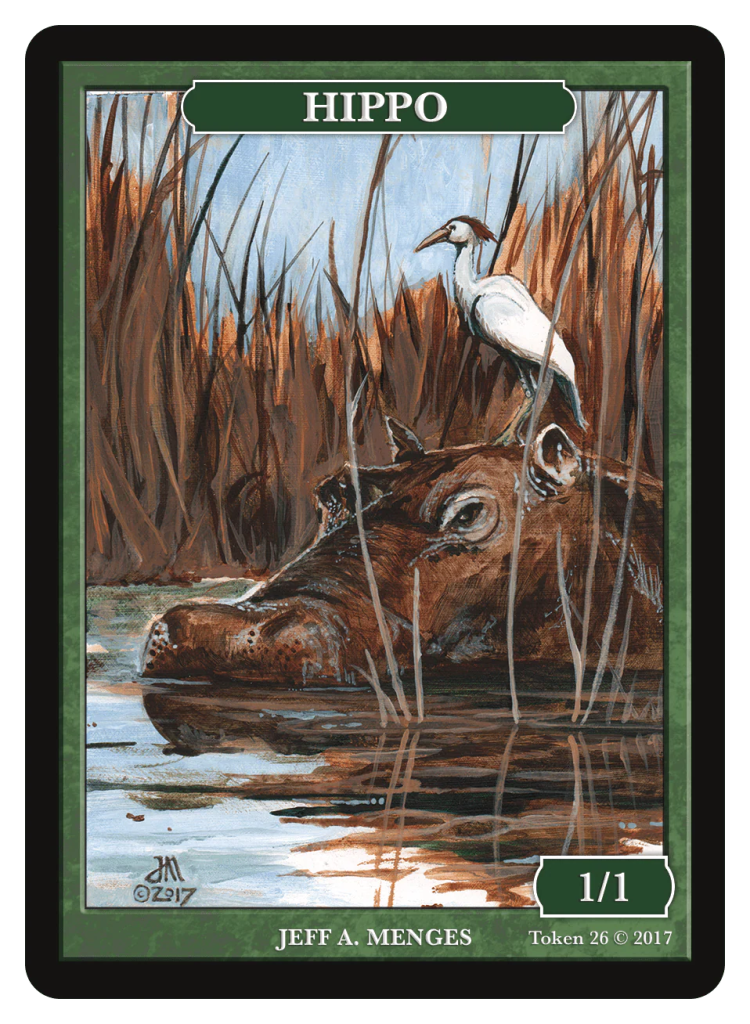
    While the last token was done by a classical artist (maybe, I don’t know), this token is done by a classic Magic artist. Swords to Plowshares, Bazaar of Baghdad, Moat! Jeff Menges has done many heavy hitter cards and this hippo token surely ranks up there! The green border is a great reminder of the creature’s color, and gives the token a ‘retro’ feel. I think this is an excellent representation of a hippo token with such a variety of colors from browns and whites to oranges and blues, while remaining grounded and not turning into a psychedelic Phelddagrif token experience. This is, perhaps, the most serious, or the least silly, hippo token on this list.

    But what’s that bird doing there? Is the bird the one doing the attacking? Perhaps that’s why the token is so weak, since many bird tokens are 1/1s. Although there are almost as many that aren’t 1/1s. And with the exception of the chocobo token, they normally fly. Is the hippo meant to be the vehicle that delivers the bird to your opponent to give a light peck? I’m not sure, and the distracting bird will probably raise these same questions from your opponent trying to track the game state.

    But that’s just the art! What about how this functions as a token? Well, you can put it on your board to represent a 1/1 hippo token. It’s flammable, but most cardboard is as well. I dropped the token from a height of 10 feet and it didn’t shatter, so they’re also safe to do that with. I shook the token too, because I saw the Professor do that for his reviews, and the token was shook. Overall, you can use this token to represent something on your board, especially a 1/1 hippo token.

    I rate this token 5 hippos out of 5!

    Hippo Token by Ken Meyer Jr. (Available through OMA)

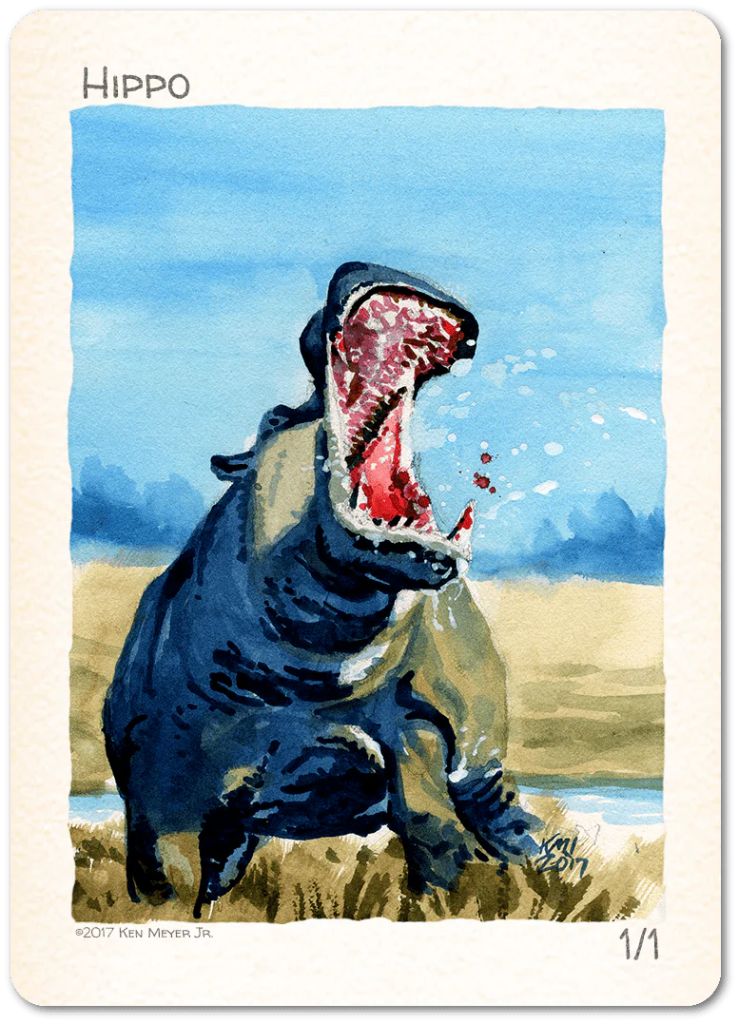
    KMJ’s token captures the kinetic force of a hippo on the savannah, spittle and blood flying from massive jaws as it lets out a pachyderm war cry. The artist of Mystic Remora and Kird Ape does not disappoint. This one begins to offer an answer as to why hippo tokens are so weak. Despite this being a particularly girthy hippo who, it could be that it is the spittle that’s hitting your opponent that deals a single damage. I don’t think it’s a particularly satisfying answer, but it’s making an attempt to answer our questions.

    But that’s just the art! What about how this functions as a token? Well… you can put it on your board to represent a 1/1 hippo token. It’s flammable, but most cardboard is as well. I dropped the token from a height of 10 feet and it didn’t shatter, so they’re also safe to do that with. I shook the token too, because I saw the Professor do that for his reviews, and the token was shook. Overall, you can use this token to represent something on your board, especially a 1/1 hippo token.

    I rate this token 5 hippos out of 5!

    Rope Arrow Hippo Token (Available through OMA)

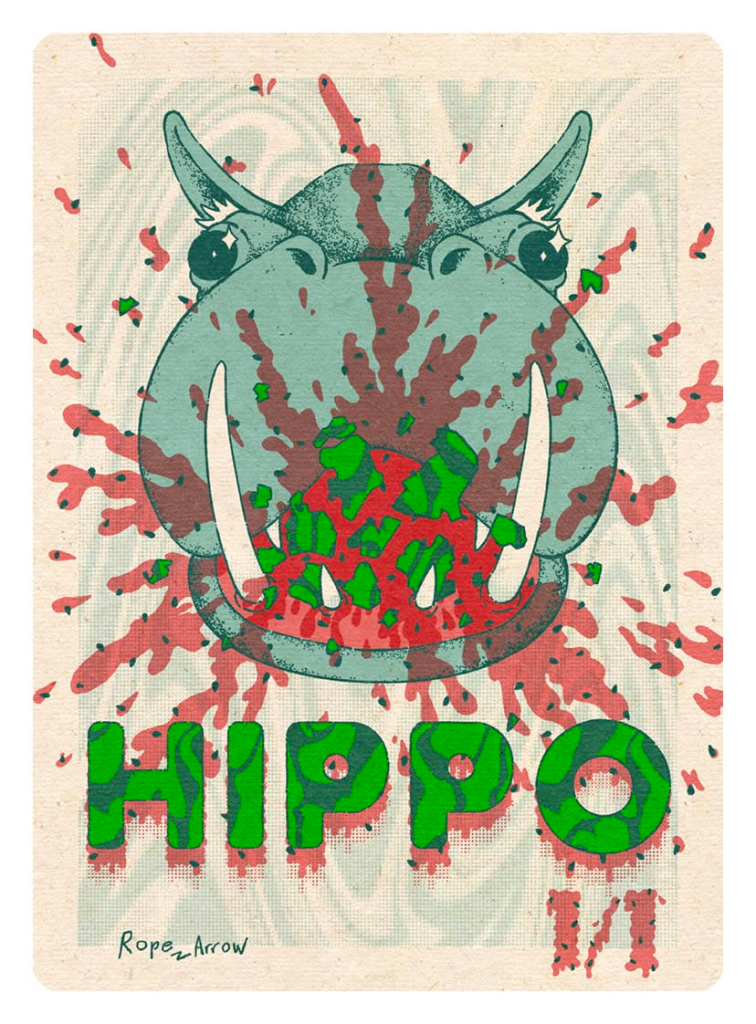
    Rope Arrow takes their psychedelic style and applies it to the infamous hippo token. This hippo demonstrates their strength by smashing a watermelon, a Gallagher-inspired fruitsplosion juicing the viewer. I’m a big fan of this one for multiple reasons, but the name of the token being spelled out in watermelon chunks tops the list.

    It’s easy to believe that a hippo in captivity might be a 1/1, having a meekness instilled in it from fellow captive creatures. And, I suppose, a launched watermelon seed would deal more damage than animal spit. The capacity for stupefying acts of violence lurks in the hearts of all creatures, can we really justify this one being so weak when the object of its wrath is more melon than cranium? Lest we forget that these zoo animals sometimes go rogue.

    I heard a funny rumor about this token too, that it was commissioned by someone who is very handsome, sometimes funny, and whose company people sometimes enjoy! But enough about whoever that is, how does this work as a token?

    As a token, you can use it to represent a hippo, it can catch fire like everything else, you can drop it and it’ll be fine, and feel free to shake it. These tokens come in a thicker card stock than the other ones too, they feel a bit more durable.

    I rate this token 5 hippos out of 5!

    Aaron Miller Hippo Token, (Available through the Artist’s Website)

    Aaron Miller is no stranger to depicting hippos on a magic card, so it’s only fitting to use his tokens given the prominent role the Zombified Greatmaws played in the Aetherdrift story by pulling Basri and Zahur’s chariot to victory. Maybe the most lore relevant hippos will ever be.

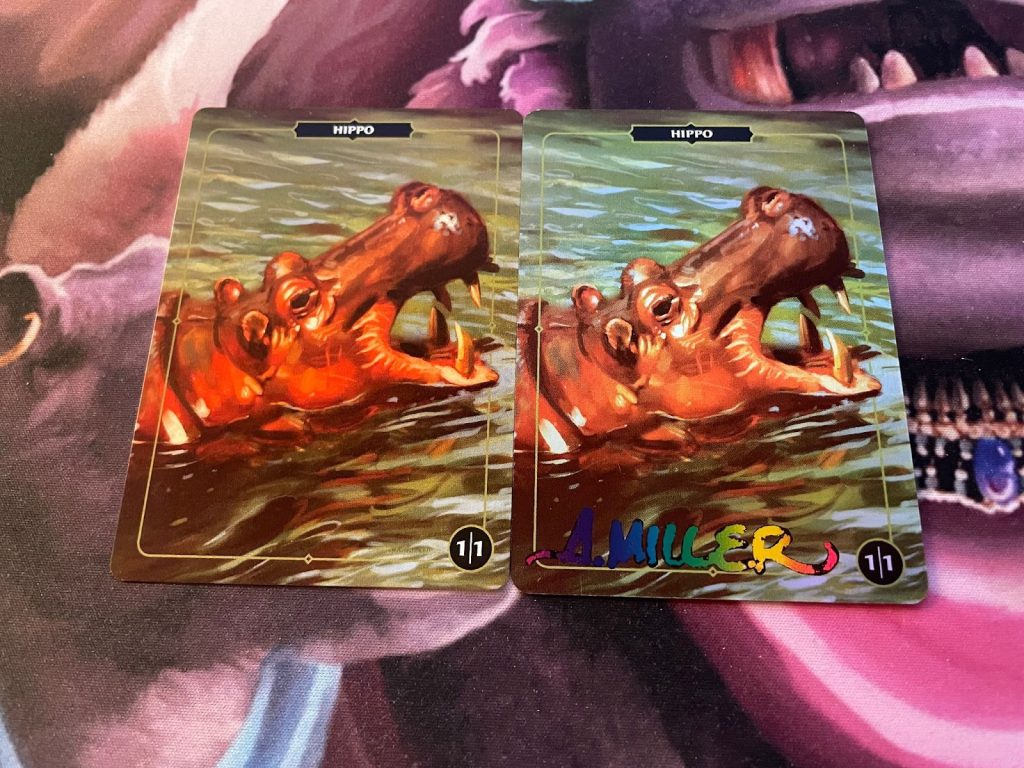
    Aaron Miller’s hippos stand firmly in the middle between KMJ’s and Jeff Menge’s hippo tokens. Miller’s hippo is languidly pushing itself through the water, but keeping its mouth open flashing its teeth to show that this hippo can do some real damage. The watercolor effect is stunning on the token as well, the discrete boundaries of the hippo melting away as the light reflects off the water. Half of the hippo is submerged in the water. 

    A question about the reality of the beast: is it really there, or is it a trick of the light on the water, and how close will you get to find out?

    This is the first token to be offered in foil on the list. Aaron Miller also offers these tokens in not only foil, but with the rainbow dragonfire signature as shown above. If you’re looking to “bling” out your Phelddagrif deck, this is a good choice. He is one of the few artists who still brings hippo tokens to cons, so you might be able to get one in person too if you catch him at a MagicCon!

    As a token, you can use it to represent a hippo, it can catch fire like everything else, you can drop it and it’ll be fine, and feel free to shake it.

    I rate this token 5 hippos out of 5!

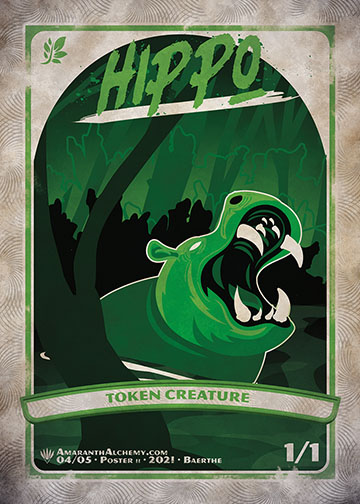
    AmaranthAlchemy Hippo Token (Available through their website)

    This is the most egregiously ferocious of the “realistic” hippo tokens, and it definitely communicates “green” without just the border. It is an interesting take, that the viewer is watching a hippo while wearing night-vision goggles, but the teeth are way too sharp nearing fangs, to effectively convince me that this is really a 1/1 hippo. The lack of pupils and green tint makes this hippo look a bit too much like Slimer for my tastes.

    As a token, you can use it to represent a hippo, it can catch fire like everything else, you can drop it and it’ll be fine, and feel free to shake it.

    I rate this token 5 hippos out of 5!

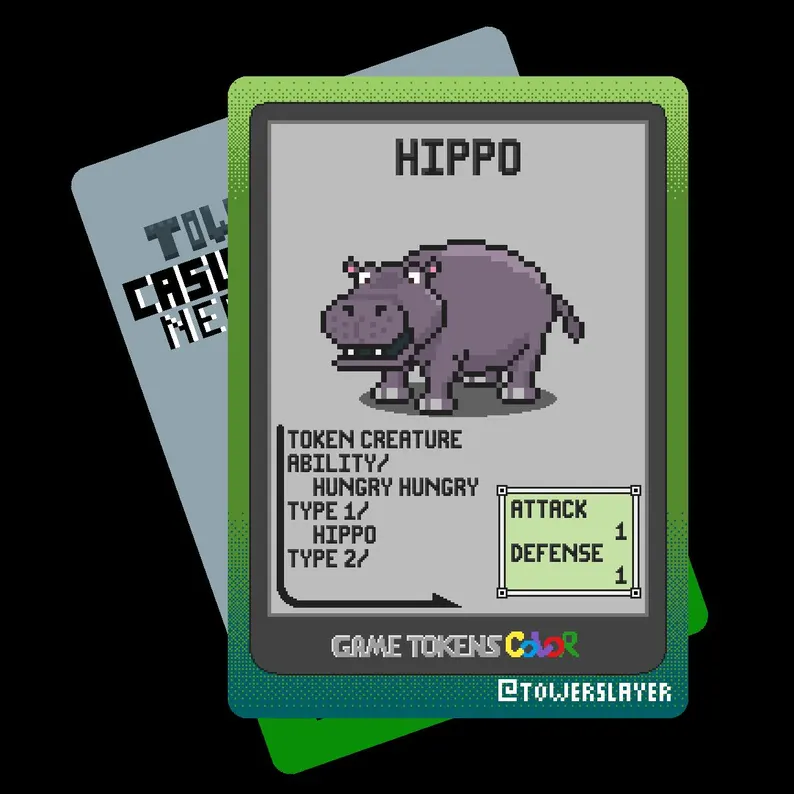
    Towerslayer 1/1 hippo tokens Available through their etsy store

    These pixel pachyderms provide comic relief:  cross eyes and a silly grin with slightly open mouth. It’s hard to take these seriously and they aren’t trying to be taken seriously. The shade on the hippo skirts the line between the more world accurate grey to the fantastical purple, playing an optical trick that makes one wonder if a purple hippo really isn’t that crazy.

    These begin to start to stretch the realm of “realistic”, but it isn’t the object of study that’s in the realm of the fantastic, but the style chosen to depict it. Perhaps there could be a more photorealistic hippo presented through pixel-art, but these tokens would look at home in any of those old videogames I never played. Maybe Super Mario?

    As a token, you can use it to represent a hippo, it can catch fire like everything else, you can drop it and it’ll be fine, and feel free to shake it.

    I rate this token 5 hippos out of 5!

    The Unreal

    “Questioning Phelddagrif,” You are saying, dear reader, as you sip your beverage of choice before forcing yourself the mandatory gulp the beverage that Society tells you to drink, “A video game isn’t real. A green hippo isn’t real either. Why can’t you understand that these are pictorial representations of hippos and not the real thing. Furthermore, there has always been some gap between art and game mechanics, especially power and toughness. It’s not fair of you to criticize these tokens in this way! And what does it mean to even review a token, especially if you’re going to say the same thing every time?!

    Which is a very astute observation. Perhaps it is too much to expect an answer to the question why a hippo token is so weak, at least in the realm of the real. Perhaps we should continue looking towards more abstract representations of hippos, marching further into the unreal, there’s no time to think about that second question!

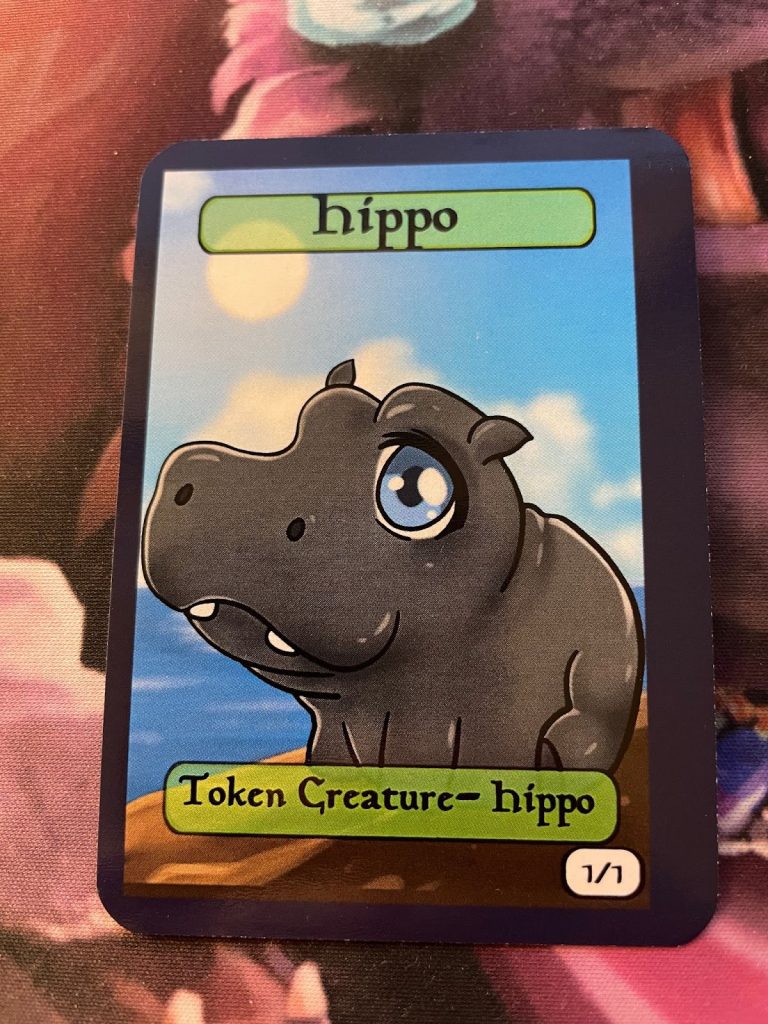
    Chibi Hippo tokens available at Megachibi.com

    A chibi hippo is an odd task. The style’s hallmarks are a chubby body, stubby limbs and a large head, which a hippo normally has. THe major difference for this hippo is the anime eyes, large and expressive with (not just one!) but two reflections in it! While not as adorable as the little freak that Mützel drew, I still find this guy pretty cute! Other than the chibi style, this is a pretty normal looking hippo, not nearly as bizarre and strange as some of the others. Still, the style puts it on this side of the border between real and unreal.

    As a token, you can use it to represent a hippo, it can catch fire like everything else, you can drop it and it’ll be fine, and feel free to shake it.

    I rate this token 5 hippos out of 5!

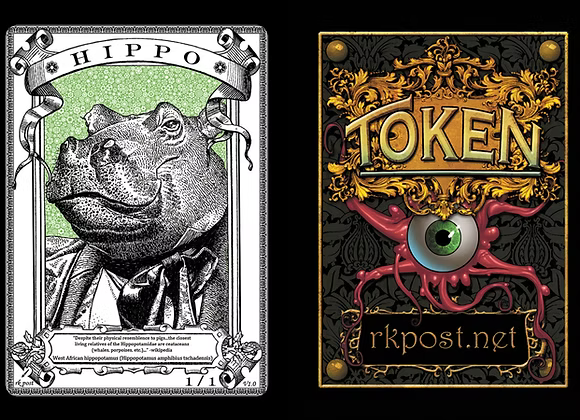
    RK Post Hippo Token (Available through the Artist’s Website)

    A fixture at most magic conventions, RK Post hippo token depicts a dapper hippo doffing a suit jacket and tie. The hippo has something between a mellow and smug expression on their face, eyes half closed and wearing a sly smile. These tokens are simply fantastic, I would say some top tier hippo tokens and would not be surprised if these have graced many commander games in the past. I’m also a fan of the use of background to indicate the tokens color, an easy enough detail to miss or ignore entirely if you want to use the token for a different use (human tokens seem to come in a lot of colors, and there’s not much sense in getting a bunch of different ones). I am a huge fan of these surreal tokens, while depicting a realistic hippo it maintains the silliness of Phelddagrif. The only downside is that it reminds me of Alice in Wonderland, which is not a very good book.

    Also, RK Post has this playmat, which, while not a hippo, feels like it has thematic resonances with Phelddagrif. If anyone agrees with me, I’ll buy one of these. Leave a comment, or respond on bluesky, telling me if you agree and I’ll support an artist.

    As a token, you can use it to represent a hippo, it can catch fire like everything else, you can drop it and it’ll be fine, and feel free to shake it.

    I rate this token 5 hippos out of 5!

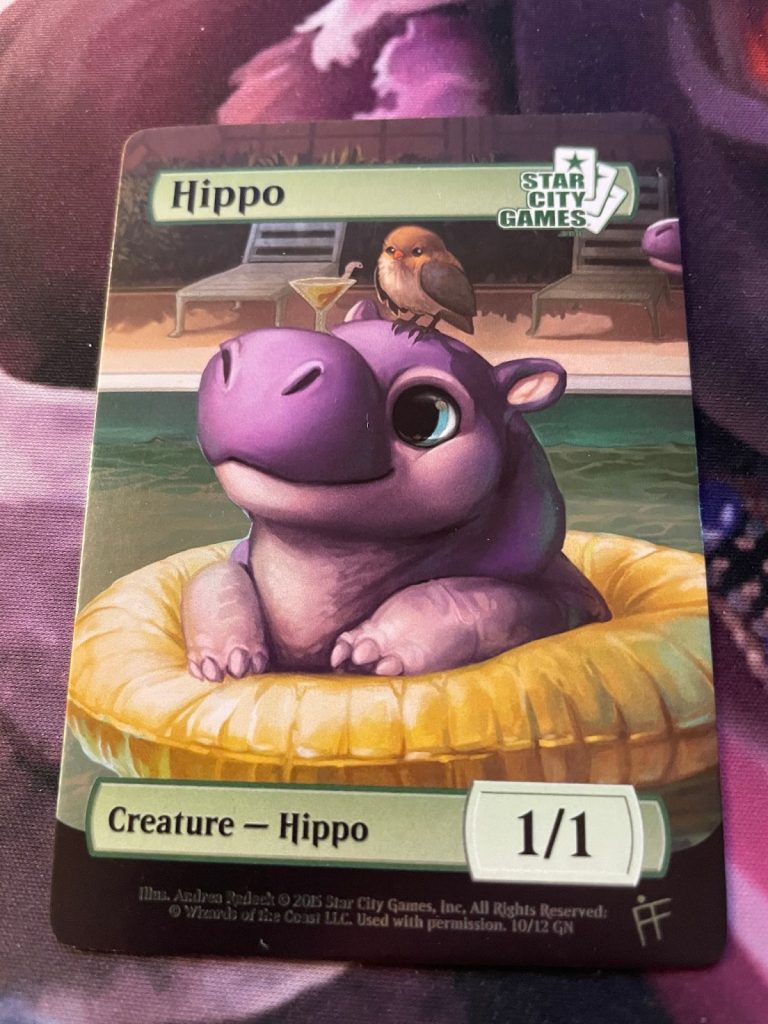
    StarcityGames Creature Collection Token by Andrea Radeck (Not available anymore, get a time machine or scour auction sites)

    This one is the classic. Allegedly. I wasn’t playing Magic for the heyday of the creature collection, a series of animal parodies of powerful Magic cards, or sometimes ones that just had some cultural cache. They’re cute, they’re collectable, and they aren’t around anymore.

    This one was made in 2015, when the options for hippo tokens were more limited than today (I assume, at least), and when more people were probably playing Phelddagrif in Commander. It is also another foil option.

    This is the first hippo token on the list that, while looking a bit cartoony, is also a demonstration of a type of hippo token: a purple hippo. This pool hippo (remember when I mentioned the pool? I bet you didn’t think that was coming back!) is unabashedly purple, not a shade between grey/purple, and not purple because we are looking at it through a purple lens like AmaranthAlchemy’s token. Just purple, unlike any hippo you will ever see out in the wild or in captivity (I hope). This is a purely fictional hippo, and we’re about to see many more.

    As a token, you can use it to represent a hippo, it can catch fire like everything else, you can drop it and it’ll be fine, and feel free to shake it.

    I rate this token 5 hippos out of 5!

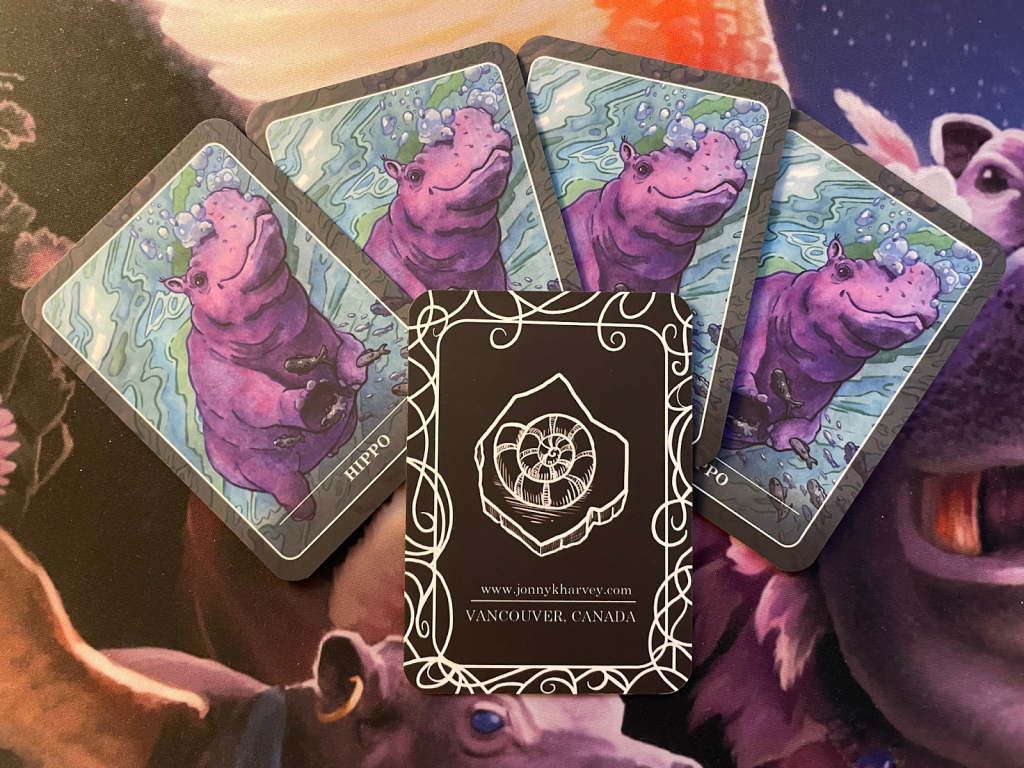
    JonnykHarvey/Helix Hippo Tokens available at their etsy store

    The Helix tokens are unique in that these are the only ones depicting an entire hippo underwater. This could almost go in the first section, other than its hue the hippo is rather normal looking. The pattern of the water’s surface is visually interesting, as quite a few tokens eschew detailed backgrounds.

    This token does not have the power/toughness on the token though, which is a demerit against it as a Phelddagrif token. Only because one may, hypothetically, use this token to represent that horrible token you get from the worst card in Magic.  

    As a token, you can use it to represent a hippo, it can catch fire like everything else, you can drop it and it’ll be fine, and feel free to shake it.

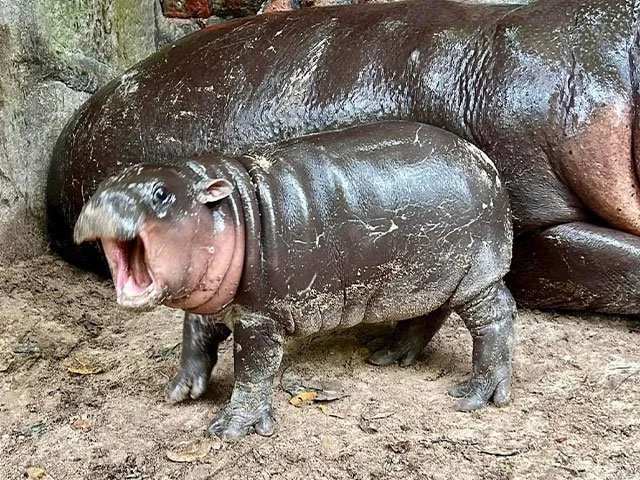
    Moo Deng

    Moo Deng was a boon to Phelddagrif. When that pygmy hippo got popular it reinvigorated the token making community to make some more hippo tokens. These hippo tokens do a good job of cutting the Gordian Knot of realistic hippo tokens by being a realistic hippo who is also very small. While it doesn’t really make sense for a full grown Bull Hippo to be a 1/1, baby Moo Deng is small and feisty enough to be a cute little 1/1 token.

    And I wrote all of that and could not find a single Moo Deng hippo token that I couldn’t confirm wasn’t AI. Moving on!

    I rate these tokens ZERO!!! Hippos out of 5 (because I couldn’t find any).

    Don’t feel bad for the little hippo. They voted for Tump.

    Children of Phelddagrif

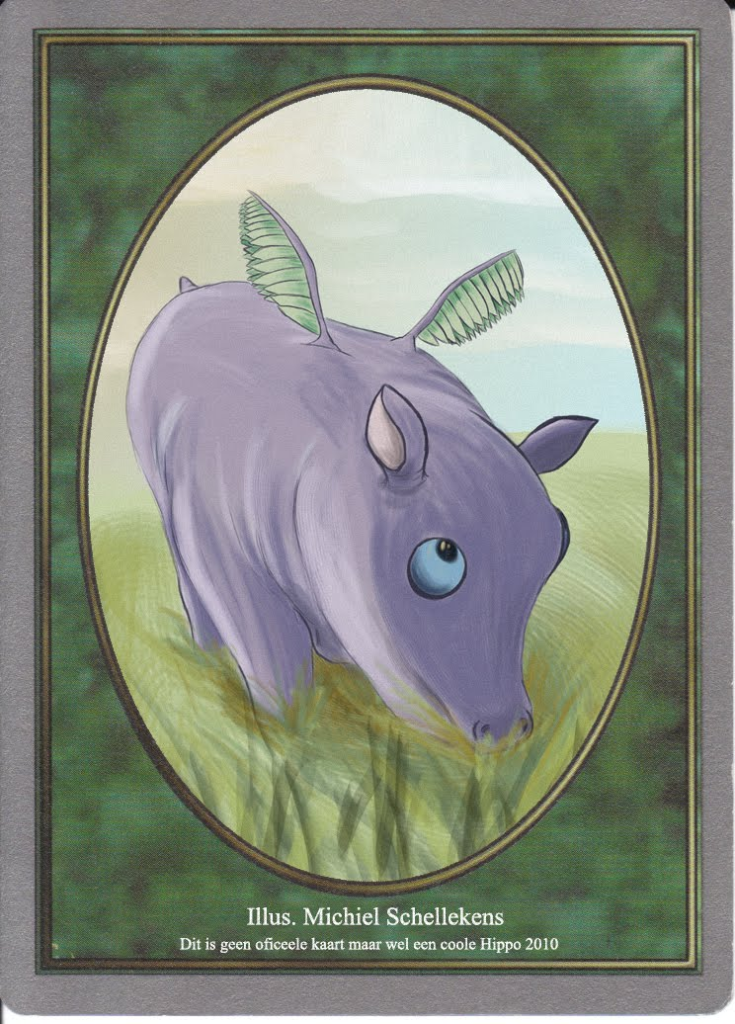
    Hippo Token with unglued frame by Michiel Schellekens
    Hippo Token byJeremy Carver

    There are many 1/1 hippo tokens that portray smaller versions of Phelddagrif. In some ways, these make sense, perhaps the tokens are meant to represent Phelddagrif’s offspring. It isn’t that Phelddagrif is conjuring hippos out of thin air, but they’re dropping their child off on your opponent’s proverbial stoop in order to…gain trample?

    Steep cost for something so negligible, but fine.

    Hippo Token by CatsAndCantrips available through Etsy

    CatsAndCantrips token is a fun fourth wall breaking example of this. The hippo is clearly a smaller Phelddagrif, standing upright on its hind legs, and holding a sign saying “free hugs”. There’s a little fierceness to the Phelddagrif too, with their furrowed brow, perhaps a hint that these hugs aren’t as free as they’re advertised to be.

    This token is cartoonish in style and execution, the hippo feels like bugs bunny, recognizing that they’re in a card game and advertising their strategy. My only gripe being that Phelddagrif need not only be defined as a group hug commander (they’re pretty good in prison strategies too), but the token being used in a group hug deck makes up for that.

    Token score: representation, fire, drop, shake, 5/5.

    Cloveralters token available through their etsy store

    Cloveralters hippo tokens, also available in foil and surge foil, are adorable. This token generates a few questions: How is the hippo holding the basket? what is it doing with the basket? How is it flying? What horrors lurk in that hippo token’s mind, is that gleam in their eye friendly or mischievous? We don’t need answers because Phelddagrif is an absurd card. Although depicting the token flying on a token without flying could be confusing. Does comprehensive rule 203.1 also apply to tokens?

    Token score: representation, fire, drop, shake, 5/5.

    Hippo Token by Inklin Customs (Available on their store)

    These tokens are adorable, and the second hippo that is under water. This one is a bit of a perplexing choice, one has to wonder what the wings are doing underwater. Perhaps they’re actually fins?

    The tiny wings are great at communicating the power of this token. Phelddagrif’s wings are gigantic in comparison, and if the wings were kept proportional one could guess that this could be an adult Phelddagrif in a different style. Sort of like Secret Lair does to cards you know and love. But these tiny wings suggest that part of the Phelddagrif lifecycle is starting with tiny wings and then growing into a larger wingspan.

    Token score: representation, fire, drop, shake, 5/5.

    Patricio Soler alter sleeve token

    This token perpetuates the head-canon that Phelddagrif’s grow into their wings. This guy is a wrinkly and ugly fellow, I love this chubby fucker. It’s also really neat that it’s an alter sleeve, which gives some functionality to your token (you can use a squirrel, saproling, any sort of 1/1 green creature token). There’s also a complimenting alter sleeve to keep a similar style between your commander and creature tokens.

    Token score: representation, fire, drop, shake, 5/5.

    GK Alters Hippo Tokens available at their etsy store

    This one has nipples.

    Rebellion

    Anything can be a token. Glass beads, dice, pennies (rip), your cat’s claw trimmings? Go for it. It’s meant to represent what’s there, it’s not a real card and nothing says that it has to be a card. It’s about what you want to communicate. Using glass beads? You’re into the classics. Dice?  You probably didn’t come prepared, and you should have. A facedown Magic card means you don’t respect morph.

    So what if you used a card from a competitor such as, say, Yu-Gi-Oh?

    Konami hippo tokens

    Wouldn’t that send a message? That Wizards should watch their back, or someone’s going to eat their lunch and steal some silverware to boot. Not only did Konami give their players one hippo token, but three different arts to choose from! What variety! It’s practically the 3/3 Beast of Yu-Gi-Oh!

    I highly endorse people using these as hippo tokens for their Phelddagrif deck. It might be a bit confusing since they’re “0/0” (which seems much weaker than any other token on this list), but there’s really only one power/toughness combination a hippo token could be (not 3/3). 

    These pieces of cardboard can represent a 1/1 hippo, they’re flammable like the others, you can drop them, you can shake them, do whatever you want with them!

    The Ones You Make

    There’s plenty of tokens you can find online and print out for yourself. Some I’ve already shared (like those baby Phelddagrif tokens I didn’t talk about), but there’s other hippo tokens you can make. For example, you could print the official Wizards hippo token.

    Oh, you didn’t know that there was an official 1/1 hippo token made by Wizards? What am I complaining about, what’s the point of this article, if there’s an official 1/1 hippo token?

    Because that token has been locked to being Magic: the Gathering Online exclusive.

    Art by Jeff Laubenstein as well, very cool!

    I also heard the one below was the official Magic: the Gathering Online token until 2014, but I can’t find anything that confirms that.

    These tokens are not flammable, they can’t even be dropped, and will take no damage from shaking them because they aren’t physical (until you print them out, in which case they’re about as good as every other hippo token). Here are the hippo emojis!

    The Ones YOU Make

    You can also make your own, draw them on scrap paper or use Infinitokens. Afterall, Wizards has little appetite for printing a 1/1 hippo token, they’d rather create a waifu mutant turtle, or anime spiderman or something. The Phelddagrif player has to take matters into their own hands and make their own tokens:

    3 hippo tokens illustrated by dick doofus

    It literally costs nothing to try! I did, and they came out pretty bad. But I enjoy them enough anyways to give myself a perfect score:

    What Did We Learn?

    Any token that wasn’t made with AI art is wonderful, a treasure. Also, reviewing tokens with the same metrics Tolarian Community College reviews deckboxes is probably not the best way to review tokens. We also learned that those are all the possible hippo tokens one can purchase and I did not miss a single one. My collection is exhaustive and complete, and so is this review. Unless someone makes a new hippo token. What are the odds of that happening?

    But, I leave you, dear reader, with this. There’s a tendency for players to desire the same token when they have to make many of the same thing, such as treasure tokens. It’s easier to recognize what’s in play when you only have to keep track of what one game piece looks like. I think the impulse to do this with hippo tokens is there as well, and I wouldn’t begrudge anyone who buys 5 of the same token and uses those for their Phelddagrif deck.

    But I would encourage you to try having several different types of tokens to give out. Think of it as giving the right player the right gift, a token that matches their deck or personality, or for politicking. Maybe your opponent will be more swayed by the non-ai waifu hippo token (it exists, I’m not linking it, I have it though and it gets 5 hippo emojis like the other ones did). Or maybe they’ll get a kick out of the M:tGO printed token.

    It might add a little more color, more texture to the game, make it a bit messier and disrupt the same old stale board state you normally see. 

    Subscribe if you like!

  • Thread-dagrif: Phelddagrif on the Information Superhighway

    Thread-dagrif: Phelddagrif on the Information Superhighway

    Token art from the MTGSalvation thread for “Show Weakness to Hide Strength”. Art made by the user WolfWhoWanders’ Girlfriend

    On August 17, 2017, the user DirkGently posted his Phelddagrif Commander deck and and primer to the Commander decklist forums on mtgsalvation. Over the next nine years the deck would be updated and tinkered over, with discussion eventually migrating to mtgnexus in 2020. Combined, both threads total over 800 posts. This post is about the that thread thread, one with the most amount of words over the longest period of time on the single topic: how to build and play the most Phelddagrif Phelddagrif Commander deck possible. devoted to this deck: new card discussion, what to remove, strategies and game reports.

    While the thread contains the technical minutia of what players expect when opening a primer (new discussion strategy, game reports), that isn’t how the it started. DirkGently’s primer starts with an alter of Phelddagrif depicted as a saint in a stand glass window. Phelddagrif is reading from a blue book, while holding a small purple hippo swaddled in a green cloth. Their green wings cascade down the border of the card, a white hot burning heart at the center of Phelddagrif’s chest. It is worth opening the primer to see the detail in this alter on its own. My favorite is the power/toughness being represented as chapter-verse notation at the bottom of the alter. 

    P/T from DirkGently’s altered Phelddagrif

    It’s a captivating way to get the reader engaged, quite different from what’s expected from the purple pachyderm. It sets a tone of reverence for Phelddagrif, a bit silly in how ornate it is. The Primer continues with lofty language around playing Phelddagrif: “He is politics become a weapon” “He is capable of winning at the most competitive Grand Prix tables”. The title of the thread is lifted from disruptive pitmage’s flavor text: “Phelddagrif: Show Weakness to Hide Strength”. The thesis of the deck stated clearly upfront:

    “No experienced player of commander could reasonably feel threatened by Phelddagrif.

    Which is exactly why it can win over. and over. and over.”

    The primer is comprehensive. There are sections on deck history, how to politic, how to play Phelddagrif, gameplay, deck composition, different versions of decklists, tips and tricks, a card glossary and changelist. At over 11,000 words, a summary can not do it justice, but to give an idea of what’s in the primer the deck lists call for approximately 20 targeted removal spells, 8 board wipes, and 12 counterspells, and 40 lands, a few of which generate slow value such as the Clue Lands, Scavenger Grounds, and Arch of Orazca. There are no win conditions other than dealing 21 commander damage with Phelddagrif: 6 attacks (without cards like Okina, Temple to the Grandfathers, which is also in most deck lists)

    Okina, Temple to the Grandfathers by by Keith Garletts

    The deck toes the line, trying to sneak under the radar of other players while steering the direction of the game into a 1v1 death match against a weakened final opponent. There can be some deals, but not too many, or you’ll be seen as politicking the table and taken out early. You can cast your permission, but not always right away, or at all, otherwise people will think you’re always holding interaction and eliminated. The pilot performs a high-wire act of playing it safe and appearing non-threatening while keeping enough gas for you to cross the finish line.

    It’s important to figure out how to communicate threat assessment, staying behind on board with the goal of jumping ahead at the end. On March 4, 2019, user Discomute calls this “Bradburrying”, named after the Australian speed skater Stephen Bradbury who won gold at the 2002 Olympics by staying in last during the race and avoiding a collision at the end that took out the other 4 skaters. Your opponents spend so much time competing against each other that they crash into each other at the last minute and the Phelddagrif deck ends up winning.

    This strategy is baked into the card choices. Instead of looking for the most efficient threats, engines, and permission, DirkGently and the rest of the thread look for what is efficient while also being unassuming. Rhystic Study is great, but it draws a lot of attention, and the card draw isn’t worth the attention that the card draws. A card that demonstrates how far the deck Bradburries is the card Conqueror’s Galleon:

    Conqueror’s Galleon by Emrah Elmasli

    A 4 mana artifact that transforms after attacking, the crew cost perfectly matches Phelddagrif’s power. The flip side of the card…

    Conqueror’s Foothold by Emrah Elmasli

    …seems like it was built for the deck. The curve here is immaculate. Turn 4 Galleon into turn 5 Phelddagrif, crew and flip into Foothold. Suddenly you have a card advantage and recursion engine on a land! It doesn’t matter that it costs a infinity and a half mana to do any of that. And, while a pretty good value engine, it looks meek compared to cards like Trouble in Pairs and The One Ring. Yet, the card has no place in the deck. As DirkGentlywrites about the card: 

    It slows the game down to a crawl, basically, a miserable crawl with all the focus on you, where you’re going to win but it’s going to take forever, and at the end people will not be thinking “huh, how weird, that game had so many powerful nasty things happening, but at the end it came down to just a derpy hippo beating face after doing nothing much all game, isn’t commander funny?” No, they’ll be thinking “Well, that Phelddagrif deck LOOKS innocent enough, but eventually it’s going to pull off some lockdown combo so you’d better smash it when you’ve got half a chance.”

    The Bradburry Paradox

    While the sheer amount of Phelddagrif discussion may have attracted me to the deck, what kept me around was the paradox of the deck itself. The gameplan is to be as nonthreatening as possible, while you use below-rate permission spells and Phelddagrif’s abilities to position the game into a situation where the decks only win condition can push you across the finish line. It’s sinister, it’s conniving, it’s Machiavellian!

    And it’s entirely dependent not only on the playgroup and how familiar and receptive they may be to the strategy, but also the pilot, and the pilot’s relationship to the playgroup. What deals are banned at the table? What if the other members of the group don’t like making deals, or like talking at the table? What if the pilot has a nasally voice and the group doesn’t like hearing it? A lot could go wrong here, and it’s compounded by the deck being played in commander, one of the biggest formats in terms of card choice. Hell, I’d love to know how Acorn cards throw a wrench into the cogs of this deck, something that was briefly brought up in the thread.

    Using the term “paradox” very loosely here, this is the contradiction in the deck. It depends a bit on the cards, but it almost depends on the people in the group more. You may play with a group of people who will see someone in last and think nothing of it, and others may smell blood in the water and start to pummel last place even more.

    I think it’s this variance that leads to so much discussion over the deck. As much as the thread becomes about updating the deck, it also becomes about updating strategy, and thinking through the multiplayer way of playing Magic. While the players know the mechanics, the rules of commander are still unexplored terrain. On September 27, 2018, DirkGently posts: 

    “I think most people don’t pay a ton of attention to politics and the nuts and bolts of multiplayer interaction, because it basically just doesn’t apply outside of this casual little bubble. When people are trying to understand stuff like card advantage and tempo, there are loads of people writing on the subject for a competitive audience in 1v1 formats and they’re widely understood and talked about so it’s easy to pick up, but there’s very little scrutiny on things that only apply in multiplayer, so most people ignore it, or at least simplify it.”

    So people begin to write about it, and think about it in the thread. Other people come in and ask for help with the deck. After a certain point, people started making accounts to thank DirkGently for making the deck, but also for help with how to play it. On March 19, 2020 in the MTGsalvation thread. InexperiencedEDH asksthreat assessment:

    “Hello! I created this account purely to post on this legendary essay. Longtime fan of your work but with all pretenses aside, I would like to get down to business:

    I have been a target in my playgroup since as long as I can remember. Unintentionally, most of my decks have turned oppressive. As a new poster, forgive me as I am unfamiliar as to how to link a card. The main decks I play are a Karametra enchantress build, a Meren deck, a Marath aggro deck, and a Marchesa deck with similar goals to this one. After achieving the role of “consistent archenemy”, I’ve decided that I am unhappy staying as such. Therefore, after narrowing the issue down, I feel like my alarm bells are too easily set off as far as threats assessment goes. I must kill that Rhystic study or your commander repeatedly or your Sword of Fire and Ice. Today, I ask you of two things, what kind of cards should I be fine with existing and performing without letting my opponent ascend into an unassailable position? And finally, what is the updated list you are currently using?”

    It’s times like these that the thread feels like time travel: did people really think of Commander this way? The posters wear their thoughts on their sleeves, they aren’t aware of the changes that are going to happen, when so much ink will be spilled (or keys clicked) about what Commander is, how to play it, what you should include in your deck, what the saltiest cards are, priority bullying, EDHrec, efficient combos, fast mana, theory and podcasts and more and more and more. It’s enough to give one a sense of trepidation feeling like you’re about to step on a butterfly. If these posters love Arch of Orazca they’re going to really love Bonder’s Enclave. Spara’s Headquarter’s is nothing compared to the surveil lands you’ll see soon.

    There’s a lot of activity in the thread between 2019-2022, when Commander begins to get really popular and a pandemic. More and more people are suggesting deck edits, developing theory, someone even posts the tokens that their girlfriend made for their Phelddagrif deck. There’s a sense of camaraderie that exudes from the thread in these years.

    The Final Days of Phelddagrif

    In 2024  updates from DirkGently become less frequent, it feels that there are less cards from current sets to add to the deck. Some sets don’t warrant a full set review. I couldn’t find anything on the Dr. Who set.  Alongside the release of Wilds of Eldraine, there began to be a lot more talk about updating the deck, bordering on an overhaul. DirkGently posts that Cryptic Command and Mystic Confluence are ‘too slow’ and needing to include ‘anti-CEDH’ cards.

    Cryptic Command by Wayne England. The 5th Mode is not being good enough for Commander anymore

    In the atmosphere is an acknowledgment that the game has sped up, and for the deck to continue to exist it needs to speed up as well. Cheaper permission starts appearing in decks, posters are talking about including Wash Away. An Offer You Can’t Refuse, which had been dismissed before, is starting to appear as a core part of the deck’s counter suite. A few posts down, while discussing different “fogs”, it’s clear that CEDH power-level decks are a concern, as a lot of discussion around Everybody Lives! is based on it stopping Thassa’s Oracle. A poster mentions that they see Thassa’s Oracle in a quarter of their games. The discussion of fogs gets so intense that the user Dunadain makes a chart showing each fog’s benefits.

    It’s clear that the old point system for commander deck categorization is starting to fail to keep up with Magic design. The idea of this Phelddagrif deck is to be played at any level, lifting opponents who are behind while clipping those who are too far ahead. What happens when everyone bursts out of the gate early on? Games of Commander are much faster now than they were 9 years ago, and with threats getting more efficient, and more value based commander design, it seemed like the deck may have been falling behind a bit and a symbol of Commander of the past.

    The commander bans of Jeweled Lotus, Mana Crypt, and Dockside Extortionist were not discussed in the thread. Dockside could not be played in the deck, and Jeweled Lotus and Mana Crypt did not fit the decks strategy. Phelddagrif didn’t need to be ramped out early by Jeweled Lotus, and Mana Crypt did not provide enough advantage for both the target it paints on the caster for the damage it will deal over the course of a game. Discussion of the bracket system created a brief burst of energy in the thread, posts on what bracket the deck could compete at, what it should compete at, and how to build the deck for that bracket started, but once again slowed down. As of writing, the last post made in the thread was 4 weeks ago. There has not been discussion about what cards from Lorwyn Eclipsed could be added to the deck.

    What strikes me is that all of this, all of these keystrokes spent over 9 years, for a commander deck of all things. Commander is perfect for the modern internet .Each deck is atomized, a reflection of a singular identity’s choices while influenced by the algorithm’s unseen hand: edhrec aggregating card choices, content creator deck techs, efficient card designs from the latest set pushing out older cards. Commander decks are tweets made physical: a note in the cacophony chorus of “I’m an individual”. They’re expressions of self with rare input from others. Outside of CEDH, there just doesn’t seem to be much reason why so much effort should be put into a commander deck.

    Maybe Bradburrying has been left behind in Commander, maybe it’s too slow, maybe people don’t like facing against a deck with 10 board wipes. Maybe Commander players today are more sensitive than players from a decade ago, maybe they’ll bristle at Conqueror’s Galleon with the same sense of alarm as a Rhystic Study or Smothering Tithe. Perhaps showing weakness to hide strength has been left behind to time, and there isn’t room for Phelddagrif in today’s Magic.

    But the thread isn’t like that, the deck is something offered to the community, and the community responds. They build upon the idea, they offer suggestions, it becomes more than just DG’s Phelddagrif deck: it becomes an archetype. One with collaborators, forged in debate, one with history, not a personal history, but a history of its own. It shows a sense of community, a group of people spent time tweaking and working with the deck, thinking through how to play it, what cards are a fit, the strategy around it. It’s not just DirkGently, but Dunadain, LyonHeart, GloriousGoose, KissmyAssassin and many more. It’s discussions about a future Phelddagrif, about which 1/1 hippo tokens to use, and people sharing the ones that they’ve made. And gratitude. What stands out the most while reading through the thread was how many people made accounts to say thanks.

    Post Credit Scene: Joker’s Trick

    When I ran across “Show Weakness to Hide Strength”, I found myself reminiscing about the past. You know, the old days, the ones when you first started playing Magic. My local game store was a 7’x7′ shack and we only played 60 card constructed. The store ordered pizza from across the street and sold it like loose cigarettes. The person who ran across the street to pick it up would get a free slice, worth dodging traffic. I remember the swearing, the cussing, the dirty bathroom and the door that could not be closed all the way, the walls covered in board games, playing in the parking lot outside the shack when there wasn’t enough room inside and scuffing sligh on the concrete. Everything was so tactile back then, so real. I can still feel the breath of my older opponent telling me, after I had lost the match to them in less than 10 minutes, that they were angry I wasted their time because they did not get any better playing against me. Sometimes, the weekly tournament cost more than the $5 entry.

    But that was once a week. Most of Magic was online. It was reading daily articles on “the mothership” or Starcitygames. Lots of reading what others have to say about Magic, about building decks, tournament reports, card evaluations. And, most of the time, spending time on different Magic forums. The Source, MtgSalvation, a long defunct Magic: the Gathering themed webcomic, these were my haunts no matter how many times I was banned.

    So, yeah, I’m nostalgic. I’m thinking about how different the internet is now compared to back then, and I feel like I’m missing it. With how the thread erodes, everyone abandoning the thread, as time marches on and leave Phelddagrif behind, I wonder what have I left behind? Can I step into that river twice?

    So here is the fakeout (double fakeout if you started reading on substack and then moved over here to get the rest of this post), the thread isn’t dead. I made it seem that way in how I wrote about it because it needs an ending, and a melancholic one about Phelddagrif fading away while everyone stands around it in a circle applauding is the best I can think of. I can’t help but sweep my own legs from beneath me. The real reason why the thread isn’t updating as much anymore is that, after 9 years, the regular posters have different interests and responsibilities. Reading through the thread is mostly about Phelddagrif, but there are glimpses into people’s lives: People moving to different countries, getting new jobs, moving again, breaking up, getting married, all that chaos that we order into a life story. Despite all this, the thread continues. Either of us could take up the mantle and begin playing and tweaking the deck, reporting our results back in the thread. There doesn’t need to be a happy ending for the thread “Show Weakness to Hide Strength” because it hasn’t ended, and it didn’t stop being joyful (except for the one time the troll went in there).

    I recently drove back to the old shack where I used to play Magic. It’s still there. The shack I mean, the store is long gone. Which is for the best, I don’t think the space could handle a prerelease. The shack now employes a psychic, there’s a giant neon sign that says so. I measured the shack to make sure I was accurate, it really was that small, and went inside. Of course I didn’t recognize the space, there were no board games on the wall, no glass display case for rare cards. The space, while small, was bigger. There was an armchair with a side table, and a curtain partitioning the seance space. The curtains parted and the psychic greeted me. They asked me what I wanted and I said that I was hoping to get a psychic reading. Maybe they would be able to tell me something about the past of this place, about what it was really like, to help the scales of nostalgia fall from my eyes so I could see the past clearly and have that famous 20/20 hindsight vision I’ve heard so much about.

    The psychic told me that I would have to book an appointment if I wanted an answer. I walked back to my car and drove home.