“What a strange demented feeling it gives me when I realize I have spent whole days before this inkstone, with nothing better to do, jotting down at random whatever nonsensical thoughts have entered my head.”
-Tsurezuregusa of Kenkō (Trans. Donald Hall)
“I know of one Greek labyrinth which is a single straight line. Along that line so many philosophers have lost themselves that a mere detective might well do so, too.”
-Death and the Compass by Jorge Luis Borges
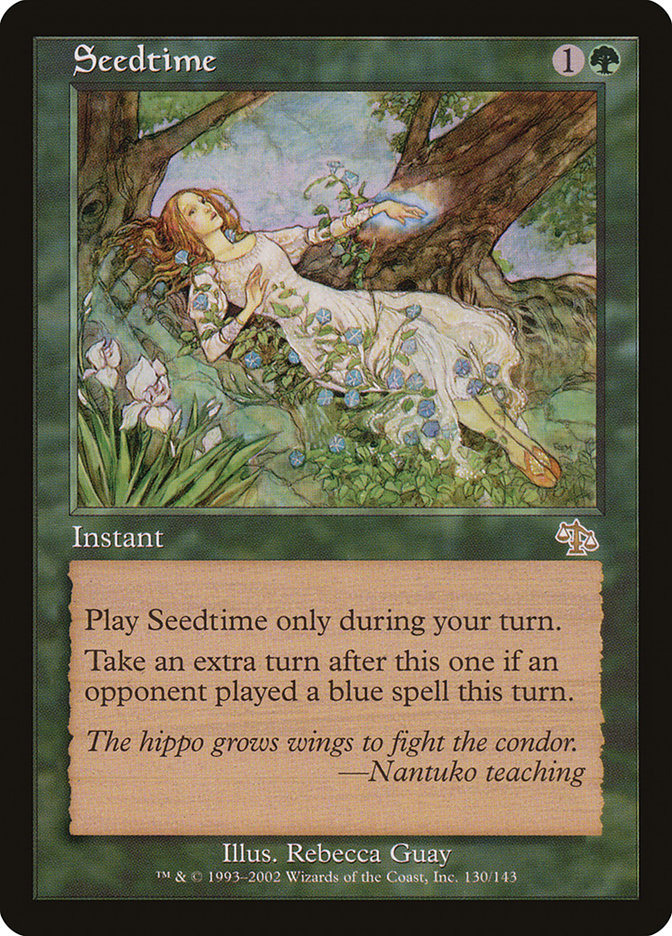
Seedtime is 2 mana instant for one generic and one green mana that gives players an extra turn. It only does this if an opponent has cast a blue spell that turn.
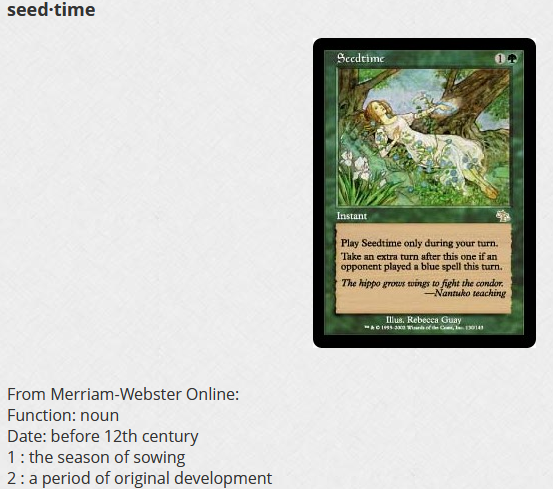
The term “Seedtime” refers to “a season of sowing” or “a period of original development.
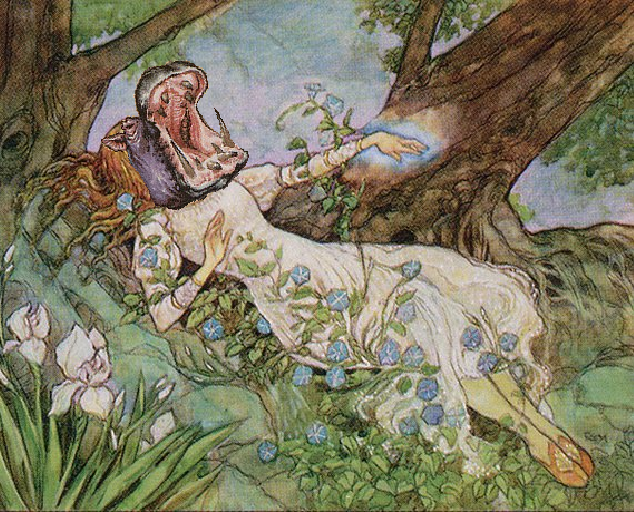
The art is classic Rebecca Guay woman doing something in nature. This time, she’s laying on some tree trunks with blue flowers coiling around her. Her left hand is held up with her palm facing forward commanding a halt, while her left hand is surrounded by a pale blue glow. Her position, and the surrounding vegetation, is reminiscent of the painting of John Everett Millais painting of Ophelia. I wonder what that’s about?
Seedtime is unique in being an instant, but it can only be played during your turn. This is a bit odd since the effect is not immediate, you’ll get the extra turn anyways, but it allows the player to cast the spell in response to a blue instant, say an impulse or opt, at the end of turn, allowing you to go through your extra turn with your opponent down on resources. The name doesn’t quite match the card’s name and sewing seeds as a metaphor. It feels a bit dissonant for planting the seeds for further success to be done at instant speed, or as a reactive action. But the card conjures a feeling of waiting, of discerning timing of when to “deploy” Seedtime. This feels more like an ambush, a trap, playing more like a blue spell that it seeks to hose. The green mage is waiting for the blue mage to respond, who is waiting for the green player to do something worth countering or responding to. Now imagine how much wasted time there is when the blue mage suspects the green mage of holding a Seedtime.
At the bottom of the card we reach perhaps the most befuddling flavor text ever created in Magic: the Gathering, a linguistic labyrinth, a semiotic snarl, a perfect mystery. Something that twists the mind into knots and exerts the vocal chords into forcing out a deflating “huh?”

I’m familiar with aphorisms, I’m not supid.1 I’ve heard“The road up and the road down is one and the same.” and “whereof one cannot speak, thereof one must be silent.” And I still have no clue what Seedtime’s flavor text is supposed to convey. It’s so baffling that I feel like I’ve been struck by the torpedo-fish. There has to be some meaning behind it. We’re nearly 400 words in, it can’t mean nothing!
I would be fine, perfectly fine, if it wasn’t for the flavor text’s subject. After all, what looks like a hippo with wings?
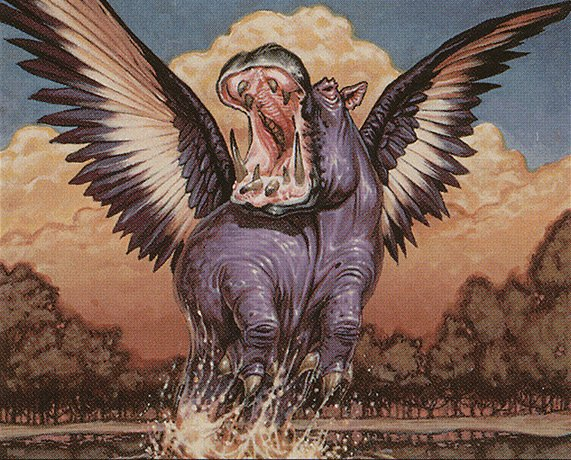
This one bit of flavor text might be the only in world lore of Phelddagrif, the only time it is obliquely mentioned on a card and taken as a known quantity in the fantasy world of Dominia.2 But can we be sure that this is about Phelddagrif? How could we know, when the flavor text is so opaque and it’s hard to tell what it’s about at all!
Normally, this type of flavor text isn’t very difficult to understand. The attribution of flavor text to a cultural teaching, a saying, some bit of plane-specific philosophy has been a long standing feature of the game. The one that springs to my mind is the 5th edition Llanowar Elves from 1997.

This specific example gives the reader an idea of the judicial system of Llanowar, but this bit of penal code helps flesh out the player’s idea of Llanowar. The flavor text evokes the Code of Hammurabi with unflinching violence and a focus on proportion. It also illustrates how Llanowar values the non-anthropomorphic natural world to the point that trespassing isn’t a violation of the person, but a violation of the will of the natural world. Pretty good for just twelve words.
Aphorism as flavor text is older than Llanowar elves, and there’s even more specific examples closer to the structure of Seedtime’s Aphorism. Mirage’s Pyric Salamander in 1996 offers insight to trauma responses and how that fear can hold a grasp on us. It also points out how scary and big dragons are.
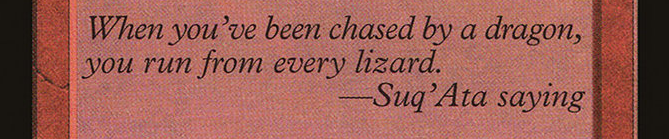
And in Lion’s Eye Diamond:

Lion’s Eye Diamond recognizes that the saying might be difficult to parse without context, offering an translation of the aphorism to the reader.3
But that was just looking at “sayings”. There’s more than one way to say “saying”. Take “proverb” for example:

Draconian Sylex, printed in 1994, and rightfully part of the reserved list, offers a look into the Icatian way of life. This one, not appealing to fantastic and expensive things like dragons and Lion’s Eye Diamonds, needs less explanation. The Icatians believe that there is no gain without sacrifice, a moral spin on the second law of thermodynamics, and a klein-bottle twist on the body-building mantra “no pain, no gain.”
There’s a lot of flavor text like this in the game. Plenty of proverbs, sayings, adages, poems, expressions, dwarvish forge-chants, troll chants (which are traditional?), riddles, and aphorisms, but what about teachings? A teaching is different from the rest of that cherry-picked list in that previous sentence. “Teachings” may point to a larger body of knowledge, not just one-off specific lessons like one of Aesop’s fables. Are there enough lessons to try and “recreate” this body of knowledge, knowing that the lesson from Seedtime falls in there somewhere?
We can always try, we’ve wasted so much time already. There are 22 cards which are attributed as a teaching from culture or ideology in Magic. 9 of those come from the Nantuko. They have the largest share of flavor text focused on teachings by a wide margin, with “Teachings of Eight-and-a-Half-Tails” having the second most at three.
Wow, those Nantuko are some studious bug nerds. Who are they?
Who are the Nantuko?
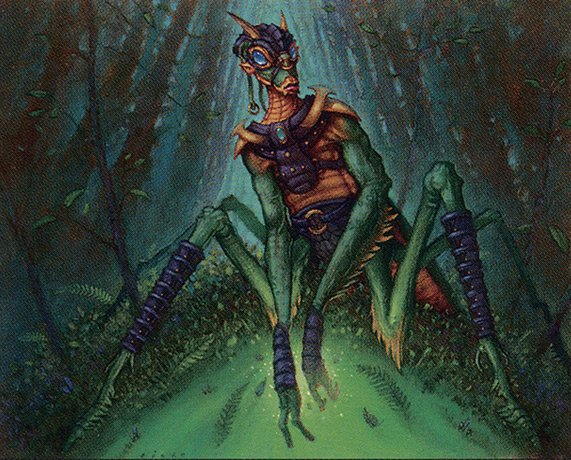
Not to be confused with the more recently re-introduced mantis looking Eumidians from Edge of Eternities: The nantuko are, according to the Odyssey Style Guide: “a race of wise, mantis-like creatures…Spiritually close to nature.” The earliest nantuko may be from The Brothers’ War as part of the Thelonite Order, but that’s not confirmed anywhere other than art for that one card. Besides, if it was ever true, it may have already been retconned.
The Nantuko of the Krosan Forest are thought of as contemplative by the other species of Otaria, or at least imagined as thinkers compared to goblins, who do not have a lot of teachings. The Nantuko respect for nature is juxtaposed by their disdain towards artifice, as well as magic using black mana. They also have an interesting relationship with death, sometimes turning into shades, indicating some transgression (maybe) has taken place by that individual. Although that’s not always the case, sometimes the Nantuko end up being weird stoically-smiling ghosts.
Phantom Nantuko proposes a problem with Nantuko clothing. It’s hard to tell how many clothes are appropriate for Nantuko, as the ghost is naked, but the Broodhatch Nantuko is geared up in leather, an odd choice for a “nature lover”. I wonder if the Nantuko raise cattle? There seems to be a large continuum on how much clothing a Nantuko wears…
There is a single legendary Nantuko: Thriss. He is the oldest of the Nantuko and, according to the Judgment Player’s Guide, has been around since shortly after the Ice Age, where he planted the seeds that became the Krosan Forest.
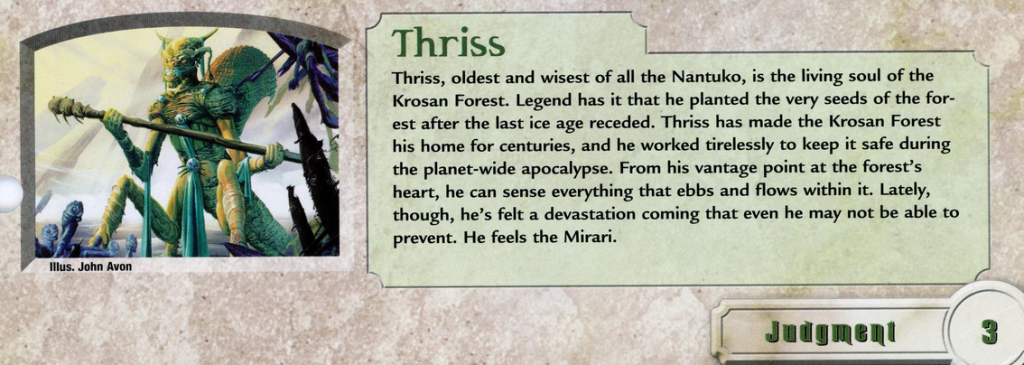
All that stuff about the “planet-wide apocalypse” and the devastation the Mirari is going to cause is fine, but what’s really interesting is the bit about the last ice age. There was another creature that made their debut shortly after Ice Age:
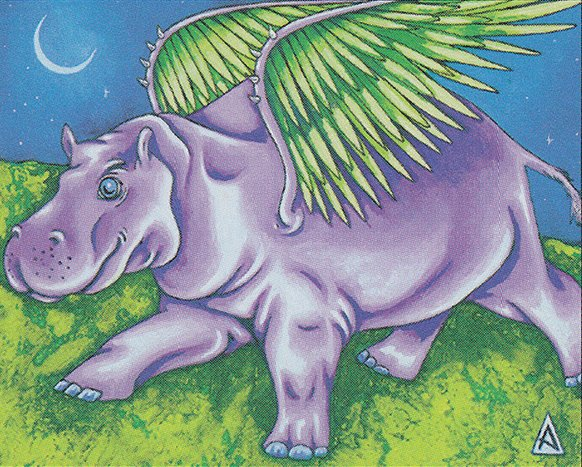
I don’t know what else Thriss did other than teach Kamahl to be a druid instead of a barbarian. Thriss was probably mutated by the Mirari and then died when the Krosan Forest was destroyed.
Perhaps Thriss and Phelddagrif had met at some point? Could the Nantuko teaching from Seedtime be a historical fact, and Phelddagrif fought a condor and Thriss saw it and thought “I should tell people about this in the future.” Although this is a bit specious: who is the condor? Why isn’t it an eagle, a griffon, another Phelddagrif? There are hardly any condors in Magic, the only condor around by the time Seedtime was printed was Skyshroud condor.
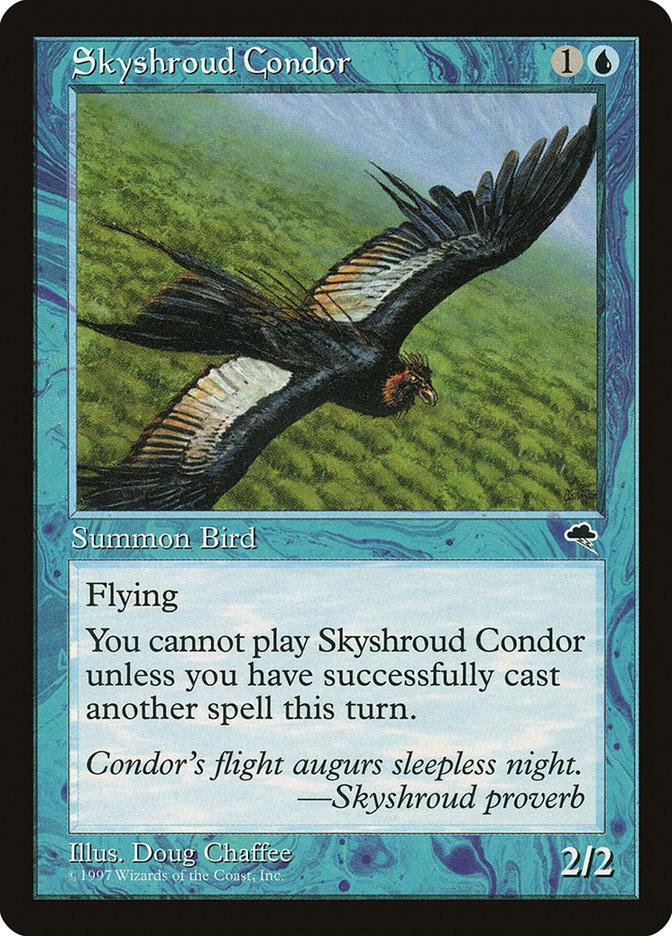
Which is on a different plane entirely! Airdrop Condor would be printed a couple months after:
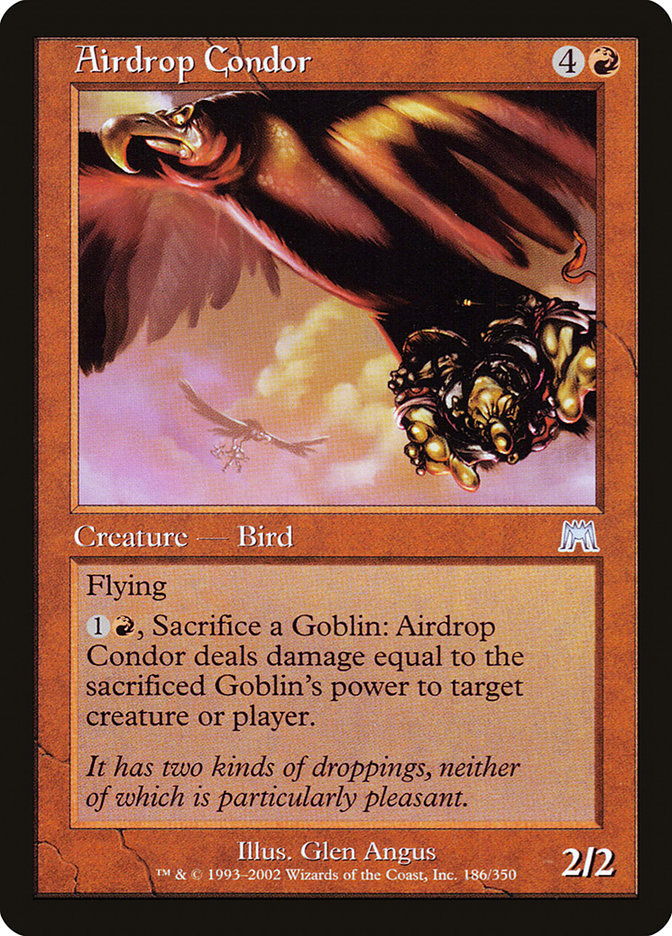
After Legions, Wizards stopped making Nantuko cards for 20 years, until Springheart Nantuko was printed in Modern Horizons 3, implying that they also may have originated from Kamigawa, slipping into Dominaria from the portal the Myojin of Night’s Reach opened to Madara.4
I’m not sure if understanding Nantuko culture helped with any interpretation of Seedtime other than taking it literally as Thriss seeing a flying hippo and a condor fight and telling other Nantuko about it. Although it may give some understanding for looking at the other teachings, and, through reading those together we might assemble a gestalt of Nantuko philosophy to guide an interpretation of Seedtime’s flavor text.
The Nantuko Teachings
A Note on Order
Approaching a collection of “teachings” brings a difficulty: what order to you read them in? Whether it’s the fragments of Heraclitus or the Tao Te Ching, the editor has to consider how to present these teachings and how to “stitch” these together.
Luckily, I get to side-step this conversation thanks to the ontological neutrality of collector numbers. So, no agenda here. Besides, we’re hoping to get a general idea of Nantuko ideology to help interpret a specific teaching, so the order may not matter much anyways.
Odyssey



Torment

Judgment


Still nothing to say about this one. Starting to think the most likely theory is that this was a story Thriss told young nantuko to scare them.
Onslaught
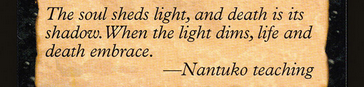
Can any conclusions be drawn from this? What might we say, after this deep dive into all the remaining Nantuko Teachings, Nantuko Philosophy is?
We know that the Nantuko believe in a soul, although it’s indeterminate whether it is immortal or not. They also believe that the spirit is separate from life and death. The tension between life and death as opposites is near the center of Nantuko philosophy. But at the core, Nantuko teachings seem very interested in identity and the self, as well as notions of personal responsibility: One should not necessarily seek solace in prayers because they could go unanswered, it’s better to do what needs to be done yourself. There’s a focus that the self should be industrious, and self-reliant, not relying on “wishes” or “prayers”, that there’s a risk in being “rooted” in something larger than oneself. And that the power of the self can be so strong it can literally ward off death.
Oh my god.
The Nantuko were libertarians, weren’t they?
The Interview
No…no…This is hard hitting investigative journalism attempting to solve the mystery of seedtime, not fanfiction. I will not brook unsubstantiated claims! I needed confirmation, something official. Obviously, it’s best to hear from the horse’s mouth. Who better than consulting the person who wrote the flavor text about what they were thinking when they wrote it?
Obviously, dear reader, there was some difficulty in tracking this person down. The flavor text was written over 20 years ago. I have a hard time remembering what I wrote yesterday, so it might be unlikely that anyone could remember what they intended by writing it.13 Even more difficult, flavor text was written in house at Wizards during that time, and no one may know who was responsible for writing which flavor text. Some said that it was impossible, I’d never find Seedtime’s flavor text author and, even if I did, they would never talk to me. Others said it was too difficult, which, since I shrink at any resistance within the first zeptosecond, meant it was also impossible.
And those people were right. Good on them! I couldn’t find anyone who would talk to me about Seedtime’s flavor text.
The trail stopped cold here. I can look at these texts all I want, mix and match them, collage them and put them in a summoning circle surrounded by Contracts from Below until the Holy Cows come home, but I’ll never really understand what the flavor text of Seedtime is about, what it’s trying to get at. It’s semantic nonsense, a bedfellow of the Walrus and the Carpenter. If only one could reveal the numinous meaning at the core of things by cutting them open and looking inside, literally getting to the core of the issue.
If only it was that easy!
Might as well give it a shot.
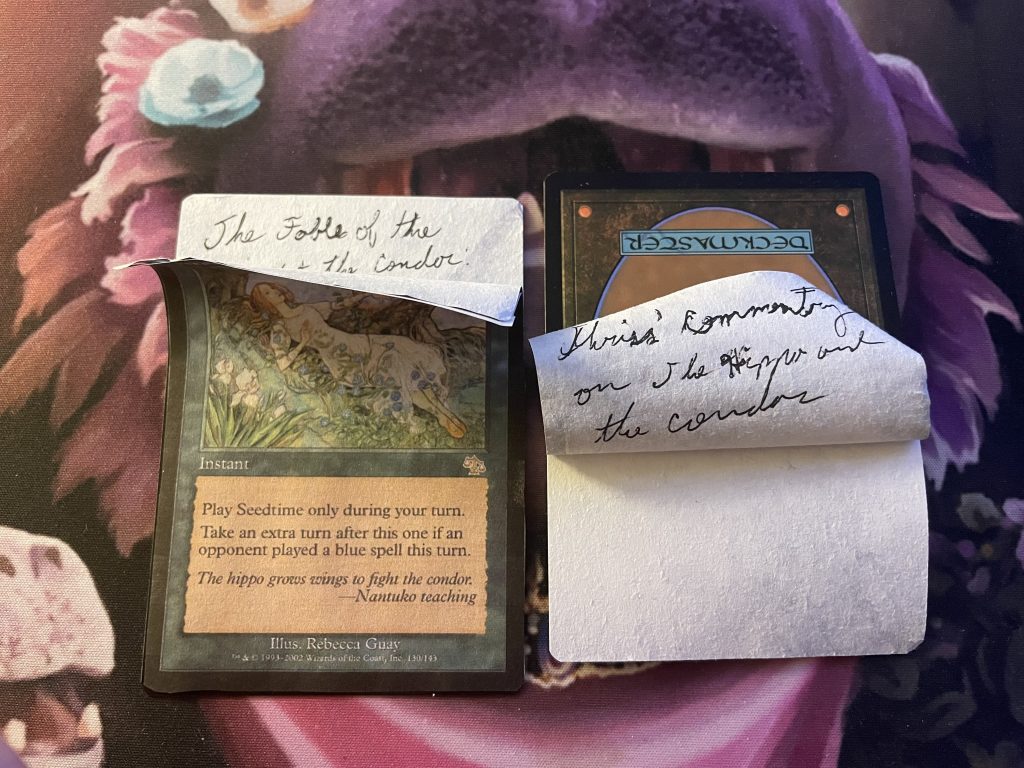
hmm…Well…Here’s what the cards say inside them:
The Fable of the Hippo and the Condor: A Nantuko Teaching
After the Ice Age, the ground thawed and the world teetered as its denizens relearned what warmth was. The world swung between harvest and desperate famines, and contagion spread across the world.
In this new world the condor believed it was their duty to bring order. The condor, holding court from its perch, claimed to see all from above, and would clean up the disease and carcass littered world. There were those who rebuked the condor’s magnanimity, claiming the condor was a tyrant imposing their will. But the condor had a rebuttal for each appeal.
“You swim in greed and are blind for it,” said the condor. “Such fecundity will be rot without end. Their blood will drench the ground and crush your crops, leaving nothing for the dirt to grow. The bones of the dead will fill the sky and blot the sun.” Which many found hard to argue against.
One day, while the condor flew seeking carrion, it received a request from a merchant.
“The road ahead has been blocked by a stone between this city and the next,” said the merchant. “With your swift wings, you would be able to carry the stone off the road, clearing the road and helping us continue to rebuild.”
“I am impartial,” the condor told the merchant. “And not used to taking requests. I take and clean as the world needs to return to a world that knows how to live with warmth, and to survive it without succumbing to fiery conflagration. I’m not a gravel huckster. Why not deal with this yourself?”
The merchant explained that they had tried, but none were able to move the stone. It was being guarded by the hippo, who was too strong for the merchant, the farmers, and the knights combined. “I cannot sell my wares, and the farmers are unable to bring their crops to the city. Without the road, the city cannot dispatch knights to deal with the bandits in the country. Without the road, the world cannot move on.”
The condor, seeking to return to a world that once was, warmth and all that yadda yadda, took up the request while making it clear to the merchant that it was not exchanging services but working towards a common goal.
The condor flew down the road and saw the hippo, standing resolutely over the stone. Seeing the determined expression in the hippos eyes, a furrowed brow and determined grin, the condor tried to reason with the hippo first. Perhaps conflict could be avoided.
“You must move on. The merchants, farmers, and kingdom need this road.” Said the condor.
The Hippo, a proud and noble beast who was not unfair, questioned why they must hinder themselves for those weaker than it, why must it relinquish what it had earned fairly, gesturing to the giant rock, by the sweat of its brow and the strength of its thighs, shoulders, loins and mind? Why must it cede what is theirs?
“The world cannot heal if you stay here,” explained the condor. “Eventually, all cedes to time, and, while unfair and unknowable, it is how the world is. We have no teachings on how to avoid death by igniting our soul or something like that.”
“It wasn’t meant to be this way.” Said the hippo.
“This is the only way for it to be.” Said the condor. Reason and understanding were not working, and the condor, reluctant, resorted to force, swooping down and soaring into the sky with the hippo’s stone.
The hippo continued to argue, and, when that didn’t work, begged the condor for more time.
The condor would only say “It will only bring you pain.” as it continued to fly away.
As the hippo felt their stone-like-burden (which is literally a stone) lifted from them, they also felt themselves grow lighter, but not any less determined. And so, seeking to take back what was lost, the hippo grew wings to fight the condor.
Thriss’ Final Commentary on The Fable of the Condor and The Hippo:
Bored, bored, bored! How bored I am of all these commentaries, of writing, of wetting my nib and scrawling on these dried leaves. I have left so many commentaries, on the condor being death, the hippo grief, on the violence of the state through taxation, heaps upon heaps of attacks on The Cabal, the nature of death, the motion of the heavens, how to crystallize a peach and milk a baloth…and there is no end! Words still come and I continue to write.
The monastery continues to publish these, handing out the leaflets of Thriss’ latest commentary, later, after a long process of review and a longer process of cultural adoption for it to become a new “teaching”…I can’t blame the monastery. I planted the seeds and named this forest “Krosa”, after all. This is what it is to be the Primus.
So I continue to write, and the forest continues to grow, roots penetrating further into the Earth while words continue their march across the page. How does one know when this stops, if not all at once and abruptly? It would be like dimming a candle; there is light until there is none. In the face of such instantaneity, what else can we do other than continue? Death, as natural as life, can only be defeated through the absurd belief that our projects keep going after we are gone, that others take up the nibs and continue our linguistic lineage. There is no guarantee, though, perhaps my descendants will scratch out my words and replace them with their own. History is rewritten, words acting like portals opening to other worlds and invading our home. Who is to say how it has ever been, or ever will be.
How absurd. How absurd.
How absurd. And yet, I continue. This is believing the hippo grows wings to fight the condor, to do otherwise is to lay down in defeat.
My first encounter with Phelddagrif was not with the original Alliances printing, but with Questing Phelddagrifs. I started collecting them, and, eventually someone keyed me in that my growing collection had a predecessor in Phelddagrif. It blew my mind that two different cards could appear to show the same thing while also being wildly different. One is clearly purple, the other thick grey skin; purple wings with spikes, the wings of a condor; one roaring in triumphant glory, the other with a peaceful enigmatic gaze. These Magic cards could show change across time, a story of a character at two different points in a story? The gears in my head started to turn, there might be more to this game than meets the eye…
But is there? So many decks, so much product around this flying purple creature-that-looks-like-a-hippo. It’s so much time spent writing and reading and rewriting about this thing. And I’m nowhere closer to understanding Seedtime’s flavor text, or if its connected to Phelddagrif at all!
Surely, this time must have meant something.
Seedtime is a bizarre color hoser from older Magic. The card asks the player to consider time, or timing, at least. The card is an instant, and can be played at any time, but only during your turn. It’s responsive, you only get something if your opponent cast a blue spell. Otherwise, nothing happens. The card makes the player consider time and timing. You have to predict not only what your opponents have in their hand, whether they want to play a spell on your turn or not, but what is in your opponent’s deck, or what opponents you’ll face at an event when playing the spell. You could run into red decks all day, and then you devoted slots to a card that does literally nothing. It might never happen, you might never get to take that extra turn. And then you spent your time doing nothing for no good reason.
One response to “Cede Time”
-
[…] color on some condor wings like the Andean Condor (Memory Gifted readers will remember my post on Seedtime and the confusion over the relationship between hippos and […]
- I am not too proud to avoid an obvious and cheap joke. ↩︎
- This is not a typo. I meant to type it that way, to establish some Vorthos cred. ↩︎
- Although I think we could have gotten there, understanding that lions are generally dangerous and to have one looking at you might mean you’re in a tough situation. The reader understands that, because this is a saying, unless Zhalfirin has a major voyeuristic lion problem, this is meant to be taken metaphorically. Still, this clarification is nice, and it would have been nicer to have one on Seedtime. ↩︎
- Which doesn’t exactly contradict the Thelonite Order thing, but the Thelonite Order turning into Nantuko was never confirmed anyways. ↩︎
- This teaching places an emphasis on silence. A simple reading of this teaching would lead us to believe that the silence is the response of negation for our prayer. But the teaching isn’t emphasizing silence, but negation. The “un”answer is the answer to the prayer, the negation of something contains a germ of the positive description. It’s reminiscent of the apophatic way, or an argument via negativa,of the medieval theologian Pseudo-Dionysus. The response, which is given (even if unanswered), is so holy, so transcendent that it gets interpreted as silence. ↩︎
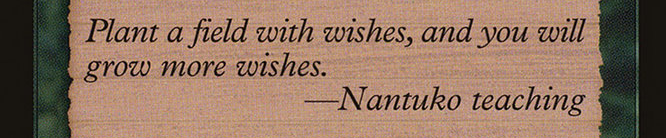
- “Shit in one hand and wish in another and see which fills up first.” is the first thing that comes to mind reading this, although the Nantuko are a little less vulgar. The farming analogy is interesting, and a bit difficult to parse if the Nantuko view agriculture favorably or not. Viewed negatively, perhaps it is a teaching about the insidiousness of wishing, the addictive quality of counterfactuals that leads to regret and resentment: a metaphysical If You Give a Mouse a Cookie. Viewed in a more positive light, perhaps it is a teaching about cultivating a positive view of the universe and attracting the good you want in the world.
A weird flavor text to include in the block that contained the original wishes. As written, both Cunning Wish and Burning Wish, could actually get copies of themselves. This, combined with Mirari, could lead to loops of wishing for a card and using the Mirari copy to get the original wish. ↩︎ - So far, the Nantuko philosophy is leaning towards statements bordering on tautology. Of course a field of wishes would grow wishes. A field of carrots doesn’t grow cabbages. It’s unfair to think of these bits of flavor text emulating koans that way though.
I suppose a reading of this could be about avoiding “rootedeness”, an attempt to persuade one to not be attached to the physical world, to those things that are changing, to not “root” yourself down, or to grow, to add to oneself, without being fixated on one thing. A plea to draw water from many wells.
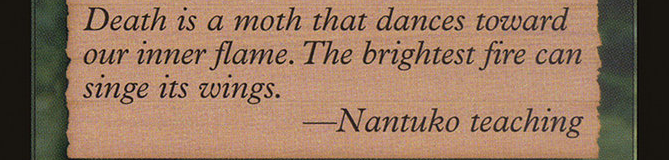
Once again, another weird flavor text considering that the white faction in Odyssey block were Nomads. The Order were also deeply spiritual, so perhaps there is some cultural cross-pollination of ideas occurring here, although the flavor text of Beloved Chaplain points to Nomad and Nantuko standing opposite of each other in some sense. ↩︎ - Getting a bit into metaphysics here, that our death is inscribed in our beginnings, a recognition of mortality as being the other half of mortality. The “inner fire” suggests that death can be warded off through intensity of ego, and that death is a force that effaces the personal. A couple things that are odd here (anticipating future teachings) is that death is characterized as neutral if not harmless. Before Kamigawa’s Kabuto Moth, moths were not a very threatening force in Magic. A dancing moth doesn’t exactly seem like a powerful adversary that one must defeat. More like a chore to take care of in order to live a healthy life. Repair the screen door to keep the moths out, warn them off with fire, put the poison in your clothes so moths don’t eat them, continue to live in order to avoid death.
The image of fire is odd here because Nantuko aren’t often seen or associated with fire. That would be the barbarians and dwarves. But I guess fire is universal enough that I shouldn’t be splitting hairs here. ↩︎ - Perhaps a look into Nantuko Aesthetic theory, that there are periods of “beauty” (when the blossom’s petals open) as well as periods without (during seasons with frost). This could indicate a natural aesthetic cycle, that there are seasons with and without beauty and they are dependent on the conditions of the environment, perhaps not just the natural world but the structures and “seasons” of one’s life as well.
It’s hard to tell if there is some psychology here too, because one could read the blossom closing as a reaction to “frost”, one’s psyche closing one off as a defense mechanism. The frost could also be the I, that one should not have a frosty demeanor (or “a mind of winter” as some horrible poet would put it) otherwise they will close the blossoms around them. ↩︎ - Another tautology, along the lines of “It’s always in the last place you look.” Perhaps a warning against fruitless searching, and an affirmation of Nantuko Philosophy of identity and semiotics. This brushes against Russel’s Barber paradox, trying to cleanly cut the gordian knot of that thorny philosophical dilemma.
Perhaps this points towards a bit of Nantuko Theology/Atheism, suggesting that there isn’t an omnipotent metaphysical force so great that it can break the rules of logic while remaining consistent. “None”, meaning “no thing”, can do this. If the Nantuko were asked “Could God make a boulder so heavy he could not lift it?” The Nantuko would say “No”, and perhaps also say that there isn’t a God (at least in that sense). ↩︎ - Charitably, there’s an interpretation towards Aristotelian metaphysics here, that our past creates our meaning in the world. This could be taken as a teleological argument, the acorn has the potential of an oak tree, but it isn’t as fixed as that. A map can show one where they will go, but a map isn’t a set of rules forcing one onto that path. There may be inertia of my personal history causing me to write about Phelddagrif, but perhaps tomorrow I’ll start carving the path towards an obsession with Brushwaggs instead. ↩︎
- This feels like it’s retreading the teaching from Refresh, although it’s painting it in a less adversarial light and showing life and death as a sort of two-halves-of-the-same-coin, and that the moment of death is not a victory over life, but an embrace between the two creating a sense of balance.
Perhaps, myself already primed here, this is similar to notions of death in the Tao Te Ching, that one does not simply “die” or “pass on”, but matter returning or changing shape, and the only thing that is lost is that form of matter, but the identity of the person (the soul) continues on in some fashion. ↩︎ - Although the flavor text is so iconic that is hard to imagine, but keeping an open mind is a virtue I’m trying to cultivate this year and not any longer. ↩︎
Leave a Reply