One of the oddities of my collection is this Questing Phelddagrif:
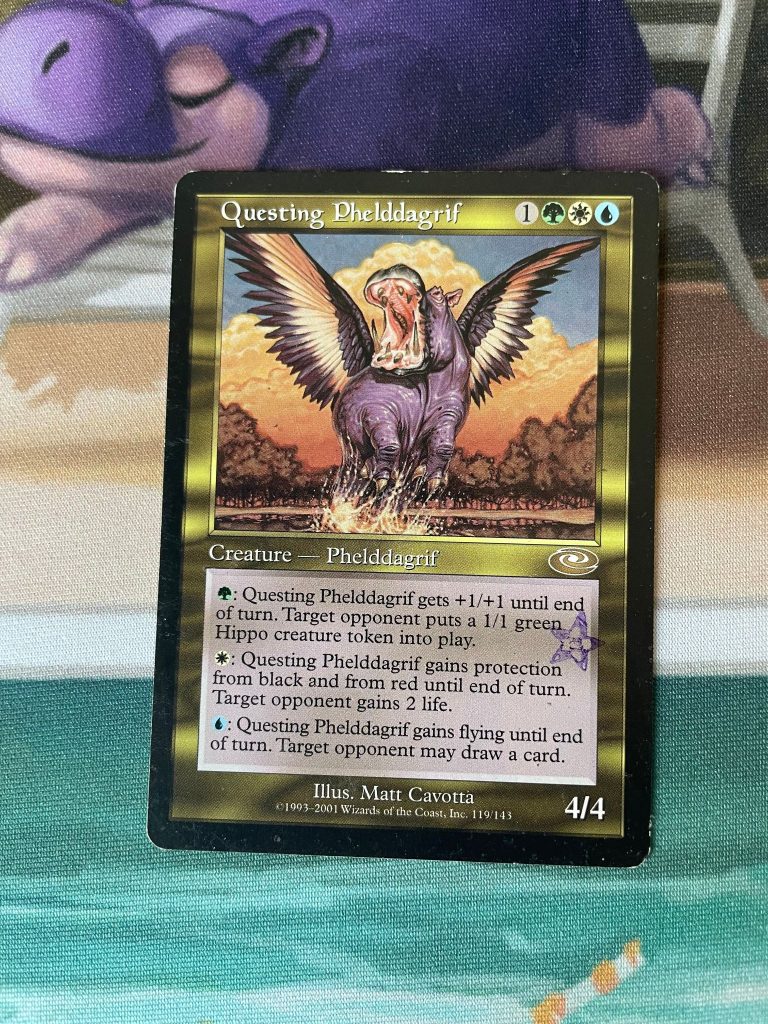
Keen-eyed readers may notice a purple star stamped in the text box that isn’t normally found on cards. Back in History Times, when there would be large limited tournaments for GPs, SCG Invitationals, and other bygone tournaments each card in the limited pool would be stamped. This was to prevent cheating by sliding in outside cards from personal collections or nearby vendors into their limited pool (a well-known example of this was Mark Justice’s Muscle Sliver cheat). While a star stamp seems easy to copy here, players wouldn’t know what shape the stamp would be, or even the color of the ink, that they should bring if they wanted to cheat. Maybe they bring a star stamp and green ink but the event is using a red balloon.
When I saw this a couple years ago on eBay, I snatched it up as a neat curio to my expanding Phelddagrif collection. The stamp was a sign that this card was present during sanctioned play at a high-ish level event. That’s neat, but just because a card was stamped doesn’t mean that it saw play. All cards opened were stamped, it was up to the players to decide what to play and what goes in what deck. With 45 cards drafted across three packs, there’s bound to be some last pick duds that you’ve got to schlep in your deckbox between rounds. I assumed that this Questing Phelddagrif was opened at some limited event sometime between 2000 and 2002, stamped, and left in a player’s sideboard throughout the event, left in the sideboard between a couple Sea Snids. I’m not Marshall Sutcliffe, but Questing Phelddagrif doesn’t seem like a very good card. It’s a four mana in three different colors for a 4/4 with no keywords, three different abilities that all give an advantage to your opponent. No thanks, I’ll play Goblin Game as the 23rd card in my deck instead.
Reader, who believes in me more than they should, I was pleasantly surprised, exuberant really, when I heard otherwise:
Turns out, the card was actually good.
What is The Good?
Let’s not beat around the bush, we know what a good card looks like, even when it’s bad. Like this one:
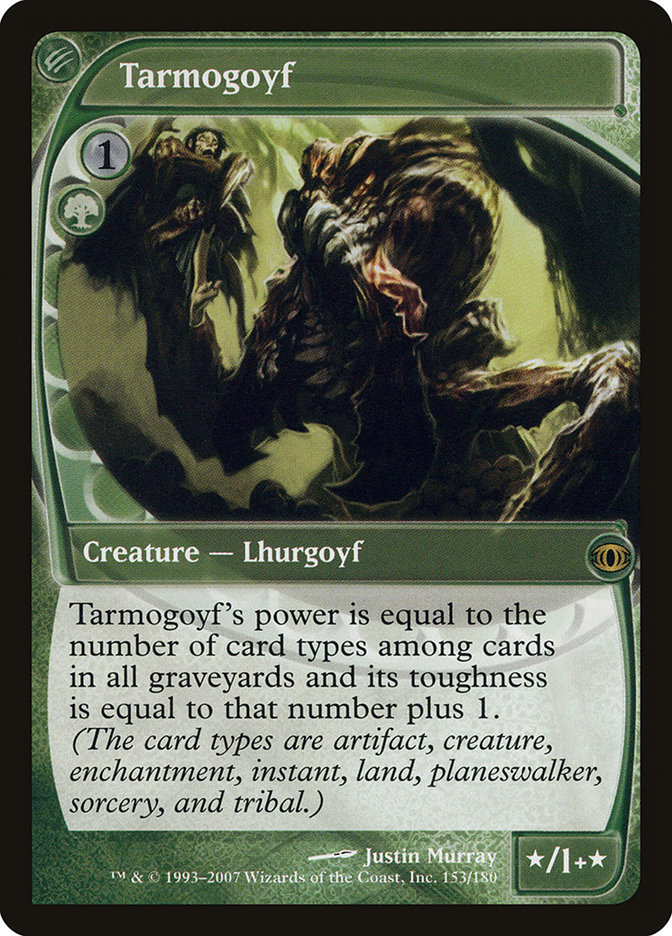
You know what this card is, unless you’ve been living under a rock, and you know it was good. Many players recognize the power of this card and, some wish it was still powerful and playable, while most wouldn’t say this card is good right now but will recognize that it once had the sauce. Tarmogoyf is one of these cards. This card is not good in any format it’s legal in, it doesn’t see any play now and it hasn’t seen any play for over 5 years, except for maybe 2015 Modern1. It’s not good because of the art. Certainly not the art, and the parsimony of design on the card is almost nonexistent (a bone thrown for my few Melvin/Melanie readers). But the impact of this card on Magic is huge, so that it even has a patina of good to it that can’t be entirely scrubbed off to time.
Tarmogoyf has an enduring legacy. Players remember how expensive this card was, having to pay $200-400 for a playset for their Legacy/Modern decks. There’s scandal around the card, there is a token for the card so that it can see play in Commander it was so beloved. Heck, die were made just for this card, it was that good!
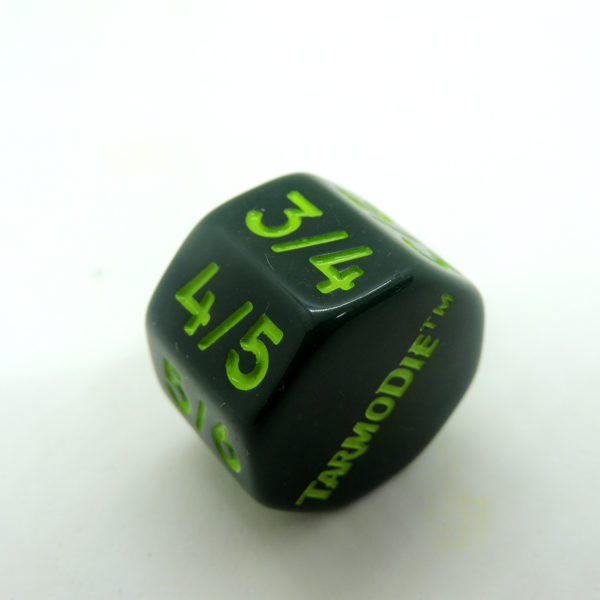
And, the card saw a lot of serious competitive play.
Respect the Competition
Phelddagrif has been, for most of Magic history, a joke. It started out that way, when the continuity director in charge of Alliances said that the name, an anagram of “Garfield Ph.D.” sounds like a flying purple hippo, not a badass nature goddess that would eventually become Freyalise. The card was then ignored as a bit of Magic zanyness until EDH became commander, Phelddagrif being at some fault for this, and some people picked up the purple hippo as an amusing multiplayer card until better things came along. Phelddagrif’s share in the meta continues to degrade to this day. Thank you Mrs. Bumbleflower.
In this context, we have a small sliver of time where Phelddagrif could be called a “good” card, in that it saw play and people built it in Commander, a casual format, at one point in the distant past.
While Commander is very popular and has done a lot for Magic, when someone says a card is good in commander there’s a sneer behind that qualifier. Cards that are good in commander always seem to have that qualifier necessary. Nobody needs to say that The One Ring is good in Commander, you say The One Ring is good. Cultivate and An Offer You Can’t Refuse though? Those cards are good in Commander.
For a card to, with heavy emphasis on the past tense, have been good in Commander feels like being slapped with the same fish twice.
But, what if, there was a different history to Phelddagrif? What if something could be uncovered about any variation of Phelddagrif (both non-questing and questing) being a force to be reckoned with? Something that could be played for higher stakes than getting someone a soda/pop/cola?
Finding Questing Phelddagrif was good in Limited was a nice treat. It was the first step to this truer history, knowing that Phelddagrif once had a place somewhere other than the fake hell-of-our-own-creation-and-a-little-bit-Wizards’-fault-too that is Commander. But this lacks something that other “good” cards have. Maybe someone was dream-crushed by Questing Phelddagrif at an FNM draft in 2001, but who else would talk about that other than the store? Being a “limited all star” means little if you don’t have a proper stage.
2001 Grand Prix Kobe
August 18, 2001 saw the start of the seventh season of the Pro Tour, beginning with two Grands Prix2: one in Denver, Colorado and the other in Kobe, Japan. Held at the Kobe International Exhibition Hall, over 1350 Magic players signed up to play Invasion Block Constructed, a format with a 60 card deck with 15 card sideboard only using cards from Invasion, Planeshift, and Apocalypse. That’s a mere 621 cards, less than 15% the size of the current standard card pool at over 4000 cards.
Despite the small card pool, the top 8 for the tournament had a variety of decks. I’ll list some of them here, but I’m working off these Japanese wiki pages for this information and I’m not sure how accurate some of the names for these decks are such as:
Steroids: a R/G aggro that Shuhei Nakamura took to 2nd place deck featuring Thornscape Familiar to make your threats like Thornscape Battlemage and Raging Kavu cheaper, and burn your opponent out with Ghitu Fire and Urza’s Rage. Kei Ikeda placed 3rd playing a similar list splashing blue.
Crosis Control: A control deck in “Crosis” colors3 that sought to control the game through counterspells like Disrupt, Undermine, and Exclude while controlling the board with Repulse, Terminate, and Void while pushing over the finish line with burn like Prophetic Bolt and Urza’s Rage. It was played by Hiroshi Kawasaki for 5th place.
Star Spangled Slaughter: A Jeskai midrange deck playing some pretty strong creatures like Meddling Mage, Goblin Legionnaire, and Lightning Angel. Also plays Urza’s Rage. Played by Ryou Ogura for 6th place.
The Solution: A deck meant to be the solution to all the problems in the meta, playing creatures with protection like Galina’s Knight, Crimson Acolyte, and Voice of All to block and get through all other creatures, while playing the control suite of Absorb, Exclude, and Repulse. Takuzo Hasegawa played this deck and placed 7th.
Trench: This deck is all either counters and permission (Exclude, Repulse, Evasive Action, Absorb) or Burn (Fire//Ice, Urza’s Rage, Prophetic Bolt). No creatures, other than the ones made by Goblin Trenches, which I doubt would win the game but would create blockers until the Trench deck won through sheer oppressive permission. This deck looks absolutely miserable, I love it. Takashi Ishida won the GP with this deck.
But what about the much vaunted 4th and 8th place slots? What did Kenshiro Ito (8th place) and Takayuki Nagaoka (4th place) bring to earn them such prestigious places in the top 8?
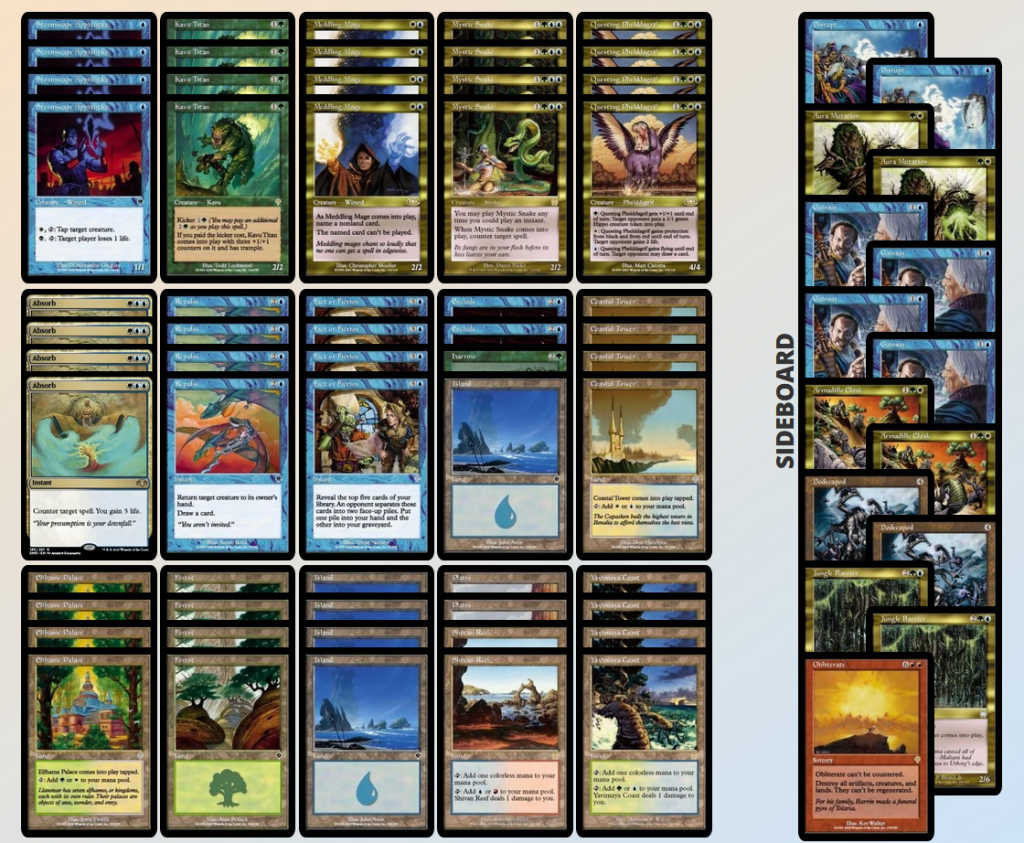
What a wild looking deck; 4 color control with 10 counterspells across Absorb and Mystic Snake and no creature removal at all. Nothing to take care of your opponent’s Flametongue Kavu or Opposing Kavu Titan’s once they stick except for Repulse. This deck is hoping to get to the long game, to stick things out until they can refill their hand with Fact or Fiction and then start beating in with a Kavu Titan or even a Questing Phelddagrif. The RG deck being a large part of the format and most removal being red based made the protection on this creature really good and a resilient threat to the format. While your opponent may gain some life, they’ll have a hard time removing the 4/4 beater permanently.
One of the neat things about this deck is that it is splashing red not for Fire//Ice or Prophetic Bolt (or even Urza’s Rage, it is the only deck in the top 8 not playing it) but for Obliterate.
Looking at Takayuki Nagaoka’s record, he had a pretty great run with the deck, winning the first 10 rounds before his first loss in round 11, ending the swiss with a record of 11-1-2 to make top 8.
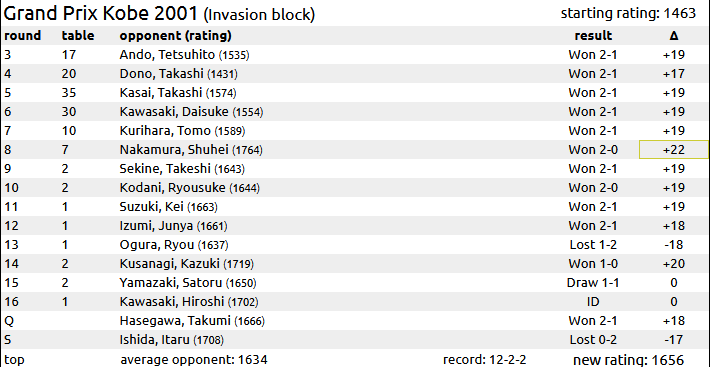
He would go on to beat Takuzo Hasegawa on The Solution in the quarterfinals, a U/W permission strategy that played creatures with protection such as Crimson Acolyte and Voice of All to stick threats that could not be answered to take over the game. Eventually, he would lose in the semi-finals to Takashi Ishida (who would win the tournament).
This strategy, control the game until you can cross the finish line until you can beat down with an evasive and sticky creature, isn’t new. It isn’t new to Invasion Block Constructed, as The Solution was doing something similar. And it wasn’t even new to use Phelddagrif to do this.
1997 Australian Championships
Nationals were large tournaments that took place from 1995-2011 (returning briefly in 2017 and 2018), a 16 year run for tournaments meant to showcase the best players from each national region. Top four players would get an invite to worlds, the winner of Nationals would lead the “national team”. In 1997, Australia would hold a very special and important National’s tournament. Although this wasn’t known at the time, someone must have sensed it in the air, as SideBoard, the magazine Wizards printed and published online, decided to commemorate the tournament by sharing these factoids about Australian Nationals:
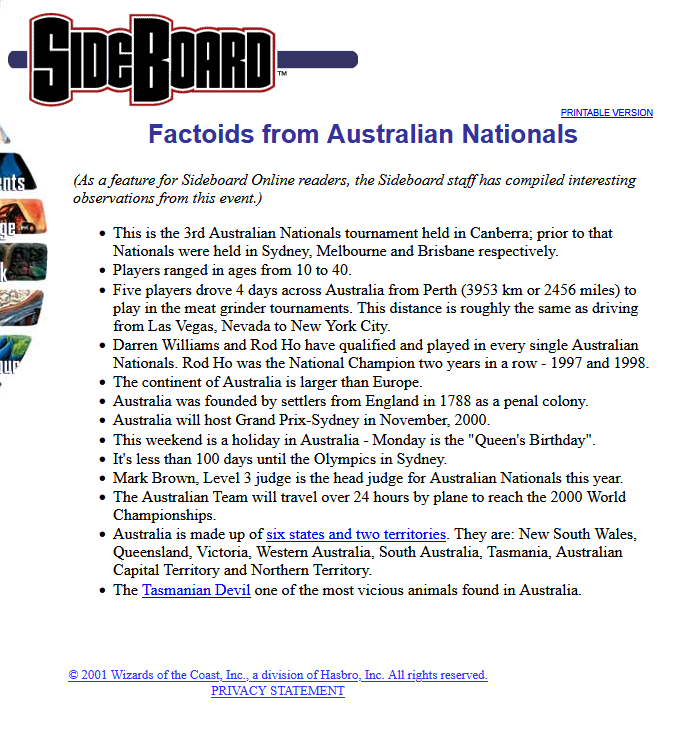
I can’t tell if the penal colony thing or the warning of the Tasmanian Devils at the end is the strangest part of this list (Here’s the page the Tasmanian Devil hyperlinks too. It’s a website you will never forget.)
In 1997 Rod Ho won Australian Nationals with this Standard Phelddagrif Deck
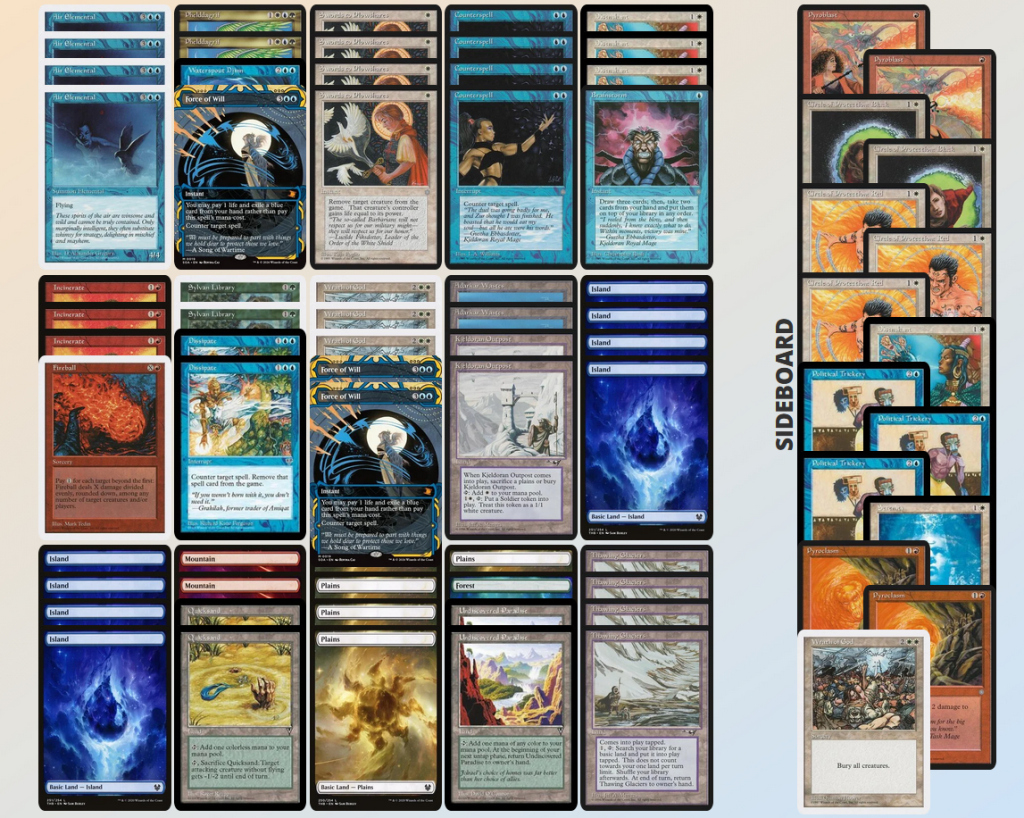
I first stumbled on this deck through a youtube channel doing old tournament replays that was playing the Australian Nationals Championships 1997 bracket: Phelddagrif vs. Forgotten Orb. The video description has this succinct summary:
Two tournament decks from 1997 Australian Nationals: Phelddagrif and Forgotten Orb. Lenny Collin’s/Rod Ho’s Phelddagrif Deck: This is a 4 color control deck (UWgr) used in Australian Nationals tournament in 1997. Phelddagrif is a multicolor creature that can be bounced (U), can trample (G) or fly (W). An ideal creature for control decks combined with Wrath of God.
Yeah, I guess Phelddagrif is pretty good when combined with Wrath of God.
The deck, which Rod Ho took to 2nd place and Lenny Colin’s took to 97th place, is not traditionally called just “Phelddagrif” as the youtube video claims. Instead it’s a version of CounterPost. It’s surprising to see this deck in the same format that would see Necropotence combo decks and the beginning of the well-oiled machine that is Sligh (or Red Deck Wins). But CounterPost has all the tools needed to deal with these decks. It’s a classic control strategy, using efficient counters and removal (Counterspell, Force of Will, Swords to Plowshares) before ending the game with a wave of soldier tokens made by Kjeldoran Outpost.
This 4-color version introduces some variations from the more traditional CounterPost decks. It’s usually U/W control, the most famous version being the one Jon Finkel played at the 1997 US Nationals. The version Rod played included Fireball to give some more reach, as well as Phelddagrif as an additional threat.
Reader, who is doing a great job!, you may doubt that this “counts” towards Phelddagrif being a competitively viable card. It’s not crucial to the strategy, there’s already a core version of CounterPost focused on cards like the titular Counterspells and Kjeldoran Outpost. Even Thawing Glaciers seems to play into the play pattern of waiting to do anything until the end of your opponent’s turn. You would be right to be doubtful, but I think Phelddagrif is doing something interesting in this deck and adds some utility.
Phelddagrif can be bounced back to hand to avoid removal or an unfavorable combat. Another neat part about Phelddagrif in this list is that it can be bounced to hand and pitched to Force of Will if needed to counter a crucial spell.4 This technique of pitching Phelddagrif is used later as well.
I keep calling this CounterPost, and I’m comfortable doing so because that’s what it’s called in this tournament report published on The Dojo for Australian Nationals. The pilot also played counterpost, not to the same success as Rod Ho did, but did not include Phelddagrif in their list. In fact, the Tournament report mentions that Michael Landers included Phelddagrif at the last minute addition to the deck. Which leads me to wonder about why the deck Rod Ho is playing has 61 cards; could Phelddagrif have been the 61st card added to the deck? Who knows! I have no way of reaching out, but if you know how to reach them and they can remember a tournament that was 29 years ago, please ask them for me!
If you want to read more about this tournament, you can read this tournament report by Michael Landers
Interlude
This, like all my Phelddagrif writing, has been fascinating and entertaining. It is also losing the plot. Are these really examples of greatness? Fourth place at a GP? First at Nationals? Those aren’t bad records, they’re quite good honestly, better than I could do. But we want to find something that makes Phelddagrif distinctive, something worthy of great renown. Something to really heap the laurels on its purple crown.
1999 Tokyo World Championship
The 1999 Magic World Championship in Tokyo was a watershed event for the game. Featuring a busted standard format of Tempest-Urza’s Saga block, and inviting some heavy hitting pro players whose names still reverberate in the halls of Magic history today: Brian Selden, Raphael Levy, Randy Buehler, John Finkel, and of course, Kai Budde who would go on to win the tournament and be crowned 1999 World Champion.
So much has already been written about this, about it being shot and aired on ESPN, about Kai’s rise to the top and his legendary winning streak, about the busted standard format and the bans surrounding it, about the accommodations in Tokyo. But less focus was given to the Extended portion of the tournament on Day 3. Decks ran the gamut of Counter Sliver, High Tide, Pox, RecSur, Sligh, and CounterOath.
Particularly, the CounterOath deck that Joao Isidro from the Portuguese team played. This was a slight variation of what was being played by other CounterOath strategies, which played Morphling as the top end and sought to loop Triskelion and Spike Feeder when milling Gaea’s Blessing with Oath of Druids. Instead of running Morphling as the top end like other oath decks, Isidro ran Phelddagrif.
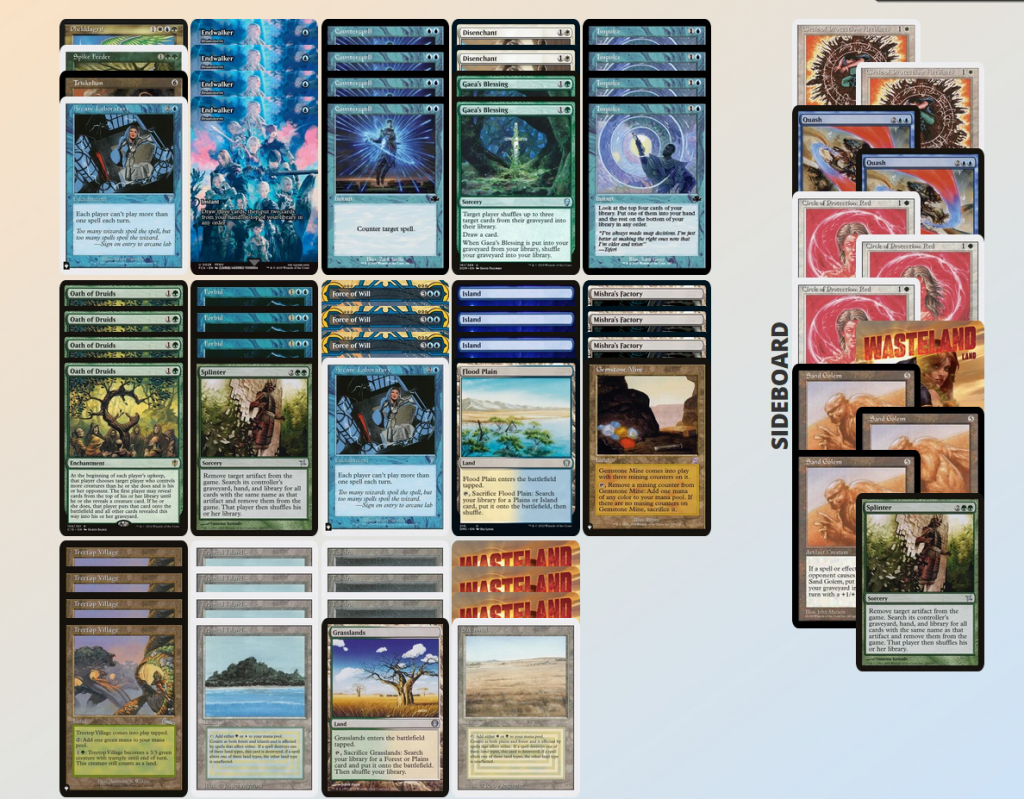
Oversoul on the Casualplayers.org forums has a great write-up on what this deck does differently; highlighting the oddity of Phelddagrif keeping Oath triggering, while being a prison deck using Arcane Laboratory and Forbid to prevent your opponent from resolving a spell the rest of the game.
But is Phelddagrif crucial to this strategy? Well, it was one of the few ways to give your opponent a creature at the time, while simultaneously acting as a threat that can continue to attack your opponent with evasion, although Morphling was a faster clock. But Phelddagrif can be used to give your opponent multiple hippos, triggering multiple Oath of Druid’s to gain life or do damage multiple times through the Spike Feeder and Triskellion loops.
Additionally, the same trick that was done with Force of Will in the 1997 CounterPost deck can be done with the buyback cost of Forbid, and then shuffling the Phelddagrif back in with Gaea’s Blessing’s triggers to get it back. Phelddagrif isn’t just a blinking spirit, a hard to remove creature meant to end the game. It’s not a poison dart frog acting as a mascot hanging out in the sideboard. Phelddagrif was central–nay–core to the strategy of this deck on the main stage of the largest tournament of the year and one of the most important tournaments in Magic history.
Atlantic Crash
Reader, have I not proven that Phelddagrif is a good card? Is my argument not only comprehensive, overdetermined, and also air tight? If not only being played to a top 4 finish in 1999’s worlds, but to place in two other large Magic tournaments of yore? While also having the feather in the purple-and-green Phelddagrif cap of being a Limited All-Star? Having discovered or uncovered these truths about Phelddagrif, I had a responsibility to go out, outside to the people where they are outside, and correct the record.
Looking to blast from the past some unsuspecting commander players, I went to my Local Game Store with my Phelddagrif decks in tow. I had tried to politic Phelddagrif before as a useless commander, that unless there was an entirely empty board there was no reason to target Phelddagrif. With what I know now that couldn’t be farther from the truth. This is a National’s winning card, played in high level competitive tournaments, the World’s tournament of Magic. I sat down at a table, grabbing a “looking for more for cedh” banner and waited for my unsuspecting competition to come to me.
My opponents, younger than me, questioned my commander choice. “This is a tournament winning card.” I told them. “Australian nationals 1996? Grand Prix Kyoto 2001? Haven’t you read the article on “Counter-felddagrif” from the mtg.wiki Japan? Rod Ho and Joao Isidro, haven’t you heard of them?”
Their blank stares spoke more than words ever could.
Was this the fate of the search for Glory? Briefly burnished by grandeur’s glow, only to recede back into obscurity? How cruel, this Pyrrhic venture to be known and respected, to touch greatness only to be disfigured by time into something unrecognizable.
“You’ve at least heard of Tarmogoyf?” I asked my fresh faced opponents. “They made a die for it.”
“I don’t know about all of that.” My opponent put Thassa’s Oracle on the stack holding priority to cast Demonic Consultation (there it is! The old card that became new, that rejuvenation! Oh what sorrow it is to be a creature printed before FIRE design, when instants and sorceries constantly bask in the sun’s glow!). My opponent named “Phelddagrif” as they flipped their deck into exile.
- I’m pretty sure this will be the next pre-modern in ~5 years. It has the chance to be cheaper since there are no reserved list cards, while tugging at player’s nostalgia for a format from 15 years ago. Sadly, I think the cards will end up getting expensive quickly, as there’s not a lot of opportunity to reprint these cards this year and, if that trend continues, few reprint sets in the future.
Reader, I hope you’re proud of me. I actually used a footnote for the correct thing this time. This section has nothing to do with Phelddagrif being played in high-level competitive events. Go back to reading the rest of this post, I worked on it. Not very hard though. ↩︎ - Isn’t that a weird pluralization of a word? Well, according to very accurate websites that is correct! ↩︎
- Before there were shards and wedge names people allegedly used the names of the elder dragons. I never heard anyone use these names and would probably just say “UBR Control”. ↩︎
- Although this is major card disadvantage to do so, since it gives your opponent a card and you have to lose Phelddagrif and Force of Will, it’s almost a two-for-zero in your opponents favor. ↩︎
One response to “Compet-agrif 1: The Waters of the Pacific”
-
[…] course, you can read more about this in my last blog post. We’re six candles in and I’m already stretching Phelddagrif […]
Leave a Reply