
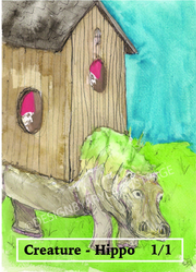
On August 17, 2017, the user DirkGently posted his Phelddagrif Commander deck and and primer to the Commander decklist forums on mtgsalvation. Over the next nine years the deck would be updated and tinkered over, with discussion eventually migrating to mtgnexus in 2020. Combined, both threads total over 800 posts. This post is about the that thread thread, one with the most amount of words over the longest period of time on the single topic: how to build and play the most Phelddagrif Phelddagrif Commander deck possible. devoted to this deck: new card discussion, what to remove, strategies and game reports.
While the thread contains the technical minutia of what players expect when opening a primer (new discussion strategy, game reports), that isn’t how the it started. DirkGently’s primer starts with an alter of Phelddagrif depicted as a saint in a stand glass window. Phelddagrif is reading from a blue book, while holding a small purple hippo swaddled in a green cloth. Their green wings cascade down the border of the card, a white hot burning heart at the center of Phelddagrif’s chest. It is worth opening the primer to see the detail in this alter on its own. My favorite is the power/toughness being represented as chapter-verse notation at the bottom of the alter.

It’s a captivating way to get the reader engaged, quite different from what’s expected from the purple pachyderm. It sets a tone of reverence for Phelddagrif, a bit silly in how ornate it is. The Primer continues with lofty language around playing Phelddagrif: “He is politics become a weapon” “He is capable of winning at the most competitive Grand Prix tables”. The title of the thread is lifted from disruptive pitmage’s flavor text: “Phelddagrif: Show Weakness to Hide Strength”. The thesis of the deck stated clearly upfront:
“No experienced player of commander could reasonably feel threatened by Phelddagrif.
Which is exactly why it can win over. and over. and over.”
The primer is comprehensive. There are sections on deck history, how to politic, how to play Phelddagrif, gameplay, deck composition, different versions of decklists, tips and tricks, a card glossary and changelist. At over 11,000 words, a summary can not do it justice, but to give an idea of what’s in the primer the deck lists call for approximately 20 targeted removal spells, 8 board wipes, and 12 counterspells, and 40 lands, a few of which generate slow value such as the Clue Lands, Scavenger Grounds, and Arch of Orazca. There are no win conditions other than dealing 21 commander damage with Phelddagrif: 6 attacks (without cards like Okina, Temple to the Grandfathers, which is also in most deck lists)
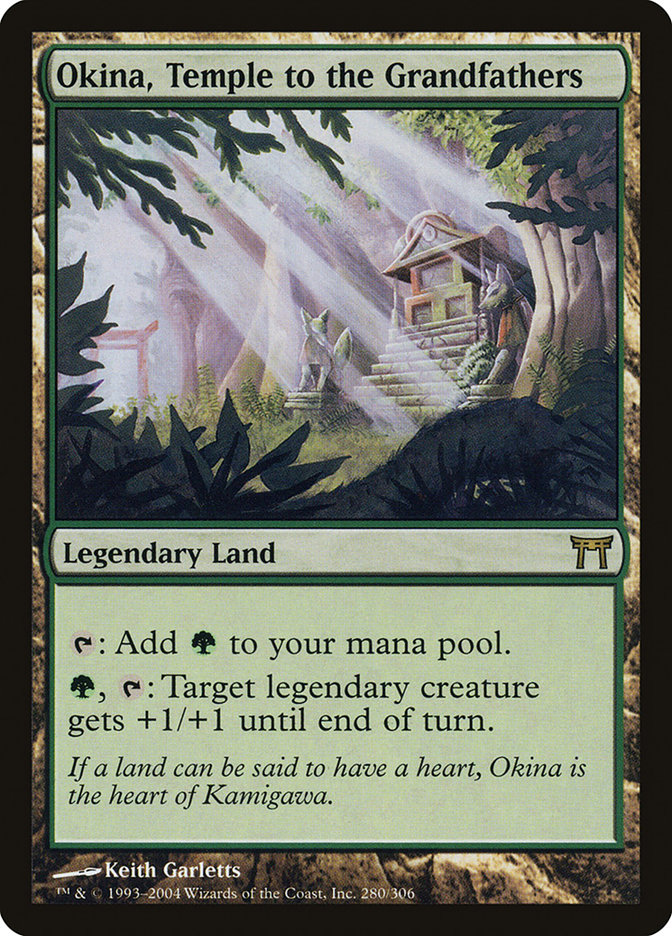
The deck toes the line, trying to sneak under the radar of other players while steering the direction of the game into a 1v1 death match against a weakened final opponent. There can be some deals, but not too many, or you’ll be seen as politicking the table and taken out early. You can cast your permission, but not always right away, or at all, otherwise people will think you’re always holding interaction and eliminated. The pilot performs a high-wire act of playing it safe and appearing non-threatening while keeping enough gas for you to cross the finish line.
It’s important to figure out how to communicate threat assessment, staying behind on board with the goal of jumping ahead at the end. On March 4, 2019, user Discomute calls this “Bradburrying”, named after the Australian speed skater Stephen Bradbury who won gold at the 2002 Olympics by staying in last during the race and avoiding a collision at the end that took out the other 4 skaters. Your opponents spend so much time competing against each other that they crash into each other at the last minute and the Phelddagrif deck ends up winning.
This strategy is baked into the card choices. Instead of looking for the most efficient threats, engines, and permission, DirkGently and the rest of the thread look for what is efficient while also being unassuming. Rhystic Study is great, but it draws a lot of attention, and the card draw isn’t worth the attention that the card draws. A card that demonstrates how far the deck Bradburries is the card Conqueror’s Galleon:
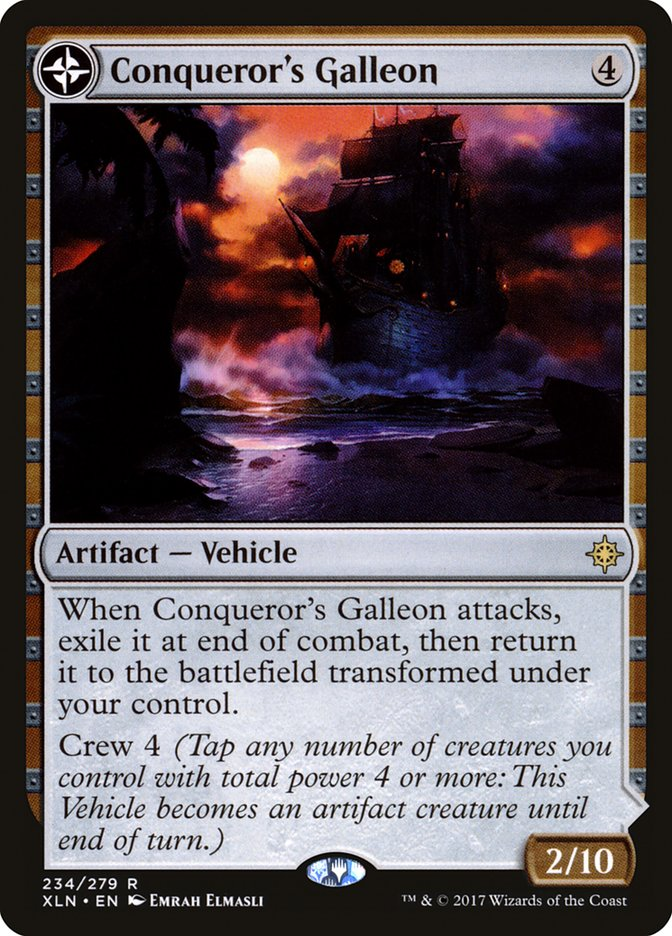
A 4 mana artifact that transforms after attacking, the crew cost perfectly matches Phelddagrif’s power. The flip side of the card…
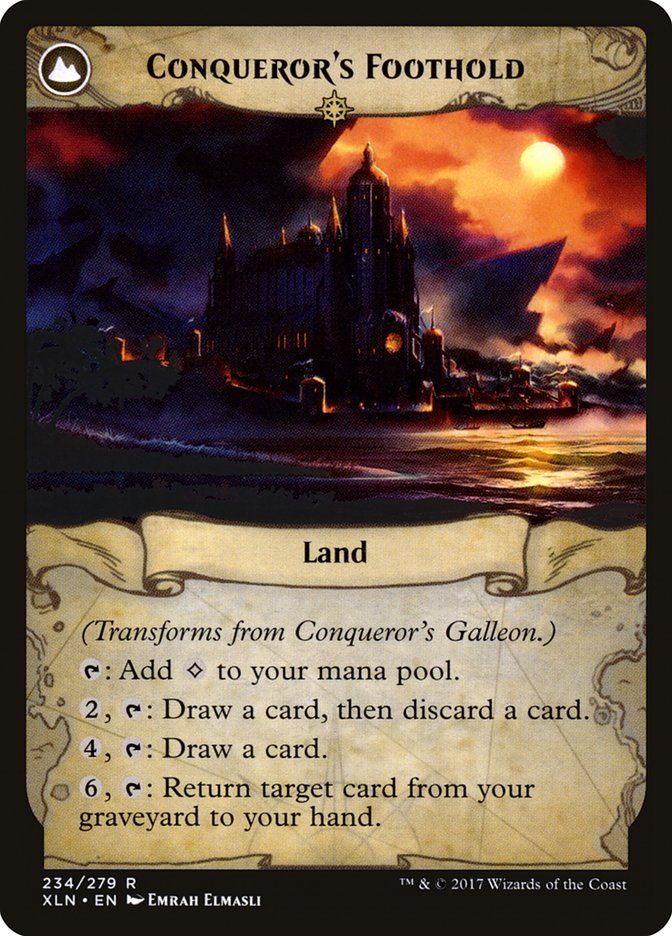
…seems like it was built for the deck. The curve here is immaculate. Turn 4 Galleon into turn 5 Phelddagrif, crew and flip into Foothold. Suddenly you have a card advantage and recursion engine on a land! It doesn’t matter that it costs a infinity and a half mana to do any of that. And, while a pretty good value engine, it looks meek compared to cards like Trouble in Pairs and The One Ring. Yet, the card has no place in the deck. As DirkGentlywrites about the card:
It slows the game down to a crawl, basically, a miserable crawl with all the focus on you, where you’re going to win but it’s going to take forever, and at the end people will not be thinking “huh, how weird, that game had so many powerful nasty things happening, but at the end it came down to just a derpy hippo beating face after doing nothing much all game, isn’t commander funny?” No, they’ll be thinking “Well, that Phelddagrif deck LOOKS innocent enough, but eventually it’s going to pull off some lockdown combo so you’d better smash it when you’ve got half a chance.”
The Bradburry Paradox
While the sheer amount of Phelddagrif discussion may have attracted me to the deck, what kept me around was the paradox of the deck itself. The gameplan is to be as nonthreatening as possible, while you use below-rate permission spells and Phelddagrif’s abilities to position the game into a situation where the decks only win condition can push you across the finish line. It’s sinister, it’s conniving, it’s Machiavellian!
And it’s entirely dependent not only on the playgroup and how familiar and receptive they may be to the strategy, but also the pilot, and the pilot’s relationship to the playgroup. What deals are banned at the table? What if the other members of the group don’t like making deals, or like talking at the table? What if the pilot has a nasally voice and the group doesn’t like hearing it? A lot could go wrong here, and it’s compounded by the deck being played in commander, one of the biggest formats in terms of card choice. Hell, I’d love to know how Acorn cards throw a wrench into the cogs of this deck, something that was briefly brought up in the thread.
Using the term “paradox” very loosely here, this is the contradiction in the deck. It depends a bit on the cards, but it almost depends on the people in the group more. You may play with a group of people who will see someone in last and think nothing of it, and others may smell blood in the water and start to pummel last place even more.
I think it’s this variance that leads to so much discussion over the deck. As much as the thread becomes about updating the deck, it also becomes about updating strategy, and thinking through the multiplayer way of playing Magic. While the players know the mechanics, the rules of commander are still unexplored terrain. On September 27, 2018, DirkGently posts:
“I think most people don’t pay a ton of attention to politics and the nuts and bolts of multiplayer interaction, because it basically just doesn’t apply outside of this casual little bubble. When people are trying to understand stuff like card advantage and tempo, there are loads of people writing on the subject for a competitive audience in 1v1 formats and they’re widely understood and talked about so it’s easy to pick up, but there’s very little scrutiny on things that only apply in multiplayer, so most people ignore it, or at least simplify it.”
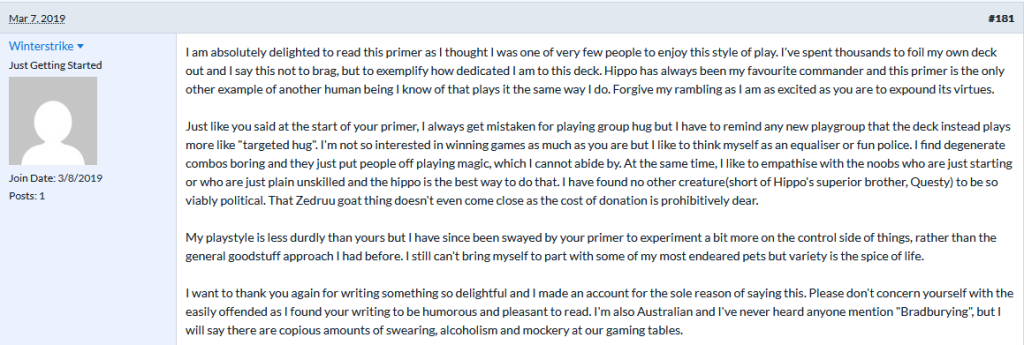
So people begin to write about it, and think about it in the thread. Other people come in and ask for help with the deck. After a certain point, people started making accounts to thank DirkGently for making the deck, but also for help with how to play it. On March 19, 2020 in the MTGsalvation thread. InexperiencedEDH asksthreat assessment:
“Hello! I created this account purely to post on this legendary essay. Longtime fan of your work but with all pretenses aside, I would like to get down to business:
I have been a target in my playgroup since as long as I can remember. Unintentionally, most of my decks have turned oppressive. As a new poster, forgive me as I am unfamiliar as to how to link a card. The main decks I play are a Karametra enchantress build, a Meren deck, a Marath aggro deck, and a Marchesa deck with similar goals to this one. After achieving the role of “consistent archenemy”, I’ve decided that I am unhappy staying as such. Therefore, after narrowing the issue down, I feel like my alarm bells are too easily set off as far as threats assessment goes. I must kill that Rhystic study or your commander repeatedly or your Sword of Fire and Ice. Today, I ask you of two things, what kind of cards should I be fine with existing and performing without letting my opponent ascend into an unassailable position? And finally, what is the updated list you are currently using?”
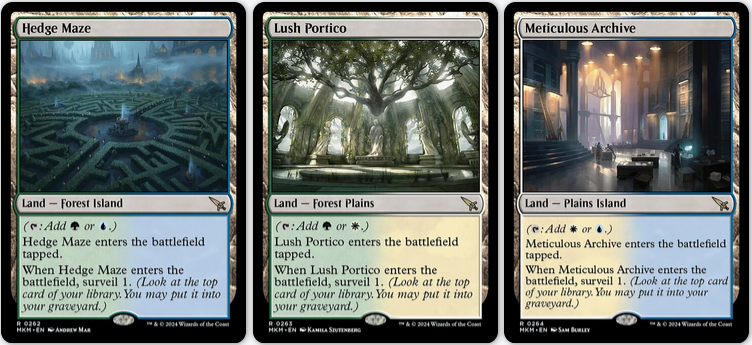
It’s times like these that the thread feels like time travel: did people really think of Commander this way? The posters wear their thoughts on their sleeves, they aren’t aware of the changes that are going to happen, when so much ink will be spilled (or keys clicked) about what Commander is, how to play it, what you should include in your deck, what the saltiest cards are, priority bullying, EDHrec, efficient combos, fast mana, theory and podcasts and more and more and more. It’s enough to give one a sense of trepidation feeling like you’re about to step on a butterfly. If these posters love Arch of Orazca they’re going to really love Bonder’s Enclave. Spara’s Headquarter’s is nothing compared to the surveil lands you’ll see soon.
There’s a lot of activity in the thread between 2019-2022, when Commander begins to get really popular and a pandemic. More and more people are suggesting deck edits, developing theory, someone even posts the tokens that their girlfriend made for their Phelddagrif deck. There’s a sense of camaraderie that exudes from the thread in these years.
The Final Days of Phelddagrif
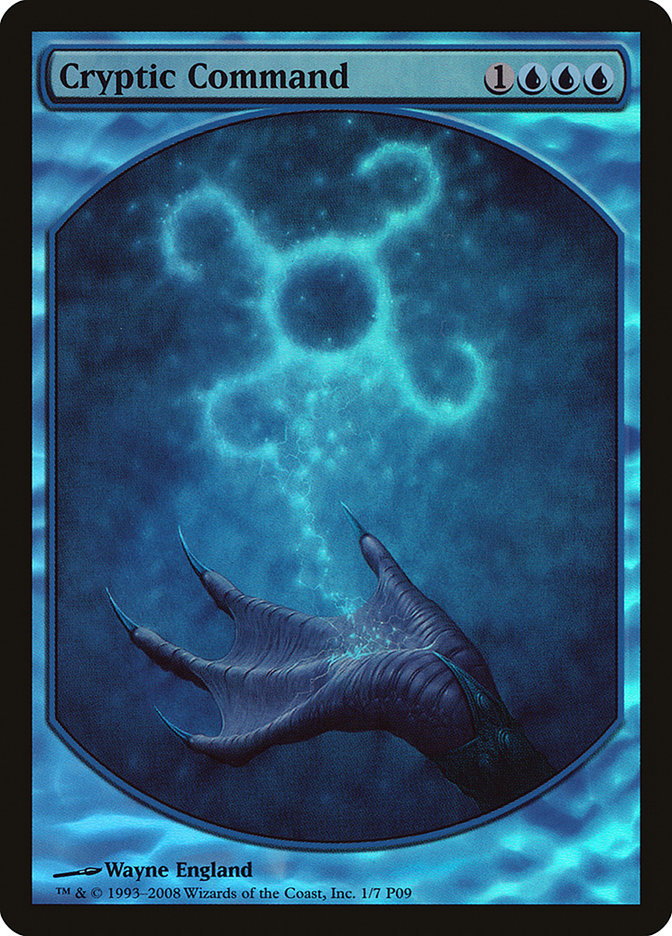
In 2024 updates from DirkGently become less frequent, it feels that there are less cards from current sets to add to the deck. Some sets don’t warrant a full set review. I couldn’t find anything on the Dr. Who set. Alongside the release of Wilds of Eldraine, there began to be a lot more talk about updating the deck, bordering on an overhaul. DirkGently posts that Cryptic Command and Mystic Confluence are ‘too slow’ and needing to include ‘anti-CEDH’ cards.
In the atmosphere is an acknowledgment that the game has sped up, and for the deck to continue to exist it needs to speed up as well. Cheaper permission starts appearing in decks, posters are talking about including Wash Away. An Offer You Can’t Refuse, which had been dismissed before, is starting to appear as a core part of the deck’s counter suite. A few posts down, while discussing different “fogs”, it’s clear that CEDH power-level decks are a concern, as a lot of discussion around Everybody Lives! is based on it stopping Thassa’s Oracle. A poster mentions that they see Thassa’s Oracle in a quarter of their games. The discussion of fogs gets so intense that the user Dunadain makes a chart showing each fog’s benefits.

It’s clear that the old point system for commander deck categorization is starting to fail to keep up with Magic design. The idea of this Phelddagrif deck is to be played at any level, lifting opponents who are behind while clipping those who are too far ahead. What happens when everyone bursts out of the gate early on? Games of Commander are much faster now than they were 9 years ago, and with threats getting more efficient, and more value based commander design, it seemed like the deck may have been falling behind a bit and a symbol of Commander of the past.
The commander bans of Jeweled Lotus, Mana Crypt, and Dockside Extortionist were not discussed in the thread. Dockside could not be played in the deck, and Jeweled Lotus and Mana Crypt did not fit the decks strategy. Phelddagrif didn’t need to be ramped out early by Jeweled Lotus, and Mana Crypt did not provide enough advantage for both the target it paints on the caster for the damage it will deal over the course of a game. Discussion of the bracket system created a brief burst of energy in the thread, posts on what bracket the deck could compete at, what it should compete at, and how to build the deck for that bracket started, but once again slowed down. As of writing, the last post made in the thread was 4 weeks ago. There has not been discussion about what cards from Lorwyn Eclipsed could be added to the deck.
What strikes me is that all of this, all of these keystrokes spent over 9 years, for a commander deck of all things. Commander is perfect for the modern internet .Each deck is atomized, a reflection of a singular identity’s choices while influenced by the algorithm’s unseen hand: edhrec aggregating card choices, content creator deck techs, efficient card designs from the latest set pushing out older cards. Commander decks are tweets made physical: a note in the cacophony chorus of “I’m an individual”. They’re expressions of self with rare input from others. Outside of CEDH, there just doesn’t seem to be much reason why so much effort should be put into a commander deck.
Maybe Bradburrying has been left behind in Commander, maybe it’s too slow, maybe people don’t like facing against a deck with 10 board wipes. Maybe Commander players today are more sensitive than players from a decade ago, maybe they’ll bristle at Conqueror’s Galleon with the same sense of alarm as a Rhystic Study or Smothering Tithe. Perhaps showing weakness to hide strength has been left behind to time, and there isn’t room for Phelddagrif in today’s Magic.
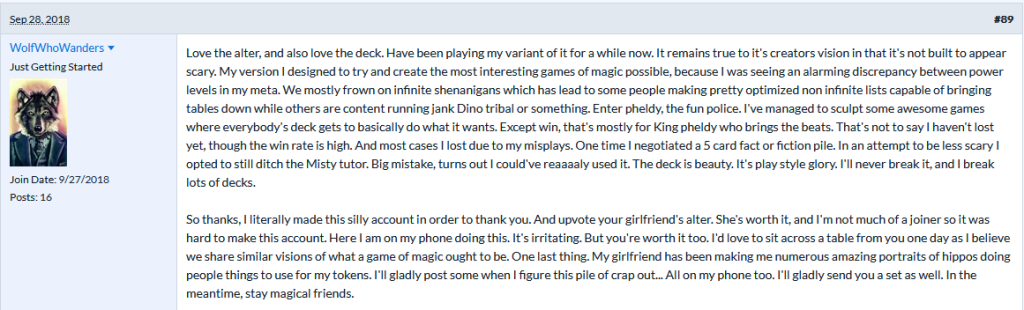
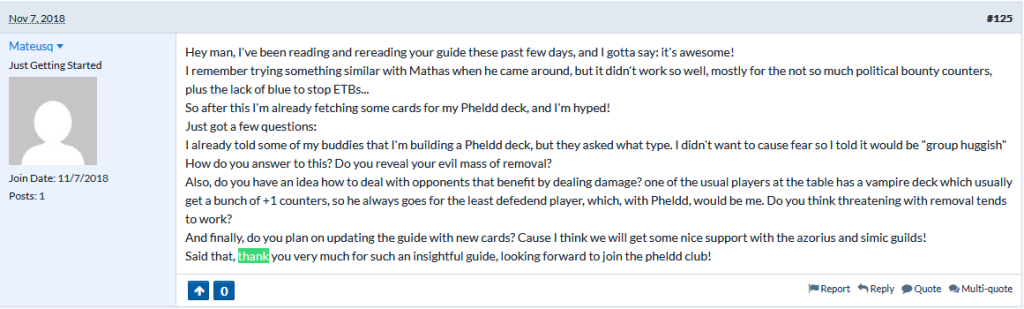
But the thread isn’t like that, the deck is something offered to the community, and the community responds. They build upon the idea, they offer suggestions, it becomes more than just DG’s Phelddagrif deck: it becomes an archetype. One with collaborators, forged in debate, one with history, not a personal history, but a history of its own. It shows a sense of community, a group of people spent time tweaking and working with the deck, thinking through how to play it, what cards are a fit, the strategy around it. It’s not just DirkGently, but Dunadain, LyonHeart, GloriousGoose, KissmyAssassin and many more. It’s discussions about a future Phelddagrif, about which 1/1 hippo tokens to use, and people sharing the ones that they’ve made. And gratitude. What stands out the most while reading through the thread was how many people made accounts to say thanks.











Post Credit Scene: Joker’s Trick
When I ran across “Show Weakness to Hide Strength”, I found myself reminiscing about the past. You know, the old days, the ones when you first started playing Magic. My local game store was a 7’x7′ shack and we only played 60 card constructed. The store ordered pizza from across the street and sold it like loose cigarettes. The person who ran across the street to pick it up would get a free slice, worth dodging traffic. I remember the swearing, the cussing, the dirty bathroom and the door that could not be closed all the way, the walls covered in board games, playing in the parking lot outside the shack when there wasn’t enough room inside and scuffing sligh on the concrete. Everything was so tactile back then, so real. I can still feel the breath of my older opponent telling me, after I had lost the match to them in less than 10 minutes, that they were angry I wasted their time because they did not get any better playing against me. Sometimes, the weekly tournament cost more than the $5 entry.
But that was once a week. Most of Magic was online. It was reading daily articles on “the mothership” or Starcitygames. Lots of reading what others have to say about Magic, about building decks, tournament reports, card evaluations. And, most of the time, spending time on different Magic forums. The Source, MtgSalvation, a long defunct Magic: the Gathering themed webcomic, these were my haunts no matter how many times I was banned.
So, yeah, I’m nostalgic. I’m thinking about how different the internet is now compared to back then, and I feel like I’m missing it. With how the thread erodes, everyone abandoning the thread, as time marches on and leave Phelddagrif behind, I wonder what have I left behind? Can I step into that river twice?
So here is the fakeout (double fakeout if you started reading on substack and then moved over here to get the rest of this post), the thread isn’t dead. I made it seem that way in how I wrote about it because it needs an ending, and a melancholic one about Phelddagrif fading away while everyone stands around it in a circle applauding is the best I can think of. I can’t help but sweep my own legs from beneath me. The real reason why the thread isn’t updating as much anymore is that, after 9 years, the regular posters have different interests and responsibilities. Reading through the thread is mostly about Phelddagrif, but there are glimpses into people’s lives: People moving to different countries, getting new jobs, moving again, breaking up, getting married, all that chaos that we order into a life story. Despite all this, the thread continues. Either of us could take up the mantle and begin playing and tweaking the deck, reporting our results back in the thread. There doesn’t need to be a happy ending for the thread “Show Weakness to Hide Strength” because it hasn’t ended, and it didn’t stop being joyful (except for the one time the troll went in there).
I recently drove back to the old shack where I used to play Magic. It’s still there. The shack I mean, the store is long gone. Which is for the best, I don’t think the space could handle a prerelease. The shack now employes a psychic, there’s a giant neon sign that says so. I measured the shack to make sure I was accurate, it really was that small, and went inside. Of course I didn’t recognize the space, there were no board games on the wall, no glass display case for rare cards. The space, while small, was bigger. There was an armchair with a side table, and a curtain partitioning the seance space. The curtains parted and the psychic greeted me. They asked me what I wanted and I said that I was hoping to get a psychic reading. Maybe they would be able to tell me something about the past of this place, about what it was really like, to help the scales of nostalgia fall from my eyes so I could see the past clearly and have that famous 20/20 hindsight vision I’ve heard so much about.
The psychic told me that I would have to book an appointment if I wanted an answer. I walked back to my car and drove home.